
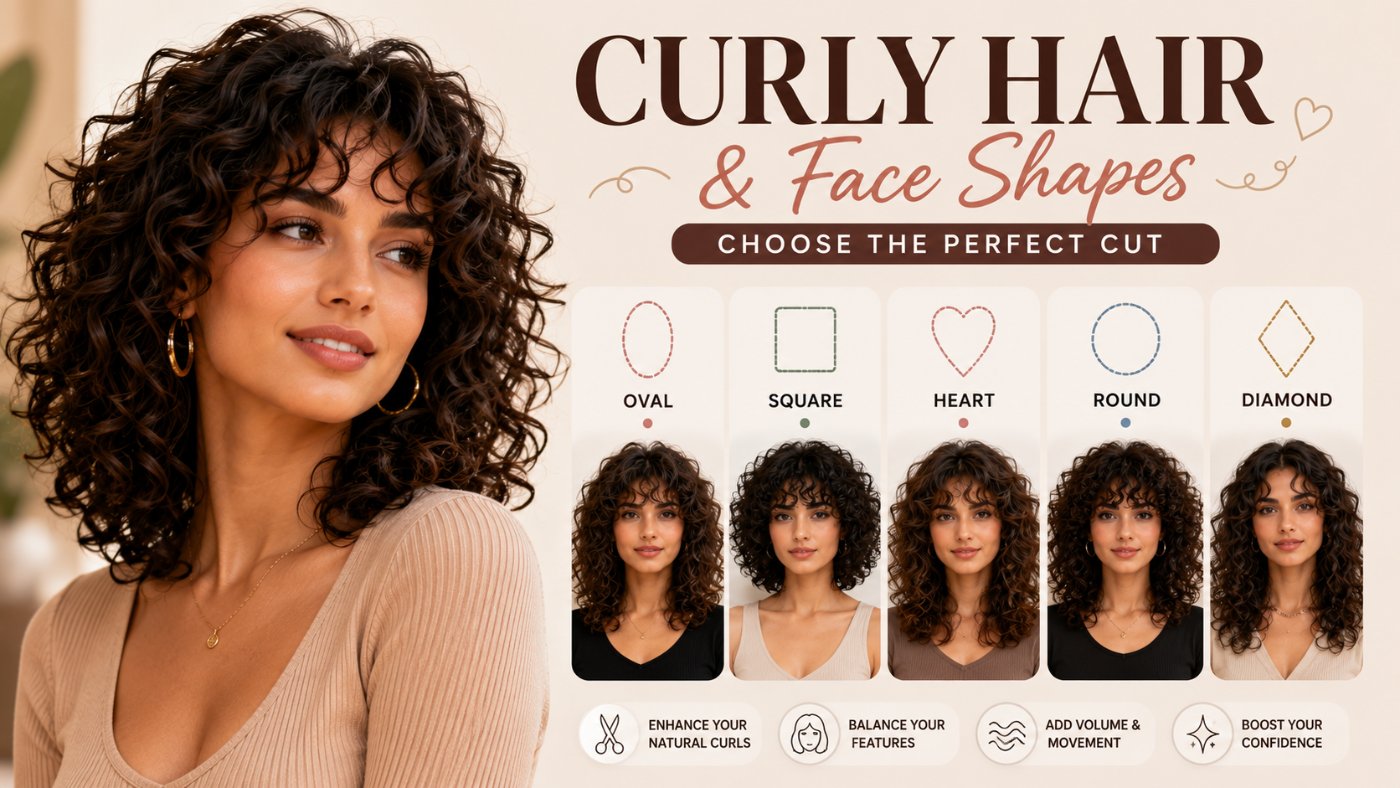
Curly Hair and Face Shape: How to Find Your Perfect Cut
Curly hair has a mind of its own, and that is exactly why the usual straight-hair haircut advice falls apart the moment you try to apply it. A layer that lays flat and elongating on straight hair springs up and adds width the second it hits a curl pattern. I learned this the expensive way, three cuts in two years, before I figured out that curly hair needs its own rules for matching a cut to your face shape, not a borrowed version of straight-hair advice.
Why Curly Hair Needs Different Face Shape Rules
Curls behave differently than straight hair because they shrink upward and outward instead of hanging down with gravity. A layer cut that would elongate a round face on straight hair can add width and roundness on curly hair instead, since the curl pattern pulls the ends up and out rather than letting them fall past the jaw.
My honest opinion here, and most curly hair advice skips this entirely: shrinkage has to be part of every single length and layer decision. A curly cut that looks perfectly proportioned wet or stretched can look completely different once it dries and springs up, sometimes shrinking by 30 to 50 percent depending on your curl pattern. Any stylist or AI tool that ignores your actual curl type and shrinkage percentage is guessing, not tailoring.
How to Identify Your Face Shape
The same measurement method applies regardless of hair texture: compare the width of your forehead, cheekbones, and jaw against the overall length of your face.
● Oval: Face is about one and a half times longer than it is wide, with a jaw slightly narrower than the cheekbones. The most flexible shape for curly cuts.
● Round: Width and length are close to equal, cheeks are the widest point, jawline is soft with no angles.
● Square: Forehead, cheekbones, and jaw are similar widths, jawline is strong and angular.
● Heart: Forehead is the widest point, face narrows to a pointed or narrow chin.
● Long (Oblong): Face length is noticeably greater than width, chin is often long.
● Diamond: Cheekbones are the widest point, forehead and jaw are narrower, chin is often pointed.
If you are between two shapes, choose the curly cut recommendation for the shape whose widest point most closely matches yours, since curl volume tends to emphasize whatever is already the widest part of your face.
Curly Cuts for Round Faces
Round faces need length and a shape that pulls curls downward rather than letting them balloon out at the sides. A long layered cut, with layers starting below the chin, uses the curl's natural volume to elongate the face instead of widening it.
Avoid a uniform, rounded curly bob that hits at the widest part of the cheeks, since the shrinkage on this length tends to create a circular silhouette that emphasizes roundness. If you want a shorter length, ask for a deva cut or shag with layers angled to pull weight downward at the front rather than an even, all-around trim.
Curly Cuts for Square Faces
Square faces benefit from curls that soften the jawline without hiding the natural structure entirely. A shoulder-length curly cut with face-framing layers breaks up a strong jaw while still letting the curl pattern show its natural texture and volume.
My contrarian take here: square faces are often told to avoid short curly cuts, but a curly pixie or short shag with soft, textured layers around the jaw actually works well, since the curl's natural irregularity already interrupts sharp angles in a way a blunt straight pixie cannot.
Curly Cuts for Heart-Shaped Faces
Heart-shaped faces do well with curly cuts that add fullness near the jaw to balance a wider forehead. A medium-length curly cut with volume concentrated at the chin and jaw level, rather than at the crown, creates that balance without adding unwanted width up top.
Curly curtain bangs or face-framing pieces that hit at the cheekbone also work particularly well here, since the natural volume of curly hair does most of the width-balancing work that straight curtain bangs need more styling effort to achieve.
Curly Cuts for Long and Oval Faces
Oval faces are the most flexible for curly cuts, similar to straight hair, and can wear nearly any length or layer structure without much correction needed. Long or oblong faces benefit most from curly cuts with volume added at the sides rather than at the crown, since additional height on top of an already long face exaggerates the length.
For long faces, a curly bob that hits at or just below the jaw, with volume encouraged at the sides through diffusing or a rounded layer shape, adds width exactly where it is needed. Avoid very long, single-length curly cuts with no layering, since the shrinkage pattern on uniform length curls tends to pull straight down the center and add visual length rather than balance it.
Using AI to Preview Your Curly Cut Before You Book
This is the part most curly hair content skips entirely, and it is the reason I started writing about this topic. You do not have to guess how a cut will look on your specific curl pattern anymore. ChatGPT and Gemini can both generate a realistic preview of a hairstyle on an uploaded photo, which means you can test length and layer options before you ever sit in a stylist's chair.
The catch is that most people type a lazy, one-line prompt and get a generic result that ignores their actual curl pattern and shrinkage. The fix is the same three-tier structure I use for every prompt on this site: start vague, add context, then add full production-level detail.
Previewing a Curly Cut on an Uploaded Photo
Bad Prompt (what most people type)
Show me with curly hair
Good Prompt (adds structure and context)
Using the photo I uploaded, show me with a shoulder-length curly cut with layers. Keep my curl pattern and face shape the same, just change the length and layers.
Expert Prompt (production-ready, fully specified)
Role: Act as a professional curly hair stylist and photo editor. Task: Using the uploaded photo, generate a realistic preview of me with a shoulder-length curly cut, long layers starting below the chin, cut dry to account for natural curl shrinkage. Constraints: Keep my exact curl pattern, curl density, face shape, and features unchanged. Do not straighten or alter the curl texture. Account for natural shrinkage, meaning the cut should appear shorter and more voluminous than a straight-hair equivalent of the same layer length. Keep lighting and background consistent with the original photo. Format: Two images, labeled "Front View" and "Three-Quarter View." Tone: Realistic, salon-quality result, not an illustration or cartoon style.
What changed: The bad prompt gives the model nothing to work with beyond "curly hair," so it invents a generic curl pattern and length that may not match your actual texture. The expert prompt explicitly requires the model to account for shrinkage and preserve your real curl pattern, which is the single most important constraint for a curly hair preview to be useful at all.
Choosing a Curly Cut Based on Face Shape via AI
Bad Prompt
What curly haircut should I get?
Good Prompt
Based on my face shape and curl pattern in this photo, suggest a curly haircut that would suit me and explain why.
Expert Prompt
Role: Act as a professional curly hair stylist with expertise in face shape analysis and curl pattern typing. Task: Analyze my face shape and approximate curl pattern from the uploaded photo, and recommend one long, one medium, and one short curly hairstyle option that would suit both. Constraints: Base recommendations on facial proportions and visible curl pattern in the photo. For each option, explain in one sentence why it balances my specific face shape, and note where layers should be placed to work with, not against, natural shrinkage. Format: A short table with columns for Length, Style Name, and Reason. Tone: Direct and specific, no generic beauty-blog language.
What changed: The expert version forces the model to factor in curl pattern alongside face shape, which most generic hairstyle prompts ignore entirely, and requires a note on layer placement relative to shrinkage, which is the detail that actually determines whether a curly cut recommendation is useful.
I use the free prompt library to keep templates like this saved so I am not rewriting them from scratch every time a friend with curls asks for a preview.
Copy-Paste Template: Curly Hair Face Shape Prompt
Use this exactly as written. Replace the [brackets] with your specifics.
Role: Act as a professional curly hair stylist and photo editor with expertise in face shape analysis.
Task: Using the uploaded photo, identify my face shape and curl pattern, and generate a realistic preview of me with [LENGTH: long / medium / short] curly hair styled as [STYLE DETAILS, e.g. "long layers starting below the chin"].
Constraints: Keep my exact curl pattern, curl density, facial features, and skin tone unchanged. Do not straighten or alter the curl texture. Account for natural curl shrinkage in the final length shown. Keep the original background and lighting.
Format: Show the result from the front and a three-quarter angle, labeled clearly.
Tone: Realistic, salon-quality photo, not an illustration.
-- Role: Professional curly hair stylist and photo editor
-- Task: Face shape and curl pattern analysis plus realistic preview
-- Format: Front view and three-quarter view, labeled
-- Constraints: Preserve real curl pattern, shrinkage-aware length, lighting, and background
-- Tone: Photorealistic, not stylized
Save this to your prompt library at promptailearning.com/prompts.
Prompt Glossary
Shrinkage: The reduction in visible hair length that occurs when curly hair dries and springs up from its stretched, wet length, which can range from mild to over 50 percent depending on curl pattern.
Curl pattern: A classification system, typically ranging from loose waves to tight coils, used to describe the shape and structure of curly hair, which affects how a haircut will look once dry.
Image-to-image editing: A technique where the AI edits an uploaded photo rather than generating a new image from scratch, which is what makes hairstyle previews possible on ChatGPT and Gemini.
Deva cut: A dry-cutting technique for curly hair where each curl is cut individually in its natural state, rather than cutting the hair wet or straightened, to account for shrinkage and curl behavior.
Constraint stacking: Listing multiple specific rules (preserve curl pattern, account for shrinkage, preserve lighting) in a single prompt so the model does not drift from the original photo or texture.
Recommended Blogs
If you found this useful, these posts go deeper on related topics:
● Long, Medium, or Short? Choosing Hair Length by Face Shape
● Best ChatGPT Prompts 2026: 200+ With Real Examples
● Best Gemini AI Prompts 2026: 100+ Templates With Examples
Frequently Asked Questions
What is the best curly haircut for a round face?
A long layered curly cut, with layers starting below the chin, works best for round faces because it elongates the face using the curl's natural volume instead of adding width at the cheeks.
What is the best curly haircut for a square face?
A shoulder-length curly cut with face-framing layers around the jaw works well for square faces, softening the jawline while keeping the curl's natural texture visible.
Can curly hair be cut short for a heart-shaped face?
Yes, but shorter curly cuts for heart-shaped faces work best when volume is concentrated near the jaw rather than the crown, to balance a wider forehead without adding extra width up top.
Why does my curly haircut look different after it dries?
Curly hair shrinks as it dries, sometimes by 30 to 50 percent depending on curl pattern, which means a cut that looks a certain length wet or stretched can look noticeably shorter and more voluminous once fully dry.
What is a deva cut and does it matter for face shape?
A deva cut is a technique where curly hair is cut dry, curl by curl, in its natural state. It matters for face shape because cutting dry accounts for shrinkage and curl behavior, producing a more accurate result relative to your actual face shape than cutting wet or straightened hair.
Can ChatGPT show me what a curly haircut would look like on me?
Yes, if you upload a clear photo showing your natural curl pattern and use a detailed prompt that specifies the length, style, and instructs the model to preserve your curl texture and account for shrinkage, as shown in the Expert Prompt examples above.
What curly haircut works best for a long or oblong face?
A curly bob that hits at or just below the jaw, with volume encouraged at the sides, works best for long faces, since it adds width where the face needs it rather than adding more length.
Is oval the easiest face shape for curly haircuts?
Yes, similar to straight hair, oval face shapes are generally the most flexible for curly cuts and can wear most lengths and layer structures without significant correction needed.
Save your favorite prompt from this post to the free prompt library so you can preview your next curly cut before you ever sit in the chair.