
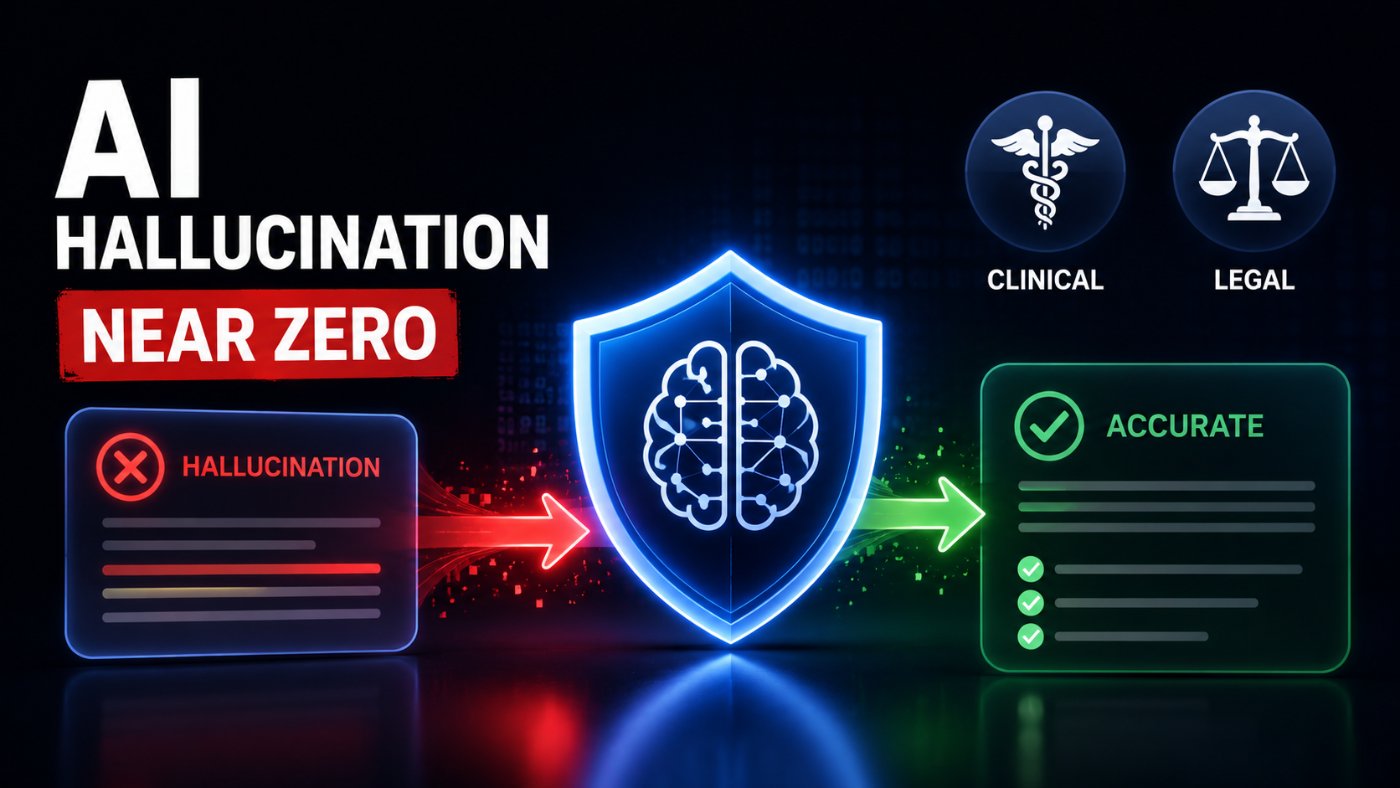
Composite Abstention Architectures Cut AI Hallucination to Near Zero in Clinical and Legal Testing
New research published in the Journal of Artificial Intelligence Research in March 2026 describes a composite abstention architecture, a method combining structural validity checks with instruction-based refusal, that pushed hallucination rates down to between 0 and 4 percent while preserving 96 to 98 percent overall accuracy across three tested models. A related pilot applying similar self-verification techniques to a synthetic clinical dataset modeled on the MIMIC-IV schema drove hallucination from 29.2 percent down to 2.0 percent.
The timing matters. As of April 2026, the AI Hallucination Cases Database had tracked 1,174 court and tribunal decisions worldwide where judges confronted AI-generated hallucinations in legal filings, and citation accuracy remains the single worst-performing task family across frontier models, averaging 12.4 percent hallucination on citation-heavy work. The new research doesn't eliminate the problem, but it is among the most rigorous evidence yet that structured self-verification, essentially forcing a model to check its own draft against explicit rules before answering, meaningfully narrows the gap in exactly the domains where a wrong answer carries real consequences.
What the Research Actually Found
The JAIR paper, authored by Angelina Hintsanen and titled Hallucination as Output-Boundary Misclassification, tested two mechanisms separately, then combined them. Instruction-only prompting, essentially telling the model explicitly to refuse when uncertain, reduced hallucination sharply but caused the model to over-abstain on roughly 10 percent of questions it could actually have answered correctly, and it still let 6 percent of hallucinations through on items with conflicting evidence.
A structural validity gate, which checks whether an answer can be logically embedded in the given context without contradiction, preserved 100 percent accuracy on genuinely answerable questions but missed confident confabulation on conflicting-evidence items at a striking rate: 70 percent hallucination on those specific cases for two of the three tested models. Combining both mechanisms into a composite architecture produced 96 to 98 percent overall accuracy with only 0 to 4 percent hallucination, because each method's blind spot was covered by the other's strength.
The Clinical Pilot: MIMIC-IV-Schema Results
A related evaluation applied a comparable self-verification approach to a synthetic dataset structured on the MIMIC-IV clinical database schema. Hallucination dropped from a baseline of 0.292 to 0.020, a 93.2 percent reduction, while maintaining a utility score of 0.538 at 89.6 percent coverage. The answerability classifier used to route uncertain cases toward abstention scored an AUROC of 0.692, described by the researchers as moderate in absolute terms and therefore positioned as a routing mechanism rather than a standalone safety guarantee.
The researchers were explicit about the limits of this result: every evaluation tier used synthetic or schema-conformant data, and validation against credentialed, de-identified real patient records remains a required step before any clinical deployment. That caveat matters more than the headline number. A 93 percent reduction on synthetic test data is a strong signal, not a certification for bedside use.
Why Legal AI Hallucination Is Still a Live Crisis
Legal use is where the consequences of hallucination have become most visible in court dockets rather than benchmarks. As of April 2026, the AI Hallucination Cases Database had logged 1,174 court and tribunal decisions worldwide involving AI-generated hallucinations in filings, and researchers tracking these cases report that the underlying errors often persist through multiple rounds of amendment, rarely self-correcting before a court intervenes.
Two failure patterns dominate. Attorneys draft filings quickly with AI assistance and fail to verify every cited authority, sometimes because the error entered through a junior associate or paralegal who incorporated fabricated case law without adequate review. In other instances, a lawyer places excessive trust in a platform's reputation, assuming brand credibility substitutes for verification. Separately, general hallucination benchmarking shows citation-heavy tasks, exactly the profile of legal research, average 12.4 percent hallucination across frontier models, with fabricated DOIs, paper titles, and case citations appearing at rates between 6.8 and 19.1 percent depending on the model.
Verma notes: the composite abstention results are genuinely encouraging, but the legal case tracker is the reality check. A model that hallucinates 2 percent of the time in a controlled academic pilot is a research result. A lawyer who doesn't independently verify a single citation because the tool sounded confident is a sanctions hearing. The gap between those two is entirely about workflow discipline, not model capability.
Where This Builds on Chain-of-Verification
The core idea behind self-correcting meta-prompts is not new. The original Chain-of-Verification, or CoVe, method proposed in 2023 has the model draft an initial answer, plan independent verification questions, answer those questions without seeing its own earlier draft so the answers aren't biased by it, and then produce a final response incorporating the corrections. CoVe reduced hallucination across list-based questions, closed-book QA, and long-form generation, and later cross-domain extensions of similar verification approaches have reported hallucination reductions in the 96 to 97 percent range without needing to modify the underlying retrieval system.
What the 2026 research adds is the finding that verification alone is not enough, and neither is refusal alone. The composite architecture's core insight, that instruction-based refusal and structural gating fail in different, complementary places, is the practical takeaway for anyone building a real workflow: stacking one form of self-correction on top of another closes gaps that either one leaves open by itself.
Self-Verification Prompting in Practice
You don't need a research paper's full pipeline to apply the same principle. The core pattern, draft, independently verify, then answer, translates into a prompt structure anyone can use for high-stakes factual work.
Verifying a Clinical or Legal Factual Claim
Bad Prompt (what most people type)
What's the standard dosage for this medication?
Good Prompt (adds structure and context)
What's the standard dosage for [medication]? If you are not certain, say so instead of guessing, and tell me what source would confirm it.
Expert Prompt (production-ready, fully specified)
Step 1 - Draft: Answer the question below as you normally would.
Question: [your question]
Step 2 - Verify: List 2-3 independent questions that would confirm or contradict your draft answer. Answer each one on its own, without referring back to your draft, as if you had not seen it.
Step 3 - Reconcile: Compare your draft to your independent verification answers. If they conflict, do not average them or pick the more confident-sounding one. State the conflict explicitly and mark the answer as unconfirmed rather than resolving it by guessing.
Step 4 - Final answer: Give your verified answer, or state clearly that you cannot confirm it and specify what source or professional should be consulted before this is acted on.
What changed: the Expert version forces the verification step to happen independently of the draft, which is the mechanism the original Chain-of-Verification research found actually reduces bias, since answering while looking at your own earlier guess tends to just confirm it. It also gives the model an explicit, safe way to report a conflict instead of silently resolving it in favor of whichever answer sounds more confident.
Copy-Paste Template: Draft-Verify-Reconcile
Use this exactly as written. Replace the [brackets] with your specifics.
Task: [your factual question or claim to check, in a clinical, legal, or other high-stakes context]
1. Draft an initial answer.
2. Independently, write 2-3 verification questions that would expose an error in that answer if one exists, and answer them without looking back at your draft.
3. Compare the draft to the verification answers. Flag any conflict explicitly rather than silently choosing one version.
4. If everything is consistent, give the final answer. If not, say 'unconfirmed' and name what would resolve it (a specific source, database, or professional review). Do not fabricate a citation, case name, or source to fill a gap.-- Task: the specific factual claim, narrow enough to verify concretely
-- Domain: clinical, legal, or another field where a wrong answer has real cost
-- Escalation: what a human should do if the model can't confirm the answer
Save this to your prompt library at promptailearning.com/prompts.
Prompt Glossary
Composite abstention architecture: a hallucination-reduction method that combines instruction-based refusal with structural validity checking, covering each mechanism's individual blind spots.
Structural validity gate: a check that verifies whether a candidate answer can be logically embedded in the given context without contradiction, independent of how confident the model sounds.
Answerability posterior: a probability estimate of whether a question is answerable given available context, used to route uncertain cases toward abstention rather than a guess.
Chain-of-Verification (CoVe): a method where a model drafts an answer, independently answers self-generated verification questions, then reconciles both into a final, corrected response.
Key Takeaways
• A composite architecture combining instruction-based refusal with structural gating achieved 96-98 percent accuracy with 0-4 percent hallucination in JAIR-published 2026 research.
• A synthetic MIMIC-IV-schema clinical pilot cut hallucination from 29.2 percent to 2.0 percent, though researchers stress real patient-record validation is still required.
• As of April 2026, 1,174 court and tribunal decisions worldwide have involved AI-generated hallucinations in legal filings.
• Citation-heavy tasks average 12.4 percent hallucination across frontier models, with fabricated citations appearing at 6.8-19.1 percent depending on the model.
• Instruction-only refusal and structural gating fail in different, complementary places, which is why combining them outperforms either alone.
• Independent, draft-blind verification remains the core mechanism behind every major self-correction method, from 2023's Chain-of-Verification through 2026's composite architectures.
Recommended Reading
What is a System Prompt?
The Guide to Agentic Prompts
Best Claude AI Prompts 2026: 25+ Types With Examples
AI Knowledge Hub
Frequently Asked Questions
What is a composite abstention architecture?
It is a hallucination-reduction method described in 2026 JAIR research that combines instruction-based refusal, telling a model explicitly to decline when uncertain, with a structural validity gate that checks whether an answer logically fits the given context. Combined, they achieved 96-98 percent accuracy with 0-4 percent hallucination across tested models.
How much did the clinical pilot reduce hallucination?
In a synthetic pilot built on the MIMIC-IV clinical database schema, hallucination dropped from 29.2 percent to 2.0 percent, a 93.2 percent reduction, while maintaining 89.6 percent coverage. Researchers noted this used synthetic data and still requires validation against real, de-identified patient records before clinical use.
How many legal cases have involved AI hallucination?
As of April 2026, the AI Hallucination Cases Database tracked 1,174 court and tribunal decisions worldwide where judges encountered AI-generated hallucinations in legal filings, a number that has grown steadily as more attorneys use AI drafting tools without full citation verification.
What is Chain-of-Verification prompting?
It's a self-correction method where a model drafts an initial answer, independently generates and answers verification questions without referring back to its own draft, then reconciles both into a final, corrected response. It was first proposed in 2023 and remains the conceptual basis for most 2026 self-verification research.
Can self-correcting prompts fully eliminate hallucination?
No. Even the best-performing composite methods in 2026 research report a 0-4 percent residual hallucination rate, and researchers are explicit that structural gates alone still miss confident confabulation on conflicting-evidence cases at high rates. Self-verification prompting reduces risk substantially but does not eliminate it, especially in high-stakes clinical or legal use.
Explore More on Prompt AI Learning
STAY UPDATED WITH AI NEWS
Follow the full AI news series and never miss a story:
• Daily AI News - Top 5 Stories Every Morning
• Weekly AI Roundups - 15+ Stories Every Monday
• Monthly AI Recaps - Full Archive by Month
LEARN TO PROMPT FOR ACCURACY
Reducing hallucination starts with how you structure the prompt itself:
• Best Claude AI Prompts 2026 - 25+ Types With Examples
• Best ChatGPT Prompts 2026 - 200+ Real Examples
• Best Gemini AI Prompts 2026 - 100+ Templates
COMPARE THE MODELS
Different models have very different baseline hallucination rates. These comparison pages help:
• ChatGPT vs Claude - Full 2026 Comparison
• AI Models Directory - Compare 60+ LLMs, Image and Video Models
BUILD SKILLS THAT COMPOUND
Reading AI news is step one. Building skills with these systems is step two:
• Free Prompt Library - 213+ Copy-Paste Templates
• Start Prompt Engineering - Free Course for All Levels
• The Guide to Agentic Prompts
• Coding Prompts for Developers - Production-Ready Templates
USE PROMPTS FOR THE NEWS TOPICS YOU READ ABOUT TODAY
Every story in today's post maps to a real use case. These prompt categories help you act on what you read:
• Business and Strategy Prompts - Analysis, Pitch Decks, OKRs
• Writing and Content Prompts - Emails, Case Studies, White Papers
• AI Knowledge Hub - Technical Blueprints and Career Guides
ABOUT THIS BLOG
promptailearning.com publishes free daily AI news, weekly roundups, monthly recaps, prompt guides, model comparisons, and course content for anyone who wants to get better at using AI. Written by Swatantra Verma. No paywalls, no fluff.
Connect With Us
• Email: contact@promptailearning.com
• Founder: Swatantra Verma on LinkedIn
• Co-Founder: Prateek Patel on LinkedIn
• Company LinkedIn: Prompt AI Learning
• Company X: @promptailearnin
Similar Updates
AI News Summaries Are Getting Facts Wrong: What the BBC-EBU Audit and Munich Court Ruling Reveal
A 22-broadcaster audit found roughly 45 percent of AI assistant news answers contained a significant issue, and a German court ruled Google liable for false AI Overviews statements. Here's what the evidence actually shows and how to prompt around it.
Prompt Injection in 2026: What OWASP and Check Point's New Reports Reveal About Data Leaks and Supply Chain Attacks
OWASP's State of Agentic AI Security 2.01 and Check Point's Annual AI Security Report 2026 both show prompt injection moving from theoretical risk to documented breaches, CVEs, and supply chain compromises.
Prompt Injection: Why It Is the #1 Agentic AI Risk in 2026
Prompt injection has overtaken every other threat as the leading cause of agentic AI security failures in 2026, with OWASP data showing a 340 percent year over year rise in attacks.
MCP Goes Stateless: The July 28 Spec Update and How to Prompt Multi-Agent Systems
The Agentic AI Foundation's next MCP specification, final on July 28, 2026, makes the protocol stateless at the transport layer. Here's what changes and how to standardize prompts across MCP and A2A.