
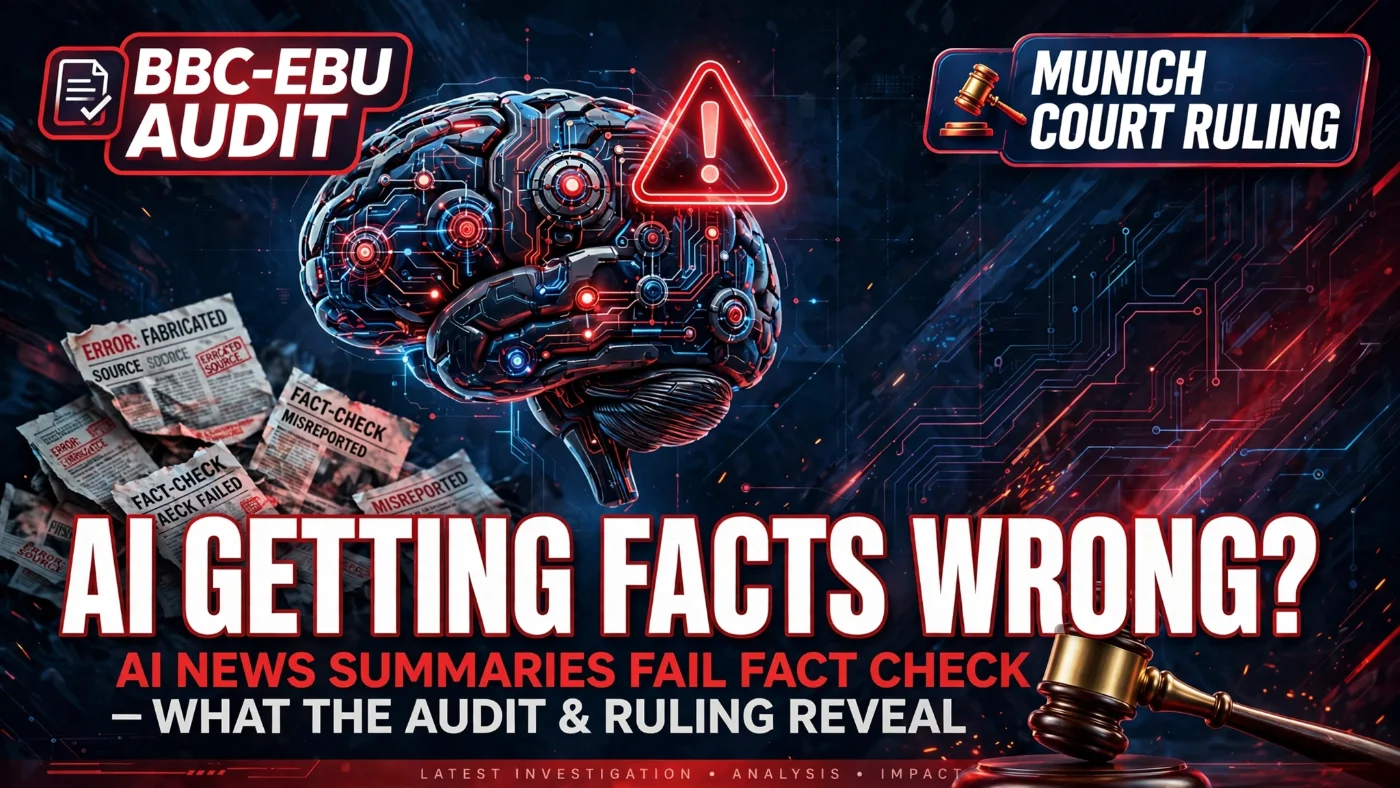
AI News Summaries Are Getting Facts Wrong: What the BBC-EBU Audit and Munich Court Ruling Reveal
An international audit coordinated by the European Broadcasting Union and led by the BBC reviewed roughly 3,000 AI assistant responses to news questions across 14 languages and 22 public-service media organizations. The finding: about 45 percent of the responses contained at least one significant issue, ranging from sourcing failures to outright factual errors.
That audit followed a narrower BBC exercise that fed 100 BBC stories into four major AI assistants and had journalists rate the answers. Fifty-one percent of the answers contained significant problems, and among responses that specifically cited BBC content, 19 percent introduced factual errors or altered quotes. Both findings arrive as roughly 60 percent of Americans now read AI search summaries, according to a June 2026 Pew Research Center report, while only about one in five who encounter these summaries call them very useful, and just 6 percent say they trust them a lot.
The Audit Numbers
The EBU-BBC audit is the largest cross-broadcaster accuracy study of its kind to date, spanning 22 public-service media organizations and 14 languages. Separately, a month-long, day-by-day experiment by journalism professor Jean-Hugues Roy tested several chatbots on their ability to summarize local news and logged hundreds of broken or incorrect URLs, hallucinated sources, and inaccurate summaries over the course of the study.
A separate line of research points to a similar order of magnitude. Recent testing of Google's AI Overviews, powered by Gemini, found the feature served inaccurate information in about 10 percent of searches, while an earlier NewsGuard audit of the ten largest chatbots found they spread false claims 35 percent of the time when prompted on controversial news topics.
A German Court Just Ruled on This
In June 2026, the Munich Regional Court issued a preliminary ruling holding Google liable for a series of false statements generated by its AI Overviews feature. The court found that instead of only surfacing relevant links based on a user's query, the AI summary tool generated independent, new statements built on a misreading of information available on the internet.
The ruling is notable because it treats an AI-generated summary as a new statement the platform is responsible for, not merely a reflection of underlying source material. Legal observers have suggested the decision could become a reference point for similar cases in other jurisdictions, since it directly addresses a question most AI Overviews-style products have not yet been tested on in court: who is liable when the summary itself is wrong, even if every underlying source was accurate.
Who Gets the Worst Answers
A February 2026 MIT study, cited by its lead author Elinor Poole-Dayan, found that chatbots gave less accurate, less truthful responses to users with lower English proficiency, less formal education, or non-US origins. The study's authors warned that large language models may exacerbate existing inequities by systematically providing misinformation, or refusing to answer, for certain groups of users.
Verma notes: this is the finding that should worry people most, and it's the one getting the least attention. An accuracy gap that tracks language proficiency and education level isn't a random bug distribution, it's a pattern that concentrates harm on people who already have fewer alternative ways to verify what they're being told.
Why This Is Happening
Part of the problem is structural. Many high-quality news sites now block AI chatbot crawlers from accessing their content, which pushes some assistants toward lower-quality, misinformation-prone sources when they attempt to answer news questions, according to reporting on the issue. A Stanford University audit of six commercial chatbots' ability to answer news questions concluded that as more people encounter journalism through AI intermediaries rather than publishers' own sites, differences in context, attribution, and source selection will increasingly determine whose reporting reaches the public and under what terms.
The problem is not limited to summarization of existing articles. NewsGuard has identified 3,749 AI-generated content farm sites operating across 16 languages, publishing with little to no human oversight, some containing leftover chatbot error messages that indicate no editing took place before publication. Separately, in spring 2026 The Atlantic alleged that AI-generated text had appeared in the New York Times' opinion pages, and after the Chicago Sun-Times cut 20 percent of its staff, the paper published an AI-generated summer reading list that recommended books which did not exist.
Prompting for Accurate News Summaries
None of this means AI summaries are useless for news, but the failure modes documented above are specific enough that a few prompting habits meaningfully reduce risk: asking for direct sourcing rather than a synthesized summary, and explicitly requiring the model to flag uncertainty rather than smooth it over.
Requesting a Sourced News Summary
Bad Prompt (what most people type)
What happened with [current event]?
Good Prompt (adds structure and context)
Summarize what happened with [current event]. Name which outlets reported each specific claim, and tell me if any details are disputed.
Expert Prompt (production-ready, fully specified)
Summarize the current state of reporting on [current event].
For every factual claim, attribute it to a specific named outlet rather than stating it as established fact. If outlets disagree on a detail, say so explicitly rather than picking one version.
If you are not confident a detail is accurate, say 'unconfirmed' instead of presenting it plainly. Do not fill gaps in your knowledge with a plausible-sounding guess.
End with a one-line note on how recent your information is likely to be,
since breaking stories change quickly.
What changed: the Expert version forces per-claim attribution instead of a single blended narrative, which directly targets the sourcing and attribution failures the BBC-EBU audit documented. It also gives the model explicit permission to say 'unconfirmed,' which counters the tendency researchers describe as models being rewarded for confident guesses over honest uncertainty.
Copy-Paste Template: Sourced News Summary Request
Use this exactly as written. Replace the [brackets] with your specifics.
Topic: [the news event or question]
Instructions:
1. Attribute every factual claim to a named source. Do not state claims as fact without attribution.
2. Flag disagreement: if sources conflict on any detail, present both versions rather than choosing one.
3. Mark uncertainty explicitly using the word 'unconfirmed' rather than presenting a guess as settled information.
4. State your likely knowledge cutoff relative to this story so I know whether to check for more recent updates.
5. If you do not have reliable information on this topic, say so directly instead of generating a plausible-sounding answer.-- Topic: the specific event or question, as narrow as possible
-- Attribution: require named sources per claim, not a blended summary
-- Uncertainty handling: explicit permission to say 'I don't know' or 'unconfirmed'
Save this to your prompt library at promptailearning.com/prompts.
Prompt Glossary
Hallucination: when a model generates plausible-sounding but false or fabricated information, often because it is optimized to produce confident answers rather than express uncertainty.
AI Overviews: Google's AI-generated summary feature shown above traditional search results, now the subject of the Munich Regional Court's liability ruling.
AI content farm: a website publishing AI-generated news or information content with little to no human editorial oversight, tracked by NewsGuard's AI Tracking Center.
Attribution: linking a specific factual claim to the named source that reported it, rather than presenting synthesized information without a traceable origin.
Key Takeaways
• A 22-broadcaster EBU-BBC audit found roughly 45 percent of AI assistant news answers had at least one significant issue, across 3,000 responses in 14 languages.
• A narrower BBC test found 51 percent of answers had significant problems, and 19 percent of BBC-sourced answers introduced factual errors or altered quotes.
• Munich Regional Court ruled in June 2026 that Google is liable for false statements generated by its AI Overviews feature, a decision that could set precedent elsewhere.
• A February 2026 MIT study found chatbots give less accurate answers to users with lower English proficiency, less formal education, or non-US origins.
• NewsGuard has identified 3,749 AI-generated content farm sites across 16 languages operating with little to no human oversight.
• Only about 6 percent of Americans who encounter AI search summaries say they trust them a lot, per Pew Research.
Recommended Reading
What is a System Prompt?
The Guide to Agentic Prompts
Best ChatGPT Prompts 2026: 200+ Real Examples
AI Knowledge Hub
Frequently Asked Questions
How accurate are AI news summaries?
An EBU-BBC audit of roughly 3,000 AI assistant responses across 22 public broadcasters and 14 languages found about 45 percent contained at least one significant issue, and a separate BBC test found 51 percent of answers had significant problems.
What did the Munich court rule about Google's AI Overviews?
In June 2026, the Munich Regional Court issued a preliminary ruling that Google is liable for false statements generated by its AI Overviews feature, finding the tool produced independent, new claims based on a misreading of source material rather than simply reflecting it.
Do AI chatbots give worse answers to some users than others?
A February 2026 MIT study found chatbots produced less accurate, less truthful responses for users with lower English proficiency, less formal education, or non-US origins, raising concerns about the technology exacerbating existing inequities.
What is an AI content farm?
It is a website that publishes AI-generated news or information content with little to no human editorial review. NewsGuard has identified 3,749 such sites operating across 16 languages.
How can I reduce the risk of getting misinformation from an AI summary?
Ask the model to attribute each claim to a named source, flag disagreement between sources, explicitly mark uncertain details as unconfirmed rather than stating them as fact, and note how current its information is likely to be.
Explore More on Prompt AI Learning
STAY UPDATED WITH AI NEWS
Follow the full AI news series and never miss a story:
• Daily AI News - Top 5 Stories Every Morning
• Weekly AI Roundups - 15+ Stories Every Monday
• Monthly AI Recaps - Full Archive by Month
LEARN TO PROMPT FOR ACCURACY
Getting reliable answers out of any model starts with how you ask:
• Best Claude AI Prompts 2026 - 25+ Types With Examples
• Best ChatGPT Prompts 2026 - 200+ Real Examples
• Best Gemini AI Prompts 2026 - 100+ Templates
COMPARE THE MODELS
Different assistants handle sourcing differently. These comparison pages help you choose:
• ChatGPT vs Claude - Full 2026 Comparison
• AI Models Directory - Compare 60+ LLMs, Image and Video Models
BUILD SKILLS THAT COMPOUND
Reading AI news is step one. Building skills with these systems is step two:
• Free Prompt Library - 213+ Copy-Paste Templates
• Start Prompt Engineering - Free Course for All Levels
• The Guide to Agentic Prompts
• Coding Prompts for Developers - Production-Ready Templates
USE PROMPTS FOR THE NEWS TOPICS YOU READ ABOUT TODAY
Every story in today's post maps to a real use case. These prompt categories help you act on what you read:
• Business and Strategy Prompts - Analysis, Pitch Decks, OKRs
• Writing and Content Prompts - Emails, Case Studies, White Papers
• AI Knowledge Hub - Technical Blueprints and Career Guides
ABOUT THIS BLOG
promptailearning.com publishes free daily AI news, weekly roundups, monthly recaps, prompt guides, model comparisons, and course content for anyone who wants to get better at using AI. Written by Swatantra Verma. No paywalls, no fluff.
Connect With Us
• Email: contact@promptailearning.com
• Founder: Swatantra Verma on LinkedIn
• Co-Founder: Prateek Patel on LinkedIn
• Company LinkedIn: Prompt AI Learning
• Company X: @promptailearnin
Similar Updates
Composite Abstention Architectures Cut AI Hallucination to Near Zero in Clinical and Legal Testing
New 2026 research combining structural validity gates with instruction-based abstention pushed hallucination rates as low as 2 percent in a clinical pilot, while legal AI hallucinations have now surfaced in 1,174 tracked court cases.

Prompt Injection in 2026: What OWASP and Check Point's New Reports Reveal About Data Leaks and Supply Chain Attacks
OWASP's State of Agentic AI Security 2.01 and Check Point's Annual AI Security Report 2026 both show prompt injection moving from theoretical risk to documented breaches, CVEs, and supply chain compromises.

Prompt Injection: Why It Is the #1 Agentic AI Risk in 2026
Prompt injection has overtaken every other threat as the leading cause of agentic AI security failures in 2026, with OWASP data showing a 340 percent year over year rise in attacks.
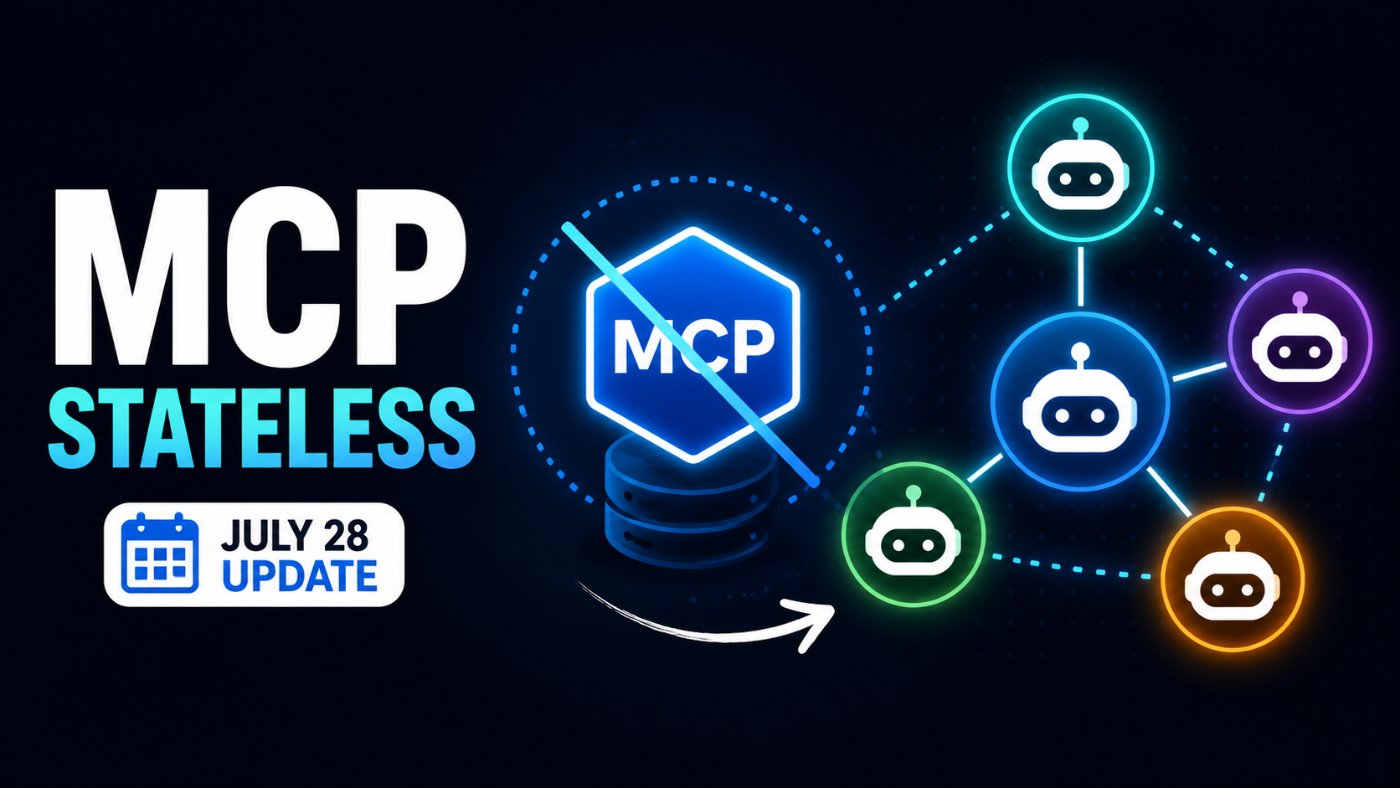
MCP Goes Stateless: The July 28 Spec Update and How to Prompt Multi-Agent Systems
The Agentic AI Foundation's next MCP specification, final on July 28, 2026, makes the protocol stateless at the transport layer. Here's what changes and how to standardize prompts across MCP and A2A.