
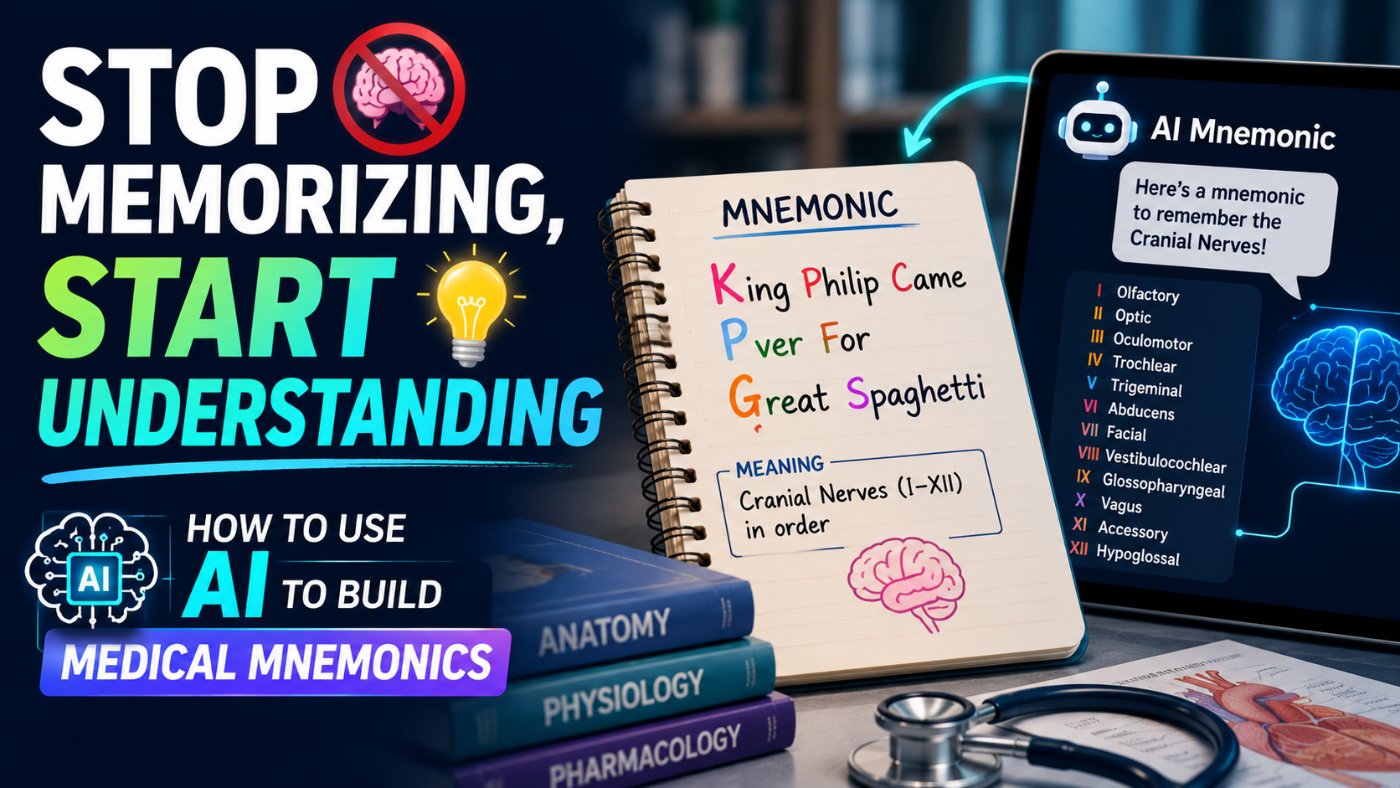
Stop Memorizing, Start Understanding: How to Use AI to Build Medical Mnemonics
Every medical student has a drawer full of mnemonics that worked perfectly on a Tuesday night flashcard session and completely fell apart during the actual exam, or worse, in front of an attending. The letters were memorized. The mechanism behind them was not. A mnemonic that only encodes a list is a party trick. A mnemonic that encodes the actual physiology, the reason the drug causes that side effect or the reason that nerve controls that muscle, is the difference between recalling an answer and understanding one.
Note: AI-generated mnemonics are a study and memory aid, not a verified clinical or exam reference. Always cross-check the underlying mechanism, drug class, or diagnostic criteria against your course material, a current textbook, or a board-recognized source such as UWorld or First Aid before relying on a mnemonic for exam prep or clinical recall.
Why Most Mnemonics Fail Under Exam Pressure
A mnemonic is only as strong as the connection between the letters and the actual concept. "SIG E CAPS" for depression symptoms works because each letter is genuinely tied to a real diagnostic criterion you already understand. A mnemonic that just assigns a random word to a random drug class, with no explanation of why, evaporates the moment exam anxiety hits and you cannot recall which arbitrary word went with which arbitrary fact.
My honest opinion here: most students ask AI for a mnemonic the same lazy way they ask for anything else, "give me a mnemonic for cranial nerves," and get back a generic phrase that is disconnected from any actual understanding of what those nerves do. The fix is not a better mnemonic generator, it is a better prompt that forces the mechanism to be part of the output, not just the memory hook.
The Anti-Slop Rule for Medical Mnemonics: Mechanism First
Every prompt in this guide follows one non-negotiable rule: ask the AI to explain the underlying mechanism or reasoning alongside the mnemonic, never the mnemonic alone. A mnemonic without the "why" attached is a string of letters. A mnemonic with the "why" attached is a compressed explanation you can unpack under pressure even if you forget the exact phrase.
● Always ask for the mechanism or clinical reasoning behind each item in the list, not just a catchy phrase.
● Always ask the AI to flag anything it is uncertain about, since a plausible-sounding but incorrect mnemonic is worse than no mnemonic at all.
● Always verify the underlying fact against your course material before trusting the mnemonic during exam prep.
Building a Mechanism-Linked Mnemonic
Bad Prompt (what most people type)
Give me a mnemonic for cranial nerves
Good Prompt (adds structure and context)
Give me a mnemonic for the 12 cranial nerves in order, and briefly explain the function of each nerve.
Expert Prompt (production-ready, fully specified)
Role: Act as a medical education tutor helping a student build a durable, mechanism-linked mnemonic. Task: Create a mnemonic for the 12 cranial nerves in correct anatomical order (Olfactory through Hypoglossal). Constraints: For each nerve, include the mnemonic word, the nerve name, and a one-sentence explanation of its primary function or a clinical sign associated with damage to it. Flag with [VERIFY] any function or clinical association you are less certain about. Format: A numbered list, one line per nerve, with mnemonic word, nerve name, and function/clinical note. Tone: Clear and educational, written for a first or second year medical student.
What changed: The expert prompt requires a function or clinical sign attached to every single item, which converts the output from a pure memory trick into a compressed review sheet. If the exact mnemonic word is forgotten later, the functional explanation is often enough to reconstruct the answer.
Building Mnemonics for Drug Classes and Side Effects
Pharmacology mnemonics are especially prone to becoming disconnected letter strings, since drug names and side effects can feel arbitrary without the shared mechanism tying them together.
Bad Prompt
Mnemonic for antihypertensive drug classes
Good Prompt
Create a mnemonic for the major antihypertensive drug classes, and explain the shared mechanism of action for each class.
Expert Prompt
Role: Act as a pharmacology tutor helping a student connect drug classes to mechanism, not just names. Task: Create a mnemonic covering the major antihypertensive drug classes: ACE inhibitors, ARBs, calcium channel blockers, beta blockers, and diuretics. Constraints: For each class, include the mnemonic element, the class name, its general mechanism of action in one sentence, and one common, well-established side effect linked to that mechanism. Do not include a side effect unless it is a well-documented, textbook-level association. Flag with [VERIFY] anything uncertain. Format: A numbered list, one entry per drug class, with mnemonic element, class name, mechanism, and side effect. Tone: Clear and educational, appropriate for board exam review.
What changed: The expert prompt explicitly ties each side effect back to the class's mechanism of action, which reinforces the underlying pharmacology instead of presenting the side effect as an isolated fact to memorize separately from why it happens.
Building Mnemonics for Differential Diagnosis Lists
Differential diagnosis mnemonics, like VINDICATE or similar frameworks, are especially useful for making sure a systematic list is not forgotten under time pressure, but only if each category is understood, not just recited.
Bad Prompt
Give me a differential diagnosis mnemonic for chest pain
Good Prompt
Create a systematic differential diagnosis mnemonic for chest pain, and give one example condition per category.
Expert Prompt
Role: Act as a clinical reasoning tutor helping a student build a systematic differential diagnosis framework. Task: Create a mnemonic-based framework for the differential diagnosis of acute chest pain, using a systems-based or categorical approach (such as cardiac, pulmonary, GI, musculoskeletal, psychiatric). Constraints: For each category, provide the mnemonic element, the category name, and one representative example condition with a brief note on its distinguishing clinical feature. Flag with [VERIFY] any distinguishing feature you are less certain about. Format: A numbered list, one entry per category, with mnemonic element, category, example condition, and distinguishing feature. Tone: Clear and clinical, appropriate for a clinical reasoning course or board review.
What changed: The expert prompt requires a distinguishing clinical feature per category, which turns a generic differential list into an actual decision-making tool rather than a set of categories with nothing to differentiate between them in the moment.
I keep this mnemonic-building prompt structure saved in the free prompt library so every new topic gets the same mechanism-first treatment instead of a generic memory trick.
Copy-Paste Template: Medical Mnemonic Prompt
Use this exactly as written. Replace the [brackets] with your specifics, then verify the output against your course material.
Role: Act as a medical education tutor helping a student build a durable, mechanism-linked mnemonic.
Task: Create a mnemonic for [TOPIC, e.g. "the 12 cranial nerves" or "antihypertensive drug classes"].
Constraints: For each item, include the mnemonic element, the item name, and a one-sentence explanation of its function, mechanism, or a distinguishing clinical feature. Do not include any fact unless it is well-established and textbook-level. Flag with [VERIFY] anything you are less certain about.
Format: A numbered list, one entry per item, with mnemonic element, item name, and explanation.
Tone: Clear and educational, appropriate for [LEVEL, e.g. "first year medical student" or "board exam review"].
-- Role: Medical education tutor, mechanism-first mnemonic building
-- Task: Mnemonic tied to explanation, not just memory hooks
-- Format: Numbered list with mnemonic element and explanation per item
-- Constraints: Textbook-level facts only, uncertain items flagged
-- Tone: Clear, educational, level-appropriate
Reminder: Verify every mnemonic's underlying facts against your course material or a board-recognized source before relying on it for exams or clinical recall.
Save this to your prompt library at promptailearning.com/prompts.
Prompt Glossary
Mechanism-linked mnemonic: A memory aid where each element is explicitly tied to the underlying function, mechanism, or distinguishing feature it represents, rather than an arbitrary word with no connection to the concept.
Constraint stacking: Listing multiple specific rules, such as requiring a mechanism explanation and flagging uncertain facts, in a single prompt so the model cannot return a memory trick with no educational substance.
Hallucination flagging: Explicitly instructing the AI to mark any fact it is less certain about, which is especially important in medical content where a confident-sounding but incorrect detail can be difficult to catch without independent verification.
Systems-based differential: An approach to differential diagnosis organized by body system or category, such as cardiac, pulmonary, or GI, used to ensure a comprehensive and systematic list under time pressure.
System Prompt: Instructions given to the AI before your actual request, used here to define the "Role" that anchors the entire response, such as medical education tutor or pharmacology tutor.
Recommended Blogs
If you found this useful, these posts go deeper on related topics:
● Best ChatGPT Prompts 2026: 200+ With Real Examples
● Best Claude AI Prompts 2026: 25+ Types With Examples
● What is Prompt Engineering?
Frequently Asked Questions
Are AI-generated medical mnemonics reliable for exam prep?
They can be a useful study aid, but the underlying facts should always be verified against your course material, a current textbook, or a board-recognized resource before relying on them, since AI can occasionally present an incorrect detail confidently.
What makes a medical mnemonic actually effective?
An effective mnemonic ties each element to the underlying mechanism, function, or distinguishing clinical feature, rather than assigning an arbitrary word with no explanation, which is what makes it recallable under exam or clinical pressure.
Can ChatGPT create mnemonics for pharmacology?
Yes, and it tends to work best when the prompt explicitly asks for the mechanism of action and a well-established side effect for each drug class, rather than just a list of drug names.
How do I know if an AI-generated mnemonic contains an error?
Ask the model to flag anything it is less certain about directly in the prompt, and always cross-check the underlying facts against your course material or a recognized board review resource before treating the mnemonic as reliable.
Is Claude or ChatGPT better for building study mnemonics?
Both work well for this task when given a detailed, mechanism-focused prompt. The quality difference comes primarily from how the prompt is structured, not which specific model is used.
Can AI help build mnemonics for differential diagnosis lists?
Yes, especially when the prompt asks for a distinguishing clinical feature per category rather than just a list of possible conditions, which turns the mnemonic into a usable clinical reasoning tool.
Should first year and clinical year medical students use different mnemonic prompts?
The core structure stays the same, but specifying the academic level and context, such as preclinical coursework versus board exam review versus clinical rotations, helps the AI calibrate the depth and clinical relevance of the explanations provided.
Can a mnemonic replace understanding the actual mechanism?
No. A mnemonic is a recall aid built on top of understanding, not a substitute for it. The mechanism-first approach in this guide is specifically designed to reinforce understanding rather than replace it with rote memorization.
Save this mnemonic-building prompt to the free prompt library so your next study session builds understanding instead of another list of letters you will forget by finals.