
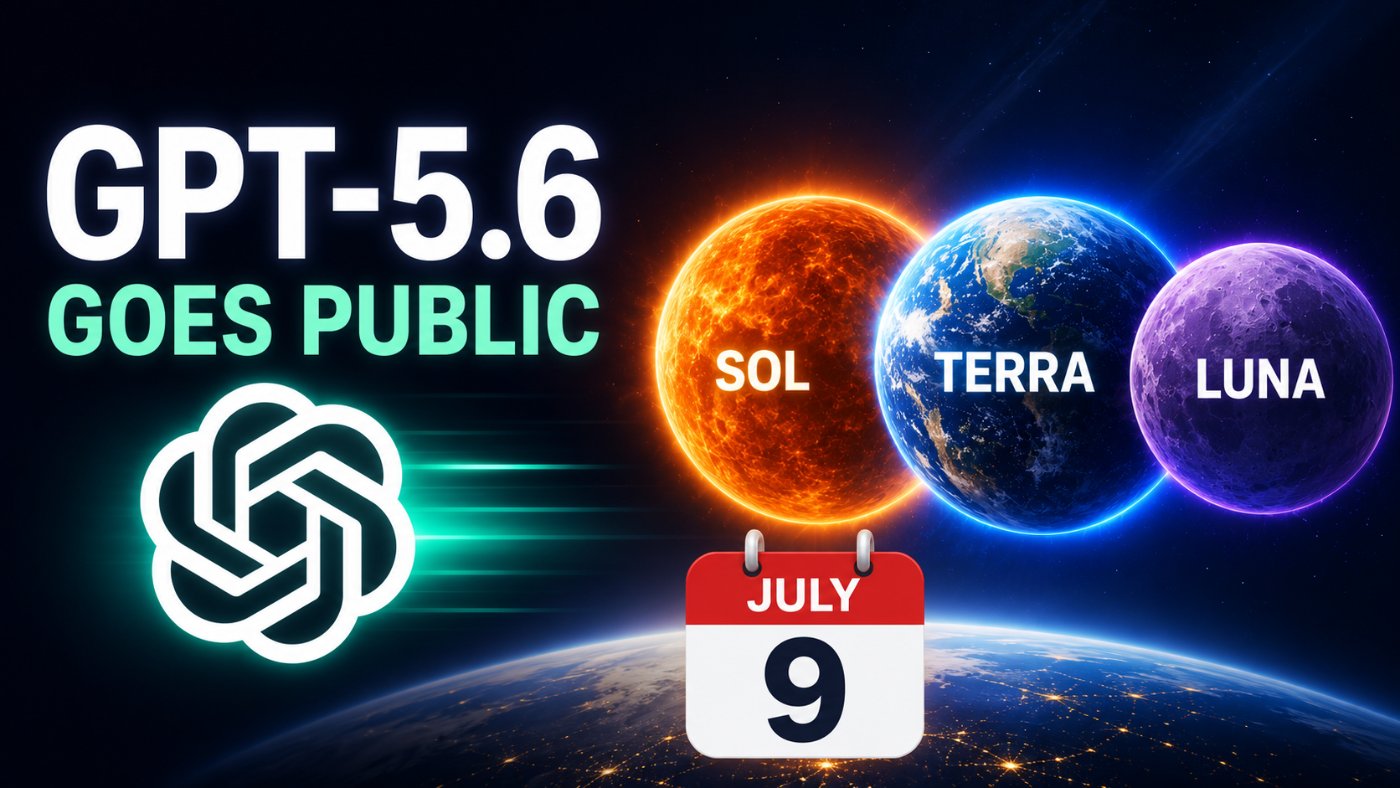
GPT-5.6 Goes Public: Sol, Terra, and Luna Launch July 9 After Government Review
OpenAI opened public access to GPT-5.6 on July 9, 2026, ending a 13-day limited preview that had restricted the model to roughly 20 government-approved organizations. The release ships three tiers: Sol, Terra, and Luna.
The rollout matters because GPT-5.6 is the first major consumer AI launch gated by a U.S. government safety review before reaching developers. OpenAI previewed the model's capabilities to the government ahead of its June 26 announcement, and the government asked that initial access go to a small trusted-partner group first. That review, tied to GPT-5.6 Sol's cybersecurity and biology capability gains, delayed general availability by nearly two weeks and set a precedent other frontier labs are now watching.
What Launched on July 9
GPT-5.6 comes in three tiers built for different jobs. Sol is the flagship, aimed at hard reasoning, coding, science, and long-horizon agentic tasks. Terra is the everyday tier, positioned as competitive with GPT-5.5 at a lower cost. Luna targets latency-sensitive and high-volume workloads where raw speed matters more than peak intelligence.
Sol also introduces a new max reasoning effort setting for the hardest problems, plus an ultra mode that coordinates subagents to speed up complex, multi-part work. In my view, the three-tier split is the more consequential change here than any single benchmark number: it lets teams route tasks by cost and latency need instead of defaulting every call to the flagship model.
Why the Government Review Happened
OpenAI says it shared GPT-5.6's planned capabilities with the U.S. government before the June 26 announcement, and the government asked that the company start with a small group of trusted partners rather than a normal staggered public rollout. OpenAI has framed this as a one-time step tied to Sol's dual-use capability gains, not a new default release process.
The trigger was cybersecurity capability. Sol is OpenAI's strongest model yet on long-horizon security tasks, including vulnerability research, and the company reports the model did not cross its internally defined Cyber Critical threshold during testing. OpenAI also disclosed using more than 700,000 A100-equivalent GPU hours on automated red-teaming aimed at jailbreaks that could generalize across many prompts rather than one-off exploits.
Verma notes: this is the second major model in six weeks to face export or access restrictions tied to dual-use risk, after Anthropic's Fable 5 and Mythos models were pulled offline in June under separate export-control rules. That is a pattern worth watching, not a one-off.
Terminal-Bench 2.1 Scores and What They Mean
OpenAI's headline evaluation for GPT-5.6 is Terminal-Bench 2.1, which measures command-line development workflows requiring planning, iteration, and tool coordination rather than single-turn code generation.
• Sol Ultra: 91.9 percent
• Sol (standard): 88.8 percent
• Terra: 84.3 percent, an improvement over its predecessor
• Luna: 82.5 percent
For comparison, third-party trackers list Claude Mythos 5 at 88.0 percent and GPT-5.5 at 88.0 percent on the same benchmark, putting base Sol only narrowly ahead and Sol Ultra clearly ahead. On SWE-Bench Pro, a benchmark many engineering teams treat as more decision-relevant for production software work, OpenAI has not published a Sol score, while Anthropic reports Fable 5 leading at 80.3 percent against GPT-5.5's 58.6 percent. The practical read: Sol appears to lead on planning-heavy terminal workflows, while multi-file software completion is still an open comparison.
Pricing and Caching Changes
API pricing is set per one million tokens. Sol runs $5 input and $30 output. Terra runs $2.50 input and $15 output. Luna runs $1 input and $6 output. GPT-5.6 also adds explicit cache breakpoints, a 30-minute minimum cache lifetime, cache writes billed at 1.25x the standard input rate, and a 90 percent discount on cached-input reads.
For agentic pipelines that repeatedly reprocess large, stable context windows, such as a coding agent re-reading the same repository on every tool call, that caching discount is the detail worth testing first, ahead of any raw benchmark comparison.
Prompting GPT-5.6 for Agentic Work
The tier split changes how you should prompt. A single generic system prompt tuned for Sol will overspend on Luna-scale tasks and underspend on Sol Ultra tasks. The fix is to prompt for the tier explicitly, telling the model how much autonomy and exploration you want before it starts calling tools.
Scoping Agentic Exploration on GPT-5.6
Bad Prompt (what most people type)
Fix the bug in this repo.
Good Prompt (adds structure and context)
Find and fix the failing test in tests/checkout.py. Read only the files needed to understand the failure before editing.
Expert Prompt (production-ready, fully specified)
<context_gathering> Goal: Find the root cause of the failing test with the fewest file reads. Method: Start with the failing test and its direct imports, then fan out only if the failure is not explained. Stop as soon as you can act. </context_gathering>
Task: Fix tests/checkout.py so it passes without breaking any other test in the suite. Run the full test file after your change and report the result. Constraints: Do not modify test assertions. Explain the root cause in one sentence before showing the diff.
What changed: the Expert version bounds how much the model explores before acting, a setting OpenAI's own guidance recommends for controlling both latency and tool-call scope on GPT-5.6, and it adds an explicit success check so the agent verifies its own fix instead of assuming it worked.
Copy-Paste Template: Tier-Aware Agent Instruction
Use this exactly as written. Replace the [brackets] with your specifics.
You are working as [ROLE] on [TASK]. Reasoning effort: [low / medium / high / max] based on task complexity. Context gathering: start broad, then narrow. Stop exploring as soon as you have enough information to act. Do not read files unrelated to [TASK]. Output format: [describe exact format required]. Before finishing, verify your own output against [SUCCESS CRITERIA] and state whether it passes.
-- Role: who the model should act as, matched to the tier you selected
-- Task: what it should produce
-- Format: how it should be structured
-- Constraints: what it must and must not do
-- Tone: how it should sound
Save this to your prompt library at promptailearning.com/prompts.
Prompt Glossary
Reasoning effort: a setting that controls how much a model explores and deliberates before answering, trading latency for thoroughness.
Context gathering: the exploration phase where an agent reads files, calls tools, or searches for information before acting.
Subagent: a secondary model instance an agent dispatches to handle part of a task in parallel, used in GPT-5.6 Sol's ultra mode.
Prompt caching: reusing a previously processed portion of a prompt to cut cost and latency on repeated or stable context.
Key Takeaways
• GPT-5.6 Sol, Terra, and Luna moved from limited preview to public rollout on July 9, 2026.
• Sol Ultra scores 91.9 percent on Terminal-Bench 2.1, versus 88.8 percent for base Sol.
• The public launch was delayed almost two weeks by a U.S. government safety review tied to cybersecurity capability.
• Pricing runs from $1 input and $6 output per million tokens on Luna up to $5 and $30 on Sol.
• Cached input tokens now cost 90 percent less, a meaningful saving for repeat-context agentic pipelines.
• OpenAI has not published a Sol score on SWE-Bench Pro, leaving multi-file coding comparisons open.
Recommended Reading
The Guide to Agentic Prompts
ChatGPT vs Claude: Full Comparison 2026
Best ChatGPT Prompts 2026: 200+ With Real Examples}
Claude API Pricing 2026: Full Breakdown
Frequently Asked Questions
When did GPT-5.6 launch publicly?
GPT-5.6 Sol, Terra, and Luna moved from limited preview to public rollout on July 9, 2026, after OpenAI first announced the family on June 26, 2026.
What is GPT-5.6 Sol's Terminal-Bench 2.1 score?
Sol scores 88.8 percent in standard mode and 91.9 percent in Ultra mode, which uses subagents to coordinate complex, multi-step work.
Why was GPT-5.6 delayed before public release?
OpenAI shared the model's capabilities with the U.S. government ahead of launch, and the government requested a limited preview of roughly 20 trusted partners first, tied to Sol's cybersecurity capability gains.
How much does GPT-5.6 cost per API call?
Sol is priced at $5 per million input tokens and $30 per million output tokens. Terra runs $2.50 and $15. Luna runs $1 and $6.
Is GPT-5.6 faster than GPT-5.5?
OpenAI has not published a specific latency percentage for GPT-5.6 versus GPT-5.5. Luna is positioned as the speed-and-cost tier for latency-sensitive workloads, while Sol targets peak capability.
Does GPT-5.6 beat Claude models on coding benchmarks?
On Terminal-Bench 2.1, Sol Ultra's 91.9 percent leads Claude Mythos 5's 88.0 percent. On SWE-Bench Pro, Anthropic reports Claude Fable 5 leading at 80.3 percent, and OpenAI has not published a comparable Sol score.
Explore More on Prompt AI Learning
STAY UPDATED WITH AI NEWS
Follow the full AI news series and never miss a story:
• Daily AI News - Top 5 Stories Every Morning
• Weekly AI Roundups - 15+ Stories Every Monday
• Monthly AI Recaps - Full Archive by Month
LEARN THE MODELS MAKING THESE HEADLINES
The models in today's news are only useful if you know how to prompt them well. Start here:
• Best Claude AI Prompts 2026 - 25+ Types With Examples
• Best ChatGPT Prompts 2026 - 200+ Real Examples
• Best Gemini AI Prompts 2026 - 100+ Templates
COMPARE THE MODELS
Not sure which model to use? These comparison pages give you the full picture:
• ChatGPT vs Claude - Full 2026 Comparison
• AI Models Directory - Compare 60+ LLMs, Image and Video Models
BUILD SKILLS THAT COMPOUND
Reading AI news is step one. Building skills with these models is step two:
• Free Prompt Library - 213+ Copy-Paste Templates
• Start Prompt Engineering - Free Course for All Levels
• The Guide to Agentic Prompts
• Coding Prompts for Developers - Production-Ready Templates
USE PROMPTS FOR THE NEWS TOPICS YOU READ ABOUT TODAY
Every story in today's post maps to a real use case. These prompt categories help you act on what you read:
• Business and Strategy Prompts - Analysis, Pitch Decks, OKRs
• Writing and Content Prompts - Emails, Case Studies, White Papers
• AI Knowledge Hub - Technical Blueprints and Career Guides
ABOUT THIS BLOG
promptailearning.com publishes free daily AI news, weekly roundups, monthly recaps, prompt guides, model comparisons, and course content for anyone who wants to get better at using AI. Written by Swatantra Verma. No paywalls, no fluff.
Connect With Us
• Email: contact@promptailearning.com
• Founder: Swatantra Verma on LinkedIn
• Co-Founder: Prateek Patel on LinkedIn
• Company LinkedIn: Prompt AI Learning
• Company X: @promptailearnin
Similar Updates
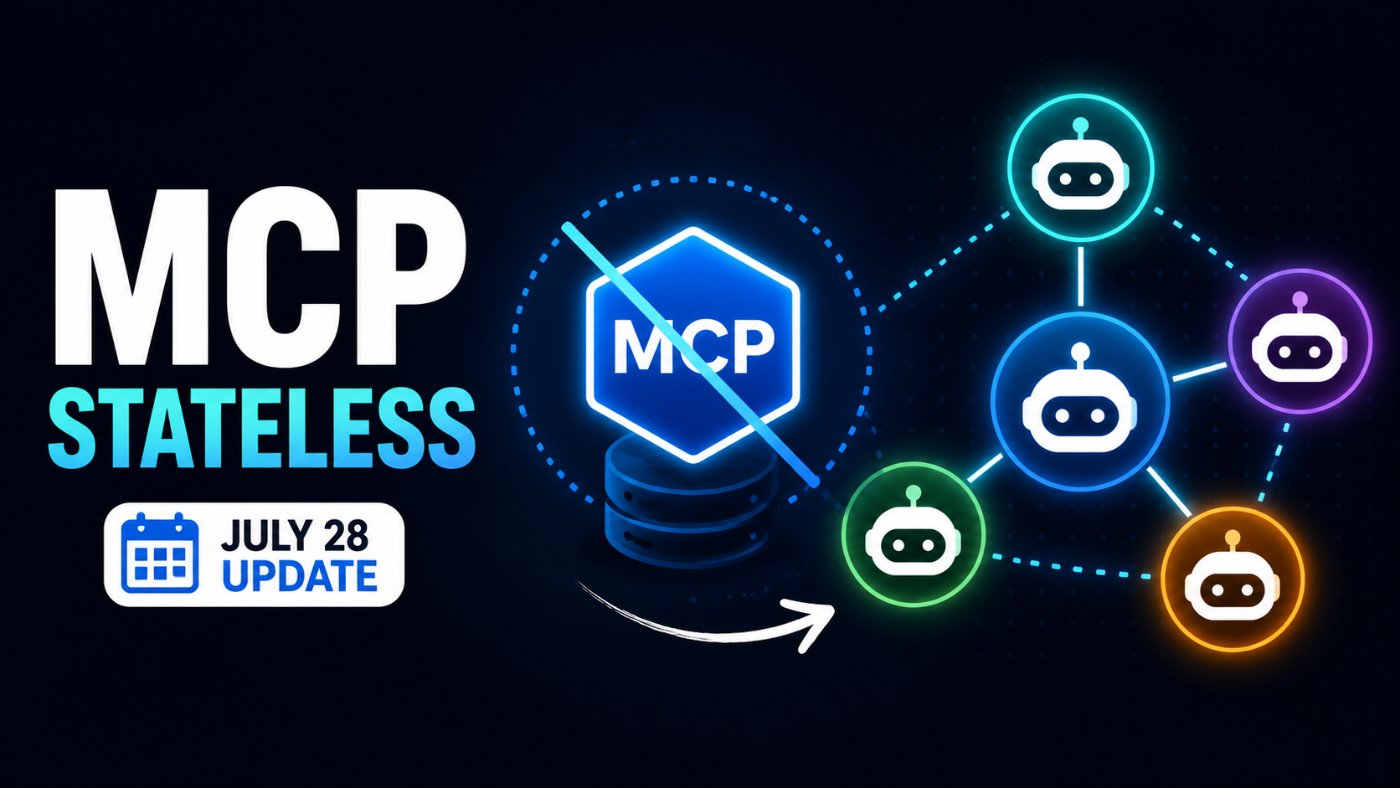
MCP Goes Stateless: The July 28 Spec Update and How to Prompt Multi-Agent Systems
The Agentic AI Foundation's next MCP specification, final on July 28, 2026, makes the protocol stateless at the transport layer. Here's what changes and how to standardize prompts across MCP and A2A.

Google AI Studio Filter Sensitivities Frustrate Developers
Developers report Google AI Studio's safety filters are blocking harmless prompts, from fiction translation to original photography, renewing scrutiny of Gemini's content moderation.

Today in AI: 5 Stories Shaping the Future, June 26, 2026
June 26, 2026: The co-author of the Transformer paper that powers every major AI model just joined OpenAI, a new attack class called Agentjacking hit 2,388 organizations with 85 percent success, Gemini 3.5 Pro has four days left, and the White House signed a sweeping AI executive order.

AI Today: GPT-5.6 Missed, Gemini Deadline Looms, Claude Enters Slack
GPT-5.6 window closes as July launch looms, Gemini 3.5 Pro deadline arrives with 5 days left, Anthropic's Claude Tag reshapes enterprise Slack workflows, SK Hynix files for a $29.4B US listing, and the coding AI arms race gets a new CNBC scorecard. Five stories from June 25, 2026.