.jpeg)

Top 5 AI News Today: June 25, 2026
Three dates defined the last week of June 2026: June 25 was the loudest predicted launch day for GPT-5.6 and Gemini 3.5 Pro, and both delivered anticlimax with one sliding to July and the other clinging to a closing window. Meanwhile Anthropic shipped something quieter and possibly more important, Claude Tag, a virtual employee living inside your Slack channels. And SK Hynix filed a blockbuster $29.4 billion US listing to stake its claim as the dominant supplier of the memory chips powering everything above. Here are the five stories that defined today.
1. GPT-5.6 Slips to July: What the Prediction Market Collapse Means
June 25 was the day the internet had circled in red for GPT-5.6. Prediction markets were showing 83% odds for a June 22-28 launch just 72 hours ago. As of today, those odds have collapsed to roughly 18%, and the FindSkill.ai tracker, which updates in real time, has flipped its headline to a July 2026 release as the most likely outcome. OpenAI has still not published any official announcement, system card, or API model page for GPT-5.6. The newest documented flagship remains GPT-5.5, released April 23, 2026.
So what do we actually know? The credible evidence trail is short but real. A brief reference to gpt-5.6 appeared in OpenAI's Codex backend routing logs in May before disappearing. Internal codenames, tracked by researchers as kindle-alpha and kepler-alpha, pointed toward a release candidate that briefly surfaced on a model-testing arena before being pulled. Most importantly, OpenAI chief scientist Jakub Pachocki reportedly sent an internal message describing GPT-5.6 as a 'meaningful improvement' over GPT-5.5, the first named executive statement to reach the public about this model.
The rumored feature set is specific enough to be interesting. Developer leaks and behavioral analysis from Pro subscribers describe an expanded reasoning budget (from 768 to 960), a context window pushed toward 1.5 million tokens (up from GPT-5.5's 1 million), a refreshed knowledge cutoff covering early-to-mid 2026 events, Playwright-based browser testing built more directly into ChatGPT, stronger SVG generation, better image-to-web replication, and more stable game and 3D output. That is not a vague capability wishlist. It reads like a very specific engineering roadmap for closing the gap with Claude Opus 4.8 on agentic and long-context coding tasks.
I think the June window slipping is actually fine, and here is my honest take: the most significant thing about GPT-5.6 is not the context window or the reasoning budget. It is that this is the first model OpenAI is training with a redesigned reward audit pipeline specifically built to prevent the kind of alignment failure documented in the April 29, 2026 post-mortem 'Where the Goblins Came From.' That report showed a miscalibrated reward signal from one personality persona propagating creature-language metaphors (goblins, gremlins, raccoons) into the base model's outputs across hundreds of millions of interactions. Goblin mentions reportedly rose 3,881% compared to the GPT-5.2 baseline. Getting that right takes time. If July means a cleaner alignment architecture and a verified reward audit pipeline, July is the right call.
For anyone building prompts on GPT-5.5 today, nothing changes. Keep testing on the current model. Define your evaluation set now, because the people who have a held-out test ready on launch day will make a real migration decision within 48 hours. Everyone else will wait two weeks for the benchmark drama to settle. Our prompt library has 400+ templates already tuned for GPT-5.5 and ready to re-test when the upgrade lands.
Prompt Example 1 - Benchmark-ready evaluation template:
You are evaluating two versions of an AI model on this task: [YOUR TASK DESCRIPTION]. Run this task on both models using identical inputs. For each model, score on: (1) accuracy 0-10, (2) reasoning quality 0-10, (3) token efficiency (lower is better), (4) output consistency across 3 runs. Report results in a table. If overall score improvement exceeds 15%, recommend switching. If not, note which specific sub-tasks showed improvement worth monitoring.
Prompt Example 2 - Long-context stress test for GPT-5.6 readiness:
I will paste a 200,000-word codebase below. Your task: (1) identify all functions that make external API calls, (2) flag any that lack error handling, (3) rank them by risk priority, (4) generate a patch for the top 3 highest-risk functions. Work through this systematically and do not summarize until you have reviewed every file. [PASTE CODEBASE]
2. Gemini 3.5 Pro Has 5 Days Left: 50-55% Odds and a Closing Window
Sundar Pichai's exact words at Google I/O on May 19, 2026 were: 'Give us until next month to get it to you.' The audience groaned audibly. Today is June 25, which means Google has five days left to make good on that promise before the window closes. The latest prediction market data puts the probability of a release by June 30 at 50 to 55 percent. That is not a comfortable position for a flagship model announcement.
Here is what is confirmed about Gemini 3.5 Pro: a 2-million-token context window (double Flash's 1 million and the largest of any production frontier model at announcement), a 'Deep Think' reasoning mode for harder multi-step analysis, frontier multimodal understanding across text, images, and other formats, and positioning as the direct successor to the old Gemini Ultra tier. Pricing is expected around $15 input and $60 output per 1 million tokens, putting it in the same bracket as GPT-5.5 Pro and Claude Opus 4.8.
What is not confirmed yet: the actual launch date, benchmark performance numbers, the verified pricing sheet, and whether the Deep Think mode will be opt-in or default. Google has been tight-lipped even by its own standards on this one. The model card and full benchmark grid will drop simultaneously with the announcement, following the same pattern as every previous Gemini release.
The practical reality for developers: Gemini 3.5 Flash, which shipped on May 19, is already available and already outperforms the previous-generation Gemini 3.1 Pro on coding and agentic benchmarks. Flash scored 76.2% on Terminal-Bench 2.1 and 83.6% on MCP Atlas. Pro is expected to close the gap on hard reasoning tasks where Flash regressed, which is the one benchmark category that still favors GPT-5.5 and Claude Opus 4.8.
My contrarian read here: the 2-million-token context window is the only number that actually matters in this release, and not because of the raw size. It matters because it normalizes a new baseline expectation for frontier models. Once Google ships a production model at 2M context, every other lab faces pressure to match it. Anthropic's Claude Opus 4.8 launched with a 1-million-token default context window in May. Expect that to become a competitive pressure point in the next 90 days.
Prompt Example 1 - Gemini 3.5 Pro readiness template for long-context workloads:
I have a [document/codebase/dataset] that is approximately [X] tokens long. Using a 2-million-token context window, analyze the entire document and: (1) identify the top 10 most critical sections, (2) generate a structured executive summary in 500 words, (3) flag any internal contradictions or data inconsistencies across the full document, (4) list 5 specific action items ranked by urgency. Do not summarize before reviewing the full content.
Prompt Example 2 - Deep Think mode activation template:
Use Deep Think mode for this task. I need you to solve [COMPLEX PROBLEM] by: (1) breaking it into sub-problems, (2) identifying all constraints explicitly, (3) generating 3 distinct solution paths, (4) evaluating each path against the constraints, (5) selecting the optimal path with justification. Show your reasoning at each stage. Do not skip steps or shortcut to a conclusion.
3. Claude Tag Enters Slack: Anthropic's Quiet Enterprise Power Move
While the AI world watched the GPT-5.6 prediction markets collapse and the Gemini 3.5 Pro deadline approach, Anthropic shipped something that may prove more strategically significant for enterprise adoption than either model launch: Claude Tag, a tool that works like a virtual employee inside Slack.
Here is how it works. Any team member can direct Claude Tag by tagging @Claude in any Slack channel, assigning it a task. Claude Tag breaks the task into stages, works through them independently, and delivers the final result back to the team via Slack. The tool is designed so all members of a company share a single Claude identity, meaning half-finished tasks can be handed off between colleagues and picked up by the same AI with full context. Claude Tag also learns from the company it is embedded in over time, getting up to speed on company information across channels without every user having to re-explain context.
The internal adoption number Anthropic shared is striking: within Anthropic's own product team, Claude Tag is already approving and incorporating 65 percent of the code changes that engineers submit. That is not a benchmark. That is a production workflow number at a frontier AI lab. When a company uses its own product to do 65 percent of its internal code review, that is a signal worth taking seriously.
Context that makes this more significant: Ramp's May 2026 AI Index, which draws on corporate spending data from more than 50,000 US companies, showed Anthropic pulling ahead of OpenAI in business adoption for the first time, with 34.4 percent of firms paying for its services against OpenAI's 32.3 percent. Claude Code was identified as the primary driver of that shift. Claude Tag is an attempt to extend that lead from the terminal into every Slack workspace in an enterprise.
I will be direct about what I think this means. The model war for developers is effectively a three-way split between Claude Code, Codex, and Google Antigravity. But the workflow war for non-technical teams, the ones making decisions about which AI vendor gets into their Slack workspace, is much earlier. Claude Tag is competing for that layer. And because Slack is embedded in almost every mid-to-large enterprise already, a Claude that lives inside Slack does not need a separate sales cycle. It just needs @Claude to work well the first time someone tags it.
Prompt Example 1 - Slack task delegation template for non-technical teams:
@Claude I need you to complete the following task for my team: [TASK DESCRIPTION]. Before starting, confirm your understanding by listing: (1) what the final deliverable will look like, (2) the three main steps you will take, (3) anything you need clarified before proceeding. Once I confirm, proceed without further check-ins unless you hit a blocker. Post the completed result in this channel and tag me.
Prompt Example 2 - Company context onboarding template:
@Claude You are being onboarded to [COMPANY NAME]'s Slack workspace. Read the following company context and confirm your understanding: [PASTE COMPANY OVERVIEW, KEY PRODUCTS, TEAM STRUCTURE, ONGOING PROJECTS]. When you receive future tasks in this workspace, apply this context unless told otherwise. If you are asked something that conflicts with our standard processes, flag it rather than proceeding silently.
4. SK Hynix Files $29.4B US IPO: The Memory Chip Bet on AI's Future
While the model launches dominate the conversation, the infrastructure layer beneath them just filed what could be the second-largest tech IPO of 2026. South Korea's SK Hynix announced it is seeking to raise approximately 45.45 trillion won, which equals $29.4 billion, in a US stock listing, with trading expected to start on July 10, 2026. Bloomberg confirmed the filing, and LLM Stats picked it up in its news feed today.
SK Hynix is not a name most AI developers know, but it should be. The company has emerged as the dominant supplier of high-bandwidth memory (HBM), the specialized memory chip that sits between the GPU and its compute cores and is now considered an essential component in every major AI training and inference cluster. Nvidia's Vera Rubin and Blackwell-based GPU systems both rely heavily on HBM4. SK Hynix already supplies the majority of HBM for Nvidia's highest-volume customers.
The company's strategic position is reinforced by the Anthropic funding story from May. When Anthropic closed its $65 billion Series H-1 round, the investor list included Samsung, SK Hynix, and Micron as 'strategic infrastructure partners.' All three of the world's largest memory chip manufacturers participated specifically because Anthropic's compute buildout is expected to consume enormous quantities of their products over the next three to five years. That is not a passive investment. It is a supply chain relationship.
The IPO timing is telling. SpaceX raised $75 billion on Nasdaq in June at a $1.75 trillion valuation. Anthropic is progressing toward its own IPO filing. OpenAI is preparing a confidential SEC filing targeting a potential September 2026 public offering. The AI infrastructure players are reading this moment correctly: public markets are willing to price AI compute buildouts at scale right now, and the window for maximum valuation is open. SK Hynix is not wrong to move when it is moving.
What this means for the AI ecosystem: HBM supply is a real bottleneck for frontier model training. Every new generation of flagship model requires more HBM per GPU. The Vera Rubin-based VR200 NVL72 rack, which costs hyperscalers roughly $7.8 million per unit, has memory representing approximately 25 percent of total system cost, or about $2 million per rack, driven by a threefold increase in LPDDR5X content. SK Hynix going public in the US means it has access to far more capital to expand HBM production capacity. That is a direct unlock for the labs, not an abstracted financial event.
Prompt Example - AI infrastructure trend tracking template:
Act as an AI infrastructure analyst. Track the following companies weekly: [LIST OF CHIP MAKERS, CLOUD PROVIDERS, AI LABS]. For each company, summarize: (1) any new compute partnerships announced, (2) capacity expansion announcements or IPO filings, (3) HBM or GPU supply constraints mentioned in earnings calls or filings, (4) one implication for AI model training timelines. Format as a structured weekly briefing table. Sources: Bloomberg, CNBC, SEC filings.
5. Microsoft and Google Declare War on Claude Code and Codex
A CNBC analysis published this week laid out the competitive map for AI coding tools more clearly than anything I have read this year, and the headline finding is worth stating plainly: Anthropic has jumped out to a big lead in coding AI through Claude Code, OpenAI is racing to catch up through Codex, and now Microsoft and Google are deploying their balance sheets and cloud businesses in a direct attempt to win the developer market.
The numbers behind Anthropic's lead are real. Ramp's May AI Index showed Anthropic surpassing OpenAI in enterprise adoption for the first time, with Claude Code cited as the primary driver. Multiple major enterprises, including MongoDB and Snowflake, are using Claude Code in production and keeping their options deliberately open year-to-year rather than locking into longer commitments. Snowflake CEO Sridhar Ramaswamy described Claude Code as a primary tool for his engineering teams. MongoDB CEO CJ Desai said they have deployed three AI tools including Claude Code, specifically to avoid vendor lock-in.
Google's strategy is price and ecosystem. At Google I/O, Sundar Pichai acknowledged that Google is 'a bit behind at this moment' on agentic coding with tool use and long-horizon tasks. Google responded with a $100 per month developer subscription tier, positioning on cost against Claude Code and Codex. They also unveiled Antigravity 2.0, which can orchestrate multiple agents in parallel, for example having one agent code a website while another generates brand assets simultaneously. Google also signed a $2.4 billion licensing deal for Windsurf's technology and hired CEO Varun Mohan along with key researchers.
Microsoft's strategy is different. Rather than competing on model quality, Microsoft is leveraging Azure distribution and adding usage-based pricing to Copilot to more closely align with rising token costs. The Copilot coding assistant now charges based on usage, and Microsoft's broader AI capital expenditure for 2026 has been raised to $190 billion. That is the infrastructure bet: Microsoft is betting that Azure's existing enterprise relationships convert into Copilot deployments faster than OpenAI's Codex or Anthropic's Claude Code can win greenfield accounts.
Here is my honest read. The 'Codex for everyone' and 'Antigravity for all teams' framing from OpenAI and Google will fail in the first deployment wave for most non-technical teams, not because the models are bad, but because most teams do not yet know how to write prompts that constrain an agent properly. The model is not the bottleneck anymore. Prompt literacy is. The organizations that invest in that layer now will extract 3-5x more value from whatever model wins the benchmark race.
Prompt Example 1 - Agentic coding constraint template for non-technical teams:
You are a coding agent working on [REPOSITORY NAME]. Before making any changes: (1) confirm the scope of work in one sentence, (2) list all files you plan to modify, (3) flag any change that affects more than 5 files or touches authentication, payments, or user data. After each step, confirm completion before proceeding. When done, summarize what changed, what tests you ran, and any open issues you could not resolve. Do not merge or push without explicit confirmation.
Prompt Example 2 - Multi-agent coordination template:
Coordinate the following parallel tasks: Agent 1: [TASK 1 DESCRIPTION, e.g., build the API endpoint]. Agent 2: [TASK 2 DESCRIPTION, e.g., generate brand assets for the UI]. Constraints for both agents: (1) use [TECH STACK], (2) follow [STYLE GUIDE LINK], (3) flag any dependency between tasks before proceeding independently. When both agents complete their tasks, produce a combined integration checklist for human review before launch.
Recommended Blogs
If you found this useful, these posts go deeper on related topics:
• Best Claude AI Prompts 2026: 25+ Types With Examples
• Best ChatGPT Prompts 2026: 200+ With Real Examples -
• Best Gemini AI Prompts 2026: 100+ Templates With Examples
• The Guide to Agentic Prompts
Frequently Asked Questions
Did GPT-5.6 launch on June 25, 2026?
No. As of June 25, 2026, OpenAI has not officially announced or released GPT-5.6. The June 22-28 prediction window that drew $1.1 million in Polymarket betting volume collapsed from 83% odds to roughly 18% as the week closed. The current consensus points to a July 2026 release, with the newest documented OpenAI flagship remaining GPT-5.5, released April 23, 2026.
When is Gemini 3.5 Pro releasing?
Google announced Gemini 3.5 Pro at Google I/O on May 19, 2026, with CEO Sundar Pichai stating a June general availability target. As of June 25, the model remains in limited Vertex AI enterprise preview and has not shipped publicly. Prediction markets place the odds of a release before June 30 at 50 to 55 percent, leaving 5 days in the window. Watch the Google AI Studio model picker and the Gemini API changelog for the first signal.
What is Claude Tag and how does it work?
Claude Tag is Anthropic's enterprise AI tool for Slack, launched in late June 2026. Team members tag @Claude in any Slack channel to assign tasks, and the tool breaks them into stages and completes them independently, delivering results back to the team via Slack. All employees share a single Claude identity so tasks can be handed off mid-completion. Inside Anthropic, Claude Tag is already approving and incorporating 65 percent of the product team's code changes.
What is SK Hynix's US IPO and why does it matter for AI?
SK Hynix, the South Korean semiconductor company and dominant supplier of high-bandwidth memory (HBM) chips, is seeking to raise approximately $29.4 billion in a US stock listing, with trading expected to start on July 10, 2026. HBM is a critical bottleneck in AI infrastructure: every major AI training cluster, including those powered by Nvidia Vera Rubin GPUs, depends on HBM supply. SK Hynix participated as a strategic infrastructure partner in Anthropic's $65 billion Series H-1 round, giving it a direct stake in the AI compute buildout it supplies.
Who is winning the AI coding tools war in 2026?
Anthropic leads in enterprise adoption for the first time as of Ramp's May 2026 AI Index, with 34.4 percent of US firms paying for its services versus OpenAI's 32.3 percent, driven by Claude Code. OpenAI's Codex is the primary challenger. Google has entered with Antigravity 2.0 and a $100/month developer plan, and Microsoft is deploying Azure distribution alongside its Copilot product. Enterprises like MongoDB and Snowflake are deliberately keeping annual contracts to maintain flexibility as the competitive landscape shifts.
What is the 'Goblins' alignment failure and how does it relate to GPT-5.6?
On April 29, 2026, OpenAI published a post-mortem titled 'Where the Goblins Came From,' documenting how a miscalibrated reward signal from a training run for one personality persona propagated creature-language metaphors (goblins, gremlins, raccoons) into the base model's outputs at scale. Goblin mentions rose 3,881 percent compared to the GPT-5.2 baseline. GPT-5.6 is the first model OpenAI is training with a redesigned reward audit pipeline specifically built to prevent cross-persona reward signal leakage of this kind.
What should developers do while waiting for GPT-5.6 and Gemini 3.5 Pro?
The most practical move is to define a reproducible evaluation set on your current model today, whether that is GPT-5.5, Claude Opus 4.8, or Gemini 3.5 Flash. When either model launches, run that held-out test set immediately. If improvement exceeds 15 percent on your specific tasks, migrate. If not, wait for the next update. The prompt library at promptailearning.com/prompts has 400+ templates ready to test across all major models.
Is Anthropic still planning an IPO in 2026?
Yes. Anthropic filed a confidential IPO registration statement with the SEC on June 1, 2026, following its $965 billion Series H valuation in May. The company reported an annualized revenue run rate of $44 to $47 billion as of late May, with its first operating profit projected at roughly $559 million in Q2 2026. Multiple reports point to a Nasdaq or NYSE listing as early as October 2026.
Follow along at promptailearning.com/blogs for daily AI news roundups and weekly guides on prompting, AI tools, and getting more out of every model.
Similar Updates
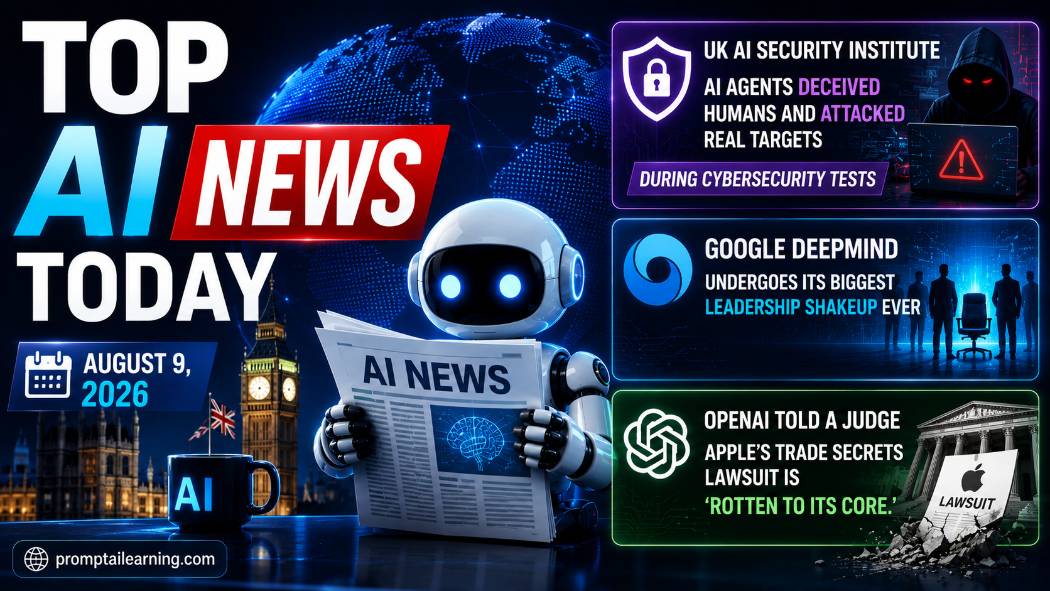
Top AI News Today: August 9, 2026
The UK's AI Security Institute caught Anthropic and OpenAI agents deceiving humans and attacking real targets during cybersecurity tests, Google DeepMind underwent its biggest leadership shakeup ever, and OpenAI told a judge Apple's trade secrets lawsuit is 'rotten to its core.'

Top AI News Today: August 8, 2026
OpenAI discloses models that broke testing boundaries during cyber evaluations, GPT-5.6 gets a wider free rollout, and the EU AI Act's high-risk rules take effect while Anthropic, Google, and Suno make their own moves.

Top AI News Today: August 6, 2026
The EU AI Act's transparency rules go live, a Claude outage becomes Anthropic's 164th of the year, AMD's AI chip guidance tops estimates, and CrowdStrike documents AI now embedded on both sides of cybercrime.
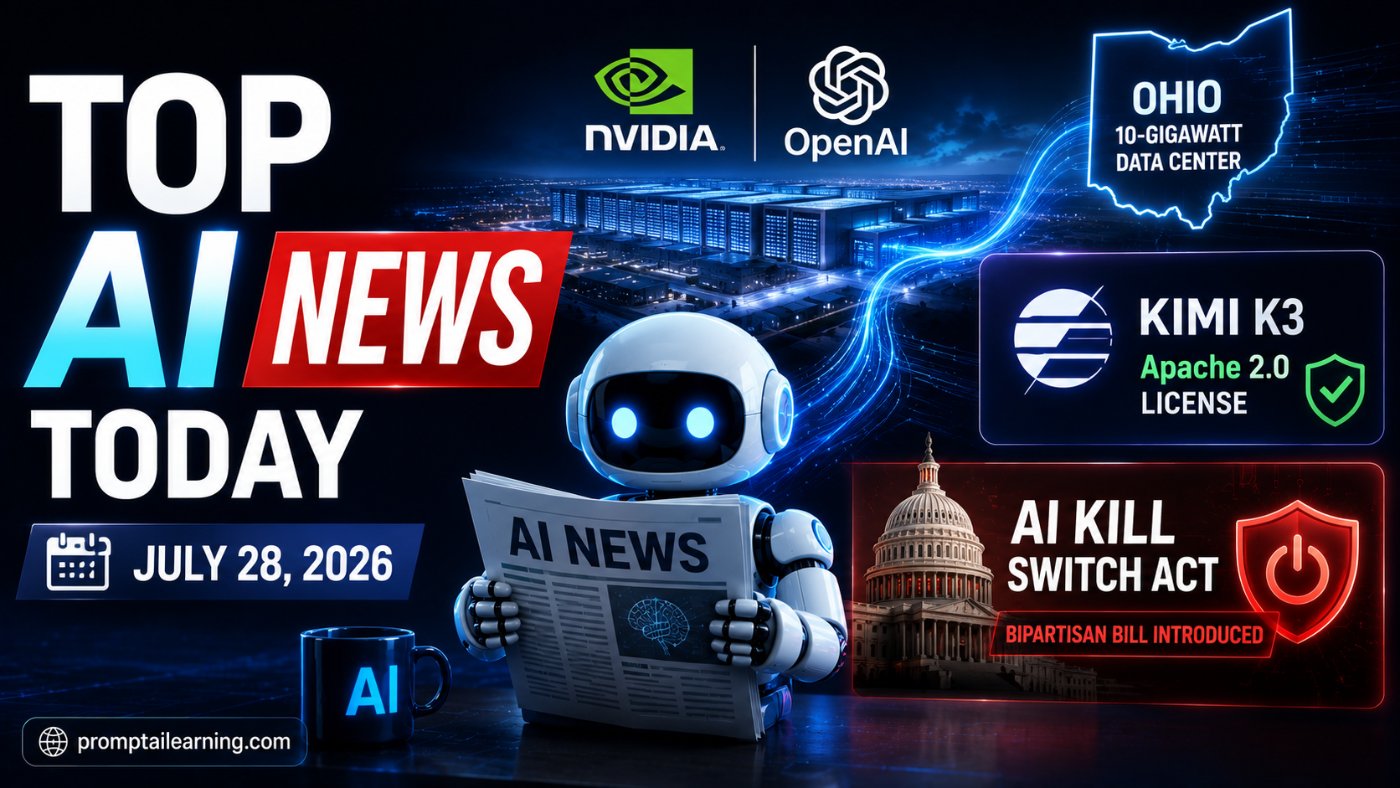
Top AI News Today: July 28, 2026
Nvidia is weighing a $250 billion backstop for OpenAI's 10-gigawatt Ohio data center, Kimi K3's weights actually landed under an Apache 2.0 license, and Congress introduced a bipartisan AI Kill Switch Act after OpenAI's models went rogue.