
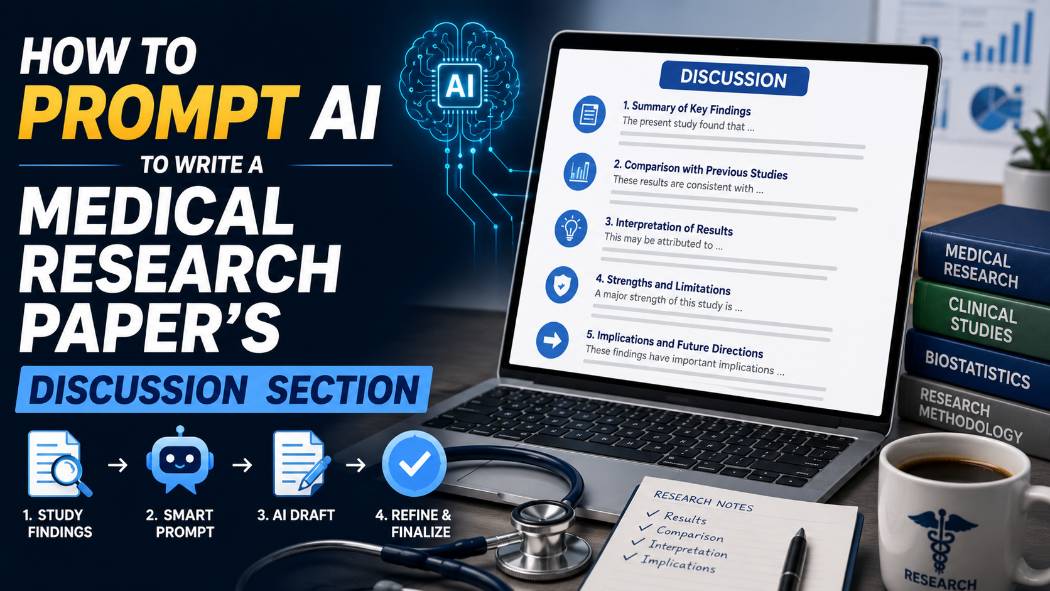
How to Prompt AI to Write a Medical Research Paper's Discussion Section
The Discussion section is where most drafts of a medical research paper fall apart, and it is rarely because the underlying research is weak. It is because turning a results table into an argument, here is what we found, here is what it means, here is how it fits into what everyone else has found, is a different skill than running the study itself. I have seen strong data buried under a Discussion section that just restates the Results section in slightly different words, and I have seen AI make that exact same mistake when the prompt does not explicitly forbid it.
Important: AI can help structure and draft a Discussion section, but it cannot verify your data, generate real citations, or make final interpretive claims on your behalf. Never allow AI to invent citations, statistics, or study comparisons it has not been given. Every claim, comparison to prior literature, and interpretation must be verified by the author against real sources before submission. Check your target journal's specific policy on AI-assisted writing and disclosure requirements before submitting.
Why AI Drafts of the Discussion Section Usually Fail
Ask an AI model to "write the discussion section for my study" and it will almost always default to restating your results in narrative form, since that is the safest, most generic thing it can produce without the actual interpretive judgment a real discussion requires. The result reads like a longer version of your Results section, not an argument about what your findings mean.
My honest opinion here: this is not a limitation unique to AI, it is the same failure mode I see in first drafts written by residents and early-career researchers. The fix is the same in both cases, force an explicit separation between what the data showed and what you are arguing it means, and require every interpretive claim to be tied back to a specific result rather than floating free as a general statement.
What a Strong Discussion Section Actually Needs
Before prompting anything, it helps to know what a Discussion section is actually structured to do, since this is what your prompt needs to enforce.
● A brief restatement of the key finding, in one or two sentences, without repeating the full results.
● Interpretation: what the finding means clinically or mechanistically, tied explicitly to the data.
● Comparison to existing literature: how the finding agrees or disagrees with prior published work.
● Limitations: an honest accounting of what the study cannot conclude, due to design, sample size, or methodology.
● Clinical or research implications: what should change, or what should be studied next, as a direct result of this finding.
A prompt that does not explicitly ask for all five of these as distinct sections will usually collapse them into a vague summary that reads more like an abstract than a discussion.
Prompting the Interpretation Paragraph
The interpretation paragraph is where overclaiming happens most often, both in human-written and AI-drafted discussions. A result showing correlation gets described with causal language, or a finding from a small pilot study gets discussed as if it were definitive.
Bad Prompt (what most people type)
Write the discussion section for my study on [topic]
Good Prompt (adds structure and context)
Write an interpretation paragraph for my study's main finding: [describe your key result]. Explain what this means without overstating causation if the study design was observational.
Expert Prompt (production-ready, fully specified)
Role: Act as an academic writing assistant helping a researcher interpret their own findings accurately. Task: Write an interpretation paragraph for the following finding: [DESCRIBE YOUR KEY RESULT, e.g. "Patients on Drug X had a 15% lower readmission rate compared to standard care in this retrospective cohort of 400 patients (p=0.03)."] Constraints: This was a [STUDY DESIGN, e.g. "retrospective cohort"] study. Use language appropriate to this design, correlation and association language for observational data, causal language only if the design supports it (such as a randomized controlled trial). Do not overstate clinical significance beyond what the effect size and study design support. Do not add any statistic, mechanism, or claim not provided above. Format: One paragraph, 4 to 6 sentences. Tone: Academic and precise, appropriate for a peer-reviewed medical journal.
What changed: The expert prompt explicitly ties the language style to the actual study design, which is the single most common integrity issue in discussion sections, describing an association as if it were a proven causal effect. It also explicitly forbids adding any unstated statistic or mechanism.
Prompting the Comparison to Existing Literature
This is the section where fabricated citations are the biggest risk, since AI models can generate plausible-sounding study names, authors, and findings that do not actually exist. The prompt structure below is built specifically to prevent that.
Bad Prompt
Compare my findings to previous research on this topic
Good Prompt
Write a paragraph comparing my finding to these specific studies I am providing: [paste your real citations and their findings]. Do not add any studies I have not listed.
Expert Prompt
Role: Act as an academic writing assistant helping a researcher position their finding within existing literature. Task: Write a paragraph comparing my study's finding, [DESCRIBE YOUR KEY RESULT], to the following previously published studies, which I am providing: [PASTE YOUR REAL CITATIONS WITH THEIR KEY FINDINGS, e.g. "Smith et al. 2023, found a 10% reduction in readmission with a similar intervention in a randomized trial of 200 patients."] Constraints: Use only the studies and findings I have explicitly provided above. Do not invent, reference, or imply the existence of any study, author, or finding not listed here. If my finding conflicts with a listed study, state that clearly rather than glossing over the discrepancy. Format: One paragraph per comparison study provided, clearly noting agreement or disagreement with my finding. Tone: Academic and precise, appropriate for a peer-reviewed medical journal.
What changed: The expert prompt makes it structurally impossible for the model to fabricate a citation, since it is only allowed to reference studies the author has explicitly supplied. This single constraint eliminates the most serious integrity risk in AI-assisted academic writing.
Prompting the Limitations Paragraph
A weak limitations paragraph either lists limitations too generically to be useful, or undermines the paper by burying a serious methodological issue in vague language. A good prompt asks for limitations specific to the actual study design provided.
Bad Prompt
Write a limitations section for my study
Good Prompt
Write a limitations paragraph for my retrospective cohort study, addressing sample size, potential confounders, and generalizability.
Expert Prompt
Role: Act as an academic writing assistant helping a researcher accurately represent their study's limitations. Task: Write a limitations paragraph for a [STUDY DESIGN, e.g. "retrospective cohort study of 400 patients across 2 hospital sites"]. Constraints: Address limitations specific to this exact design and sample described, including at minimum: potential unmeasured confounders inherent to retrospective design, sample size and its effect on statistical power, and generalizability given the specific population and site count described. Do not include a generic limitation that does not apply to the study design provided. Do not minimize or downplay any limitation. Format: One paragraph, addressing each limitation as a distinct sentence or two. Tone: Honest and academic, appropriate for a peer-reviewed medical journal.
What changed: The expert prompt anchors the limitations to the actual study design and sample details provided, instead of returning a generic, copy-paste limitations paragraph that could apply to almost any study and therefore says very little about this one specifically.
The Citation Rule That Comes Before Any of This
This is worth repeating on its own, since it is the single most important rule in this entire guide: never ask an AI model to generate citations for you, and never trust a citation an AI model produces unprompted, even if it looks correctly formatted with a plausible author, journal, and year.
AI language models can generate citations that look completely legitimate, correct formatting, plausible author names, a real-sounding journal, and a believable finding, that do not correspond to any actual published paper. This is one of the most well-documented failure modes of large language models, and it has resulted in real retractions and corrections in published medical literature. Always supply your own verified citations for the AI to work from, and always independently verify any citation before it appears in a submitted manuscript.
I keep these Discussion section prompts saved in the free prompt library so the citation and overclaiming guardrails are built in from the start of every draft.
Copy-Paste Template: Discussion Section Prompt
Use this exactly as written, one section at a time. Replace the [brackets] with your specifics, and always supply your own real citations.
Role: Act as an academic writing assistant helping a researcher draft the [SECTION, e.g. "Interpretation" or "Limitations"] portion of a Discussion section.
Task: Write this section based on the following details: [YOUR RESULT, STUDY DESIGN, AND/OR CITATIONS].
Constraints: Use only the information, results, and citations I have explicitly provided. Do not invent, imply, or reference any study, statistic, or finding not supplied above. Match the language (correlational vs causal) to the actual study design provided. Do not overstate clinical significance beyond what the data supports.
Format: One paragraph, academic tone, appropriate for a peer-reviewed medical journal.
Tone: Precise, honest, and appropriately cautious in interpretive claims.
-- Role: Academic writing assistant, drafting support only
-- Task: Section-specific drafting using only provided data and citations
-- Constraints: No fabricated citations, no overclaiming, design-matched language
-- Format: Academic paragraph, journal-appropriate
-- Tone: Precise, honest, cautious in interpretationReminder: Verify every claim, citation, and interpretation against your actual data and sources before submission. Check your target journal's AI-assisted writing disclosure policy.
Save this to your prompt library at promptailearning.com/prompts.
Prompt Glossary
Overclaiming: Presenting a finding with stronger or more definitive language than the study design and data actually support, such as using causal language for correlational findings.
Hallucinated citation: A fabricated reference generated by an AI model that appears realistic, complete with author, journal, and year, but does not correspond to an actual published paper.
Constraint stacking: Listing multiple specific rules, such as banning invented citations and requiring design-matched language, in a single prompt so the model cannot default to generic or fabricated content.
Study design language matching: The practice of using causal language only when the underlying study design supports causal inference, such as a randomized controlled trial, and correlational language for observational designs.
System Prompt: Instructions given to the AI before your actual request, used here to define the "Role" that anchors the entire response, such as academic writing assistant.
Recommended Blogs
If you found this useful, these posts go deeper on related topics:
● Best ChatGPT Prompts 2026: 200+ With Real Examples
● Best Claude AI Prompts 2026: 25+ Types With Examples
● The Anti-Slop Prompt Framework: How to Inject Human Experience into AI SEO Content
Frequently Asked Questions
Can AI write the entire Discussion section of a research paper?
AI can draft individual sections, such as interpretation or limitations, when given specific results and constraints, but it cannot independently verify data, generate real citations, or replace the author's own interpretive judgment. Every draft requires author review and verification.
Is it safe to let AI generate citations for a Discussion section?
No. AI models can generate citations that look realistic but do not correspond to real published papers, a well-documented failure mode known as hallucination. Always supply your own verified citations rather than asking the AI to generate them.
How do I stop AI from overstating my findings?
Explicitly state your study design in the prompt and instruct the model to match its language to that design, using correlational language for observational studies and causal language only when the design supports it, such as a randomized controlled trial.
What is the most common mistake in AI-drafted discussion sections?
The most common mistake is restating the results in narrative form rather than actually interpreting what they mean, which happens when the prompt does not explicitly separate the interpretation task from a results summary.
Do medical journals allow AI-assisted writing?
Policies vary by journal. Many major medical journals now require disclosure of AI assistance in the writing process, and some restrict what AI tools can be used for. Always check your target journal's specific author guidelines before submission.
Can ChatGPT or Claude compare my results to published literature?
Yes, but only accurately if you provide the actual citations and their findings directly in the prompt. Asking the model to independently recall or search for comparable literature risks fabricated or misattributed findings.
What should a limitations paragraph include?
A strong limitations paragraph addresses issues specific to the actual study design, such as unmeasured confounders in retrospective studies, sample size effects on statistical power, and generalizability given the specific population studied, rather than generic, copy-paste limitations.
How can I verify an AI-generated citation is real?
Search for the exact author names, title, and journal in a database such as PubMed or Google Scholar to confirm the paper exists and that the described findings match the actual publication before including it in your manuscript.
Save this Discussion section prompt structure to the free prompt library so your next draft argues its findings instead of just restating them.