
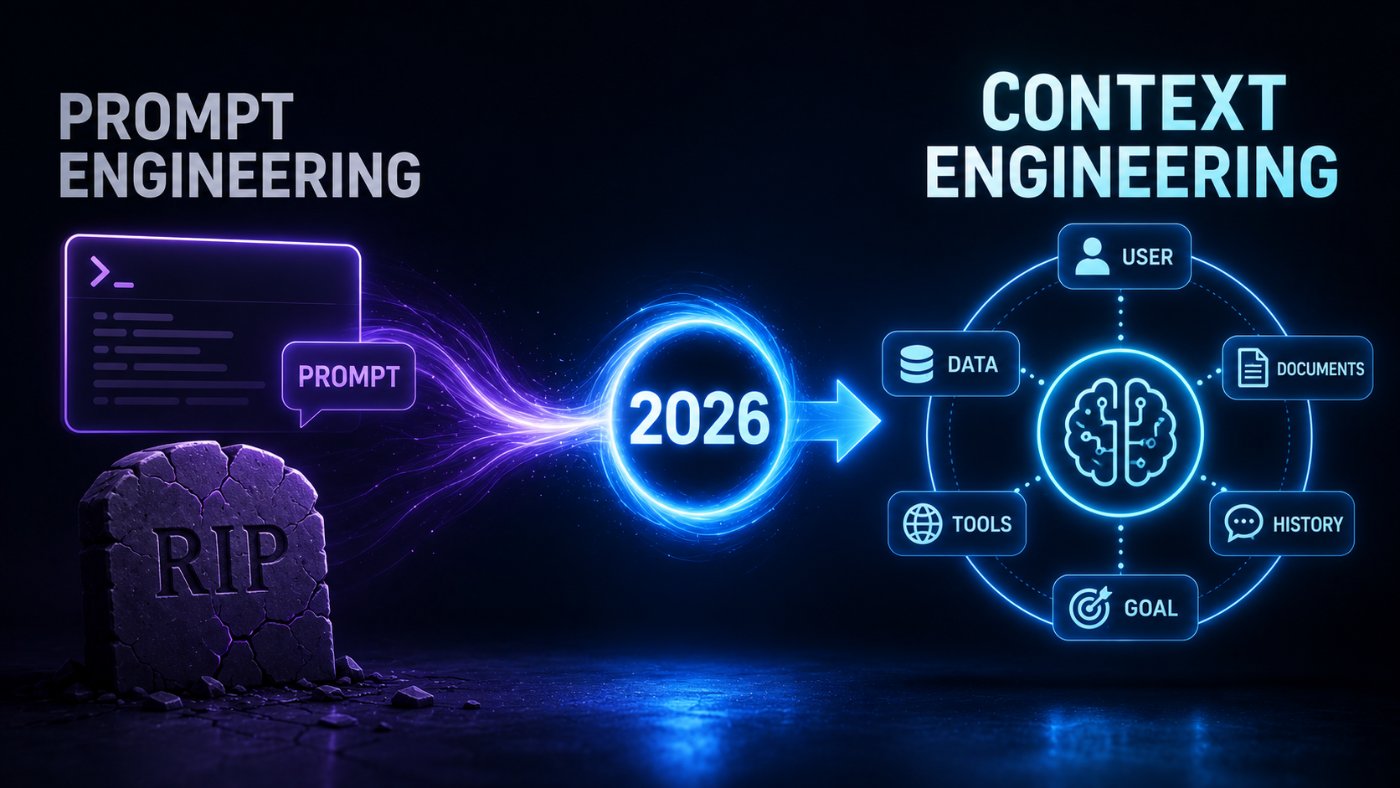
Prompt Engineering Isn't Dead, It Got Absorbed: Inside 2026's Shift to Context Engineering
A 2026 State of Context Management Report found that 82 percent of IT and data leaders now agree prompt engineering alone is no longer sufficient to power AI at scale, and 95 percent of data teams plan to invest in context engineering training this year. The finding captures a shift that has been building since Andrej Karpathy coined the term context engineering in mid-2025: writing a good instruction still matters, but it has stopped being the thing that determines whether an agent succeeds or fails.
The clearest evidence for why arrived in February 2026, when independent researcher Damon McMillan published a peer-reviewed study running 9,649 experiments across 11 models and four context formats. The results didn't just confirm that context matters more than phrasing, they overturned some of the field's working assumptions about which context choices actually move the needle and which ones are folklore.
Why the Instruction Became 5 Percent of the Problem
Karpathy's framing is the one practitioners keep returning to: the model is like a CPU, and its context window is like RAM. Everything the model can reason about in a single response has to fit inside that window before generation starts. Prompt engineering optimizes one layer of what fills that window, the instruction itself. In a 2023 GPT-4 workflow, a single well-written instruction like telling the model to think step by step could meaningfully move output quality. By 2026, with agents running multi-step workflows across dozens of tool calls, retrieving documents mid-task, and maintaining memory across sessions, that instruction has become a small fraction of what the model actually processes.
Practitioners now commonly describe production system prompts running into the thousands of tokens purely as the structural foundation, defining who the model is and what rules it follows, while the bulk of what determines success or failure is the other five layers: retrieved knowledge, tool definitions and results, conversational and session memory, structured state, and guardrails. One widely cited estimate puts the instruction itself at roughly 5 percent of what a working agent actually sees, with the remaining 95 percent being everything engineered around it.
What the 9,649-Experiment Study Actually Found
McMillan's study, titled Structured Context Engineering for File-Native Agentic Systems, used SQL generation as a proxy for realistic programmatic agent work, testing 11 models against four context formats, YAML, Markdown, JSON, and a compact custom format called TOON, on schemas ranging from 10 to 10,000 tables. Several of its findings cut directly against common assumptions in the field.
First, architecture choice turned out to be model-dependent rather than universally beneficial: file-based context retrieval improved accuracy for frontier-tier models including Claude, GPT, and Gemini by 2.7 percentage points, but produced mixed, often negative results for open source models, with an aggregate 7.7 percentage point deficit. Second, and more surprising, the specific format used to structure context had no statistically significant effect on aggregate accuracy at all, a chi-squared test returned p=0.484. Whether a team spent weeks debating YAML versus JSON versus a token-efficient custom format mattered far less than which model was doing the reading.
Third, model capability dwarfed every other variable tested: a 21 percentage point accuracy gap separated frontier and open source tiers, larger than any effect from format or retrieval architecture combined. Fourth, well-structured, domain-partitioned schemas allowed file-native agents to scale up to 10,000 tables while maintaining high navigation accuracy. Fifth, and perhaps most counterintuitive, smaller file size didn't predict faster or more efficient runs. Compact formats like TOON, designed specifically to minimize token count, sometimes caused models to spend more tokens reasoning about an unfamiliar format than they saved in raw size, a pattern researchers have nicknamed the grep tax. Familiarity beat compression.
Verma notes: the format finding is the one worth sitting with. Teams have spent real engineering time picking the 'optimal' context format based on token efficiency alone, and this study says that bet mostly doesn't pay off. What actually predicts success is whether the format is one the model has seen enough of during training to read fluently, which is a very different design question than raw compactness.
The Six-Layer Context Stack
Practitioners have converged on describing context engineering as work across six layers rather than one. System instructions form the foundational layer, defining identity, rules, and format, the same territory prompt engineering used to cover alone. On top of that sits retrieved knowledge, information pulled from documents, databases, or internal wikis at the moment it's needed rather than pre-loaded wholesale. Tool definitions and their results form a third layer, since an agent's understanding of what it can do and what a tool call just returned both consume context space and shape the next decision.
The remaining three layers are where most production failures now originate: conversational and session memory, which determines whether an agent remembers a critical constraint from five sessions ago or silently drops it; structured state, tracking variables like task progress or user preferences outside the raw conversation text; and guardrails, the safety and formatting constraints that need to persist across an entire multi-step run rather than just the opening turn.
Dynamic Context Injection: Stateful, Not Static
The mechanism that operationalizes most of this is what practitioners call Dynamic Context Injection, an automated pipeline that delivers the right slice of information to a model at the exact moment it's needed, rather than pre-loading everything into a static prompt at the start of a conversation. A customer support agent doesn't need a customer's entire account history sitting in context for every message, it needs their current subscription status and relevant ticket history injected the moment a support query starts, and nothing else cluttering the window.
This is explicitly a shift away from treating the model as a stateless tool, something closer to a calculator that takes an input and returns an output, toward treating it as a stateful partner with continuous memory and awareness of an ongoing task, where the operational environment is designed as carefully as the instruction itself. The tradeoff is real: a 2026 review of long multi-session agent deployments found a common failure pattern where an agent correctly remembered a high-level project goal across five sessions but silently lost a specific constraint, in one documented case an API rate limit, that had been established early on and never resurfaced in later context injections.
Where Zero-Shot Still Works, and Where It Doesn't
None of this means zero-shot prompting has become useless. For narrow, self-contained tasks with no external state, answering a general knowledge question, drafting a short piece of text, doing a one-off calculation, a well-written instruction with no injected context still performs perfectly well, and adding unnecessary retrieved context to a simple task can even hurt performance by diluting the model's attention with irrelevant material.
The death of zero-shot is really about scope: as soon as a task depends on external, current, or session-specific information, a customer's account status, a codebase's actual schema, a decision made three turns ago, zero-shot prompting has no mechanism for supplying that information reliably. That is a different failure mode than the model being incapable, and it's why the fix is architectural rather than a matter of writing a cleverer instruction.
Writing Prompts for a Context-Engineered System
The instruction layer hasn't disappeared, it's just now written to work with the other five layers instead of carrying the whole task alone. The most common failure is writing an instruction that assumes information the surrounding system was actually supposed to inject.
Structuring an Instruction for a Context-Fed Agent
Bad Prompt (what most people type)
Answer the customer's question about their account.
Good Prompt (adds structure and context)
Using the customer record and ticket history provided below, answer their question. If the needed information isn't in the provided context, say so rather than guessing.
[injected context goes here]
Expert Prompt (production-ready, fully specified)
You are a support agent. Your context window for this turn contains:
<customer_record>[injected: subscription status, plan tier]</customer_record>
<ticket_history>[injected: last 3 relevant tickets, if any]</ticket_history>
<current_constraints>[injected: any account-level flags or holds]</current_constraints>
Answer the customer's question using only the information above and what they've said in this conversation. If a fact you need isn't present in either source, tell the customer you need to check rather than inferring it. Do not assume information from a prior session unless it appears explicitly in the context blocks above.
Customer message: [USER QUERY]
What changed: the Expert version treats the instruction as a consumer of clearly labeled, separately injected context blocks rather than a self-contained request, and explicitly tells the model not to fill gaps by inference. That mirrors the study's finding that reliability comes from how context is structured and bounded, not from a cleverer sentence.
Copy-Paste Template: Context-Aware Agent Instruction
Use this exactly as written. Replace the [brackets] with your specifics.
You are [ROLE]. The following context has been retrieved or injected for this specific task, current as of this turn:
<retrieved_context>
[injected: relevant documents, records, or data for this task]
</retrieved_context>
<session_state>
[injected: constraints, prior decisions, or progress from earlier in this session that must not be dropped]
</session_state>
Instructions: Use only the context above and the current message to complete [TASK]. If required information is missing from the context, state that explicitly rather than filling the gap with an assumption. Preserve any constraint listed in session_state through your entire response, even if it isn't directly relevant to this specific question.-- Role: what the agent is doing right now, scoped narrowly
-- Retrieved context: what was pulled in for this turn specifically, not the whole knowledge base
-- Session state: constraints from earlier that must persist and not silently drop
Save this to your prompt library at promptailearning.com/prompts.
Prompt Glossary
Context engineering: the systematic design of everything an LLM sees before generating a response, including system instructions, retrieved knowledge, tool results, memory, state, and guardrails, not just the instruction text.
Dynamic Context Injection (DCI): an automated pipeline that delivers relevant, current information to a model at the exact moment it's needed, rather than pre-loading a static prompt with everything upfront.
Grep tax: the token overhead a model incurs when reasoning about an unfamiliar, compact context format, which can offset or exceed the format's raw size savings.
Stateful agent: an AI system designed to retain and act on information across multiple turns or sessions, as opposed to a stateless system that treats each request independently.
Key Takeaways
• 82 percent of IT and data leaders say prompt engineering alone is no longer sufficient to power AI at scale, per a 2026 State of Context Management Report.
• A 9,649-experiment study found context format has no statistically significant effect on aggregate accuracy, while model capability produced a 21-point accuracy gap, by far the largest factor tested.
• File-based context retrieval helped frontier models by 2.7 percentage points but hurt open source models by 7.7 percentage points on aggregate.
• Compact context formats designed to save tokens can backfire, a pattern researchers call the grep tax, when a model is unfamiliar with the format.
• Zero-shot prompting still works fine for narrow, self-contained tasks; it fails specifically when a task depends on external, current, or session-specific information.
• Practitioners describe modern context work across six layers: instructions, retrieved knowledge, tool results, memory, structured state, and guardrails.
Recommended Reading
The Guide to Agentic Prompts
What is a System Prompt?
Coding Prompts for Developers - Production-Ready Templates
AI Knowledge Hub
Frequently Asked Questions
What is context engineering?
Context engineering is the systematic design of everything a large language model sees before generating a response, including system instructions, retrieved knowledge, tool definitions and results, memory, structured state, and guardrails. It expands on prompt engineering, which focuses narrowly on the instruction text itself.
Is prompt engineering dead in 2026?
Not exactly. Writing a clear instruction is still necessary, but a 2026 survey found 82 percent of IT and data leaders believe it's no longer sufficient on its own to power AI at scale. Prompt engineering has effectively been absorbed into the broader discipline of context engineering.
Does the format of context (JSON, YAML, Markdown) affect AI accuracy?
A large 2026 study of 9,649 experiments across 11 models found format had no statistically significant effect on aggregate accuracy. Model capability was a far larger factor, producing a 21 percentage point accuracy gap between frontier and open source models.
What is Dynamic Context Injection?
It's an automated pipeline that delivers relevant, current information to an AI model at the exact moment a task needs it, such as pulling a customer's live subscription status into context right when they submit a support query, rather than relying on a static, pre-written prompt.
When does zero-shot prompting still work well?
Zero-shot prompting remains effective for narrow, self-contained tasks that don't depend on external or session-specific information, such as general knowledge questions or short one-off writing tasks. It becomes unreliable specifically when a task needs current data, account state, or memory from earlier in a session.
Explore More on Prompt AI Learning
STAY UPDATED WITH AI NEWS
Follow the full AI news series and never miss a story:
• Daily AI News - Top 5 Stories Every Morning
• Weekly AI Roundups - 15+ Stories Every Monday
• Monthly AI Recaps - Full Archive by Month
LEARN THE SKILL REPLACING PROMPT ENGINEERING
Writing good instructions is still the starting point. Build on it here:
• Best Claude AI Prompts 2026 - 25+ Types With Examples
• Best ChatGPT Prompts 2026 - 200+ Real Examples
• Best Gemini AI Prompts 2026 - 100+ Templates
COMPARE THE MODELS
Frontier and open source models respond very differently to injected context. These comparison pages help:
• ChatGPT vs Claude - Full 2026 Comparison
• AI Models Directory - Compare 60+ LLMs, Image and Video Models
BUILD SKILLS THAT COMPOUND
Reading AI news is step one. Building skills with these systems is step two:
• Free Prompt Library - 213+ Copy-Paste Templates
• Start Prompt Engineering - Free Course for All Levels
• The Guide to Agentic Prompts
• Coding Prompts for Developers - Production-Ready Templates
USE PROMPTS FOR THE NEWS TOPICS YOU READ ABOUT TODAY
Every story in today's post maps to a real use case. These prompt categories help you act on what you read:
• Business and Strategy Prompts - Analysis, Pitch Decks, OKRs
• Writing and Content Prompts - Emails, Case Studies, White Papers
• AI Knowledge Hub - Technical Blueprints and Career Guides
ABOUT THIS BLOG
promptailearning.com publishes free daily AI news, weekly roundups, monthly recaps, prompt guides, model comparisons, and course content for anyone who wants to get better at using AI. Written by Swatantra Verma. No paywalls, no fluff.
Connect With Us
• Email: contact@promptailearning.com
• Founder: Swatantra Verma on LinkedIn
• Co-Founder: Prateek Patel on LinkedIn
• Company LinkedIn: Prompt AI Learning
Company X: @promptailearnin
Similar Updates

AIUC-1 Explained: Inside the AI Agent Security Certification Backed by Anthropic, IBM, and the Cloud Security Alliance
The Cloud Security Alliance added AIUC-1 to its STAR Registry on June 30, 2026, the same month NIST advanced its own federal AI Agent Standards Initiative. Here's how the world's first AI agent certification actually works.

Composite Abstention Architectures Cut AI Hallucination to Near Zero in Clinical and Legal Testing
New 2026 research combining structural validity gates with instruction-based abstention pushed hallucination rates as low as 2 percent in a clinical pilot, while legal AI hallucinations have now surfaced in 1,174 tracked court cases.

AI Memory Features Are Everywhere in 2026, and Someone Already Figured Out How to Poison Them
ChatGPT, Gemini, Claude, Grok, and Copilot all shipped persistent memory in 2026. Microsoft then found 31 companies quietly hijacking that memory through hidden prompts. Here's the full picture and how to protect what your AI remembers.

1,184 Malicious Skills, One Marketplace: Inside the ClawHavoc Attack and the Coming AI Prompt Store Crackdown
The ClawHavoc campaign poisoned OpenClaw's ClawHub marketplace with 1,184 malicious skills, leading to 247,000 confirmed installs and $2.3 million in stolen crypto. Here's what happened and how the EU AI Act's August 2026 deadline changes the picture.