
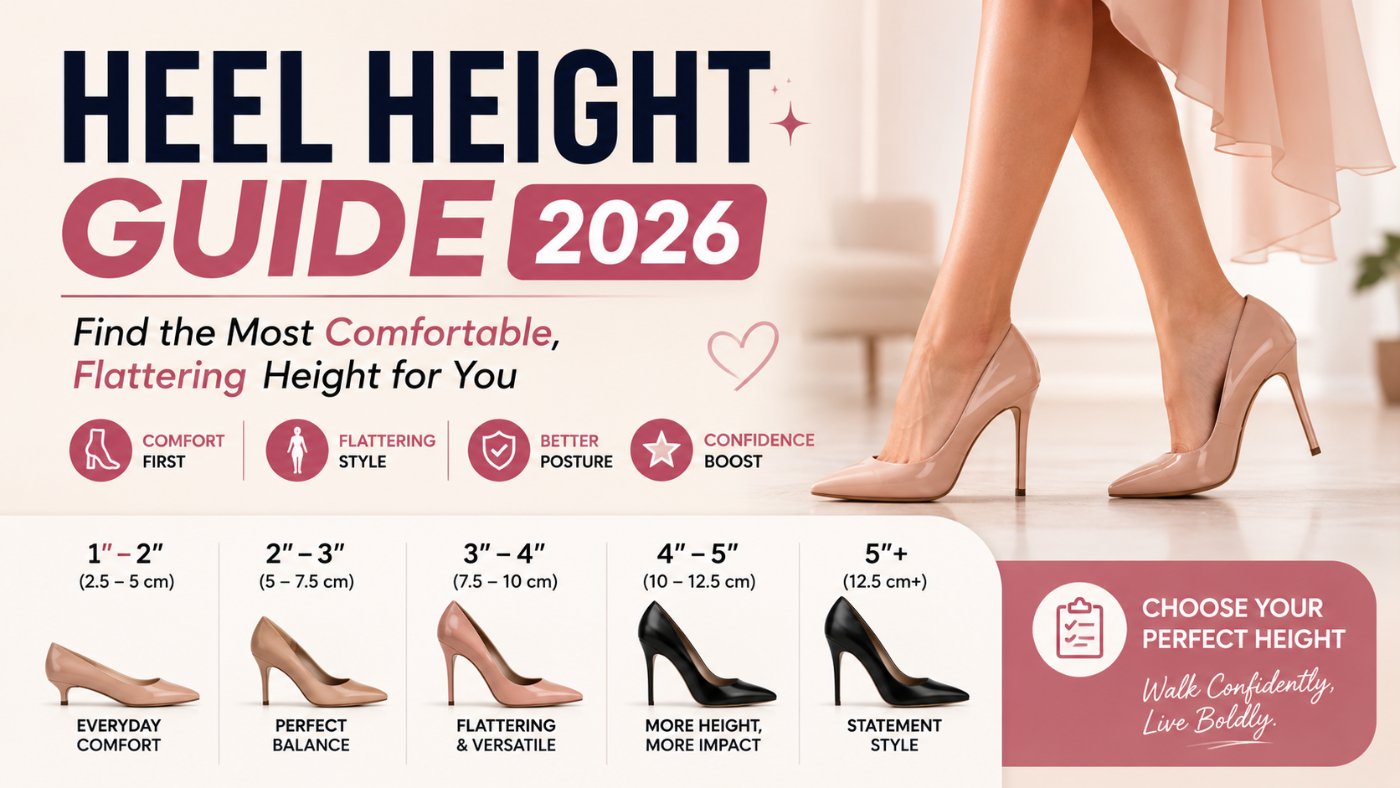
Heel Height Guide 2026: Find the Most Comfortable, Flattering Height for You
I once wore four-inch heels to a wedding and spent the entire reception sitting down, pretending I was "saving my energy for the dance floor." I was not. I was in pain. That night taught me the one rule this entire guide is built on: the most flattering heel height is worthless if you cannot walk in it for more than twenty minutes, and the most comfortable heel is worthless if it does the opposite of what you wanted your outfit to do.
Why Heel Height Is a Balance, Not a Single Answer
Every heel height guide on the internet treats this like a pure styling question. It is not. Heel height affects your posture, your calf muscles, the pressure on the ball of your foot, and how long you can actually stay upright at an event. Any recommendation that only talks about how a heel looks and ignores how it feels after two hours is incomplete advice.
My hot take: comfort should come before flattery in this decision, not after it. A heel that looks slightly less dramatic but lets you walk normally all night will always read better in photos than a heel that forces you to stand stiffly in one spot because you are afraid of falling.
How to Match Heel Height to Your Body Type
Height and proportion both matter here more than most guides admit.
● Petite frames (under 5'4"): Mid heels between 2 and 3 inches add length without throwing off your natural stride, and a pointed toe adds even more visual height.
● Tall frames (5'8" and up): Low heels or flats often look more proportional, since you already have length to work with. A block heel around 1 to 2 inches adds polish without adding unnecessary height.
● Average height (5'4" to 5'7"): The most flexible range. Almost any heel height works, so the decision comes down to comfort and occasion rather than proportion.
● Wider calves or ankles: A block heel or wedge distributes weight more evenly than a thin stiletto, which reduces strain and tends to look more balanced against a fuller lower leg.
● Narrow ankles: Strappy sandals or heels with an ankle strap in any height create definition and tend to photograph better than a plain pump.
If your priority is standing for more than an hour, weight distribution matters as much as height. A wider heel base at 3 inches is often more comfortable than a thin stiletto at 2 inches.
Flats and Low Heels (Under 1.5 Inches): Who They Work For
Flats and low heels are the most forgiving option for almost every body type, and they are the right call for anyone on their feet for most of the day. They work particularly well for tall frames, since they keep proportions balanced without adding unnecessary height.
For petite frames, flats are not off-limits, they just need a pointed toe or an ankle strap to create the illusion of a longer leg line. Ballet flats and loafers with a low block heel are the most versatile choices for daily wear, travel, and work environments where you are walking often.
Kitten and Mid Heels (1.5 to 3 Inches): Who They Work For
This range is the sweet spot for most people, and it is the height I recommend by default when someone asks me what to wear to a wedding, an interview, or a dinner they are not sure about. It adds enough height to elongate the leg without the instability of a taller stiletto.
Petite frames benefit the most from this range, since 2 to 3 inches adds visible length without forcing an awkward gait. Average height frames can wear kitten and mid heels for almost any occasion, and wider calves tend to look more proportional in a mid-height block heel than in a very thin, very tall heel.
High Heels and Stilettos (3 Inches and Up): Who They Work For
High heels and stilettos create the most dramatic leg line and are the right choice for formal events, evening wear, and occasions where you are not walking or standing for extended stretches. They work well on most body types, but the calf and ankle carry more visual weight here than at any other height, so fit matters more.
My contrarian take: taller frames are often told to avoid very high heels because the extra height is unnecessary. I disagree, if the goal is a formal, elongated silhouette for a single evening, a tall frame in a well-fitted stiletto looks intentional and confident, not excessive. The advice to "stay low" only makes sense for someone who is on their feet all night, not someone sitting through a dinner and a few photos.
Using AI to Preview a Heel Height Before You Buy
This is the part most shoe guides skip entirely, and it is the reason I started writing about this topic. You do not have to guess how a heel height will look with your outfit or your proportions anymore. ChatGPT and Gemini can both generate a realistic preview of footwear on an uploaded photo, which means you can compare flats, mid heels, and stilettos side by side before you ever order a pair.
The catch is that most people type a lazy, one-line prompt and get a generic result that does not reflect their actual proportions or outfit. The fix is the same three-tier structure I use for every prompt on this site: start vague, add context, then add full production-level detail.
Previewing a Heel Height on an Uploaded Photo
Bad Prompt (what most people type)
Show me in heels
Good Prompt (adds structure and context)
Using the photo I uploaded, show me wearing a 3 inch block heel in nude color. Keep my outfit and proportions the same, just change the shoes.
Expert Prompt (production-ready, fully specified)
Role: Act as a professional stylist and photo editor. Task: Using the uploaded photo, generate a realistic preview of me wearing a 3 inch nude block heel with a closed pointed toe. Constraints: Keep my exact body proportions, height, and pose unchanged. Do not alter my outfit unless requested. Keep lighting and background consistent with the original photo. Show the result from a full-body front angle and a close-up of the shoe. Format: Two images, labeled "Full Body" and "Shoe Detail." Tone: Realistic, editorial-quality result, not an illustration or cartoon style.
What changed: The bad prompt gives the model nothing to work with beyond "heels," so it invents a generic height and style. The good prompt anchors the edit to your actual photo and names a specific height and color. The expert prompt locks the model into preserving your real proportions, specifies exact shoe details, and requests multiple angles, which is the difference between a preview you can trust and one you cannot.
Choosing a Heel Height Based on Occasion via AI
Bad Prompt
What heels should I wear to a wedding?
Good Prompt
Based on my height and this outfit in the photo, suggest a heel height for a wedding and explain why.
Expert Prompt
Role: Act as a professional stylist with expertise in footwear and body proportion. Task: Analyze my height and outfit from the uploaded photo and recommend one flat or low heel, one mid heel, and one high heel option suited for a wedding guest. Constraints: Base recommendations on proportion, comfort for several hours of standing, and how each option pairs with the outfit shown. Format: A short table with columns for Height, Style Name, and Reason. Tone: Direct and specific, no generic fashion-blog language.
What changed: The expert version forces the model to weigh comfort and proportion together instead of returning the same generic "wear a heel that makes you feel confident" answer.
I use the free prompt library to keep templates like this saved so I am not rewriting them from scratch every time a friend asks for a shoe preview.
Copy-Paste Template: Heel Height Preview
Use this exactly as written. Replace the [brackets] with your specifics.
Role: Act as a professional stylist and photo editor with expertise in footwear and body proportion. Task: Using the uploaded photo, generate a realistic preview of me wearing [HEIGHT: flat / kitten / mid / high] heels in [STYLE/COLOR DETAILS, e.g. "black pointed-toe pump, 2.5 inch heel"]. Constraints: Keep my exact body proportions, height, and pose unchanged. Keep the original background and lighting. Do not alter my outfit unless requested. Format: Show a full-body front angle and a close-up shoe detail, labeled clearly. Tone: Realistic, editorial-quality photo, not an illustration. -- Role: Professional stylist and photo editor -- Task: Heel height preview with proportion accuracy -- Format: Full body view and shoe detail view, labeled -- Constraints: Preserve real body proportions, lighting, and background -- Tone: Photorealistic, not stylized
Save this to your prompt library at promptailearning.com/prompts.
Prompt Glossary
Zero-shot prompting: Asking the AI to complete a task without giving it any examples. The "Bad Prompt" examples above are zero-shot, which is why they return generic results.
Few-shot prompting: Giving the AI 2-5 examples before your actual request. Useful if you want consistent styling across multiple heel height previews.
Image-to-image editing: A technique where the AI edits an uploaded photo rather than generating a new image from scratch. This is what makes footwear previews possible on ChatGPT and Gemini.
System Prompt: Instructions given to the AI before your actual request, used here to define the "Role" that anchors the entire response (stylist, photo editor).
Constraint stacking: Listing multiple specific rules (preserve body proportions, preserve lighting, preserve background) in a single prompt so the model does not drift from the original photo.
Recommended Blogs
If you found this useful, these posts go deeper on related topics:
● Best ChatGPT Prompts 2026: 200+ With Real Examples
● Best Gemini AI Prompts 2026: 100+ Templates With Examples
● What is Prompt Engineering?
Frequently Asked Questions
What heel height is most comfortable for all-day wear?
Flats and heels under 1.5 inches are the most comfortable for all-day wear, since they keep pressure off the ball of the foot and do not require adjusting your posture or stride.
What heel height is best for short height?
Mid heels between 2 and 3 inches with a pointed toe add the most visible length for petite frames without making walking difficult.
Are block heels more comfortable than stilettos?
Yes, generally. Block heels distribute body weight across a wider surface, which reduces pressure on any single point of the foot compared to a thin stiletto heel.
What heel height is appropriate for a job interview?
A mid heel between 1.5 and 3 inches, in a closed-toe pump or block heel style, is generally considered appropriate and professional for most interview settings.
What is the most flattering heel height for wide calves?
A block heel or wedge, rather than a thin stiletto, tends to look more proportional against fuller calves because it balances visual weight rather than emphasizing a stark contrast.
Can ChatGPT show me what a heel height would look like on me?
Yes, if you upload a clear full-body photo and use a detailed prompt that specifies the height, style, and color, and instructs the model to preserve your actual body proportions and lighting, as shown in the Expert Prompt examples above.
Do tall women need to avoid high heels?
No. Taller frames can wear high heels for formal events without looking disproportionate, especially for occasions involving limited walking, such as a seated dinner or a photographed event.
What heel height works best for wedding guests?
A mid heel between 2 and 3 inches is generally the safest choice for wedding guests, since it balances a dressy look with enough stability for standing through a ceremony, photos, and dancing.
Save your favorite prompt from this post to the free prompt library so you can preview your next pair of heels before you ever check out.