
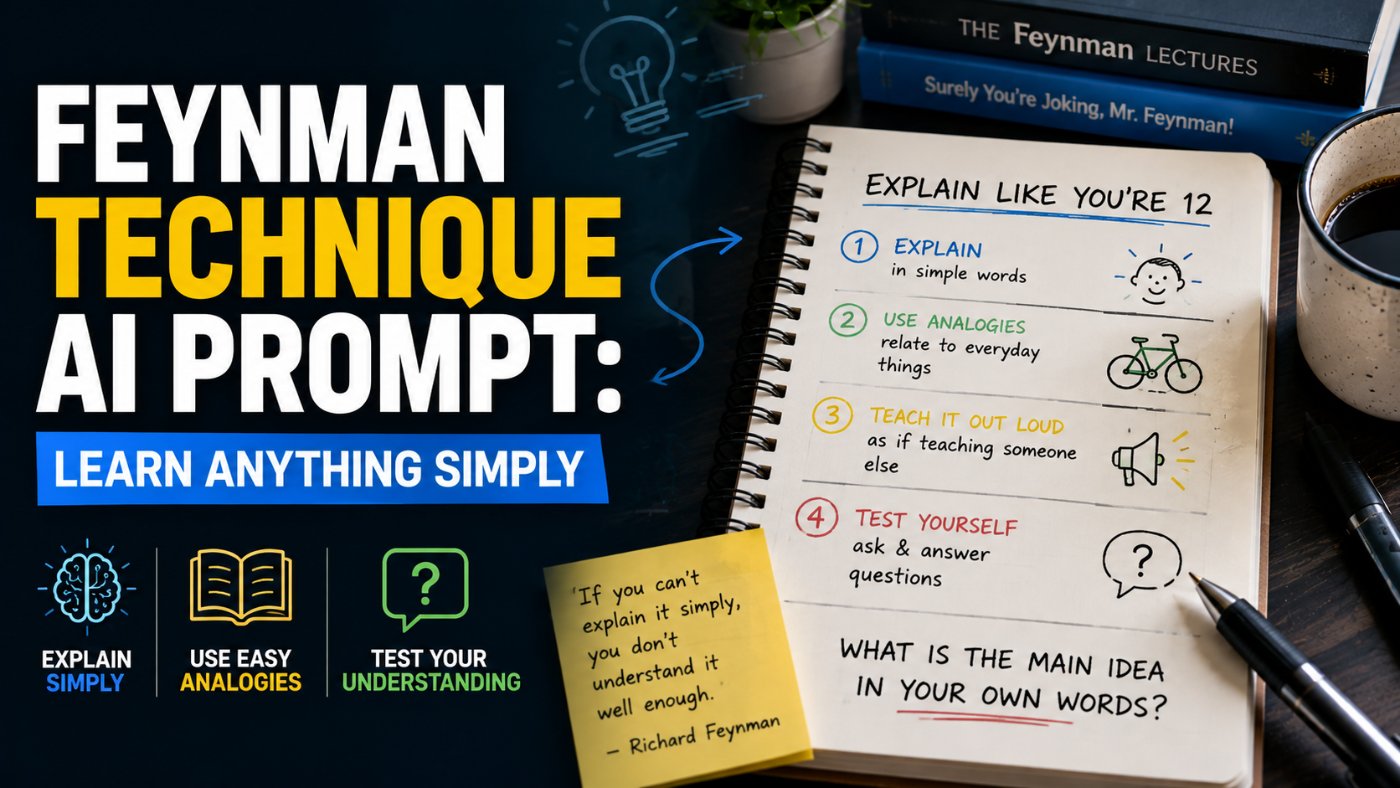
Feynman Technique AI Prompt: Learn Anything Simply
I have read the Wikipedia page on quantum computing at least four times over the years and forgotten it just as many times. What finally made it stick was not a better article, it was asking an AI to explain it to me like I was 12, with an analogy I could actually picture, and then having to answer a question about it. That last part, the question, is the piece almost everyone skips, and it is the piece that actually makes the technique work.
What The Feynman Technique Actually Is
The Feynman technique is a learning method named after physicist Richard Feynman, built on a simple idea: if you cannot explain something in plain language, you do not actually understand it yet, no matter how well you can recite the technical definition. The traditional version has you explain a concept out loud in simple terms, in your own words, and use that explanation to find the gaps in your own knowledge.
Flipping it around with AI works just as well for the intake side of learning: instead of you explaining a concept to find your own gaps, you ask the AI to explain it to you in the simplest possible terms first, which strips away the jargon that usually makes a new topic feel harder than it actually is. The test question at the end is what closes the loop and turns a passive explanation into active learning.
The Core Prompt: Explain It Like I'm 12
Bad Prompt (what most people type)
Explain quantum computing to me.
Good Prompt (adds structure and context)
Explain quantum computing to me in simple terms, like I'm new to the topic.
Expert Prompt (production-ready, fully specified)
Act as a world-class teacher.
Task: Explain [COMPLEX TOPIC, e.g. Quantum Computing / Blockchain] to me as if I am a 12-year-old.
Format: Use simple analogies drawn from everyday life, avoid jargon entirely or define any technical term the moment you use it. Keep the explanation to a few short paragraphs, not an exhaustive lecture.
Constraints: Do not use the actual technical term to explain itself (for example, do not explain a qubit by saying it is 'a quantum bit'). If a perfect analogy breaks down at some point, briefly say so rather than letting the analogy imply something inaccurate.
Tone: Warm, patient, genuinely simple, not simplified-sounding while secretly still complex.
At the end, ask me one question that tests whether I actually understood the core idea, not just whether I can repeat a term back to you.
Topic: [YOUR TOPIC HERE]
What changed: The bad prompt returns a technically accurate but jargon-heavy explanation aimed at someone who already has background knowledge. The good prompt asks for simplicity but leaves the model free to still lean on technical terms. The expert prompt forbids circular definitions, requires flagging where an analogy breaks down, and adds the test question, which is the step that actually reveals whether the explanation worked or just sounded like it worked.
Why This Prompt Works: Breaking Down Each Instruction
● "As if I am a 12-year-old" forces genuine simplification, not just a shorter version of the same jargon-heavy explanation. A 12-year-old framing rules out unexplained technical vocabulary almost automatically.
● "Use simple analogies" is doing the real cognitive work. A good analogy maps an unfamiliar concept onto something you already understand deeply, which is why it sticks better than a definition.
● The closing test question is the step most people skip when prompting AI for explanations, and it is the single most important part. Answering it, even briefly, forces retrieval, not just recognition.
● The constraint against circular definitions (explaining a qubit as "a quantum bit") catches a very common AI habit of technically answering the prompt while not actually simplifying anything.
Example: Quantum Computing Explained Simply
Here is roughly what this prompt returns when you use it, so you know what a good result looks like before you run it yourself.
A regular computer is like a light switch, it's either on or off, a 1 or a 0. A quantum computer is more like a spinning coin, while it's still spinning in the air, it's kind of both heads and tails at once. That in-between state lets a quantum computer explore many possibilities at the same time instead of checking them one at a time like a regular computer would.
Question: If a regular computer checks answers one at a time like flipping through pages in a book, and a quantum computer can check many at once like the spinning coin, why might that make quantum computers much faster at certain kinds of problems, like finding one specific page in a massive book?
Example: Blockchain Explained Simply
Imagine a notebook that everyone in your class has an identical copy of. Whenever someone makes a trade, like swapping a sticker for a snack, that trade gets written down in every single copy of the notebook at the same time. Since everyone has the same copy, no one can secretly erase a trade or write down a fake one, because it would not match everyone else's notebook. That shared, everyone-has-a-copy notebook is basically what a blockchain is.
Question: If someone tried to cheat by changing just their own copy of the notebook to say they have more stickers than they really traded for, what would happen when their notebook is compared to everyone else's?
Variation: Going One Level Deeper After The Basics Click
Once you have answered the first test question correctly, use this follow-up prompt to add one layer of real complexity back in, without jumping straight to the full technical version.
Expert Prompt
Act as a world-class teacher continuing my lesson.
Task: I understood your simple explanation of [TOPIC] and answered correctly that [PASTE YOUR ANSWER TO THE PREVIOUS QUESTION]. Now explain the next layer of detail, still using plain language and analogies, but introduce one real technical term and define it clearly the moment you use it.
Format: A short explanation building directly on the previous analogy, not a completely new one. End with another test question slightly harder than the last one.
Constraints: Do not introduce more than one or two new technical terms in this step. Keep building on the same analogy from before rather than switching to a new one.
Tone: Same warm, patient tone as before, treat this as the next lesson in the same sequence.
Topic: [YOUR TOPIC HERE]
My previous answer: [YOUR ANSWER HERE]
Variation: Testing Yourself Instead Of Being Tested
Flip the technique around to its traditional form: you explain the concept in your own words first, and the AI finds the gaps, which is a stronger test of whether you genuinely understand it or just followed along with a good explanation.
Expert Prompt
Act as a world-class teacher checking my understanding using the Feynman technique.
Task: I am going to explain [TOPIC] to you in my own words, as if teaching it to someone with no background. After I explain it, identify anything that was vague, incorrect, or leaned on a term I did not actually define, and ask me one question that addresses the biggest gap.
Format: Wait for my full explanation. Then give specific, direct feedback on what was strong and what was unclear, followed by one targeted question.
Constraints: Do not just correct me directly, ask a question that leads me to correct it myself if possible.
Tone: Constructively critical, specific about exactly where the explanation broke down.
Topic: [YOUR TOPIC HERE]
My explanation: [WRITE YOUR OWN EXPLANATION IN YOUR OWN WORDS]
Common Mistakes That Weaken This Technique
Watch For These
Skipping the test question. Reading a great analogy and immediately closing the tab gives you the same false sense of understanding as reading a textbook explanation. Always answer the question, even briefly, in your own words.
Picking a topic that is too broad. "Explain physics to me" produces a shallow, unfocused answer. "Explain why the sky is blue" or "explain how a battery stores energy" produces something you can actually hold onto.
Treating the analogy as literally true. A good analogy simplifies by leaving things out. If you notice the expert prompt flagged a place where the analogy breaks down, pay attention to that note rather than over-extending the comparison in your own head later.
Copy-Paste Template: Feynman Technique Prompt
Use this exactly as written. Replace the [brackets] with your specifics.
Act as a world-class teacher.
Task: Explain [COMPLEX TOPIC] to me as if I am a 12-year-old. Use simple analogies and ask me a question at the end to test my understanding.
Format: A few short paragraphs, plain language, one clear analogy from everyday life, any technical term defined the moment it's used.
Constraints: Do not use the technical term to define itself. Flag briefly if the analogy breaks down anywhere. End with one test question that checks real understanding, not just recall of a term.
Tone: Warm, patient, genuinely simple.
Topic: [YOUR TOPIC HERE]
-- Role: World-class teacher explaining a complex topic simply
-- Task: Simplify with analogies, then test understanding
-- Format: Short explanation, one core analogy, closing question
-- Constraints: No circular jargon, analogy limits flagged, real test question
-- Tone: Warm, patient, genuinely simple
Save this to your prompt library at promptailearning.com/prompts and reuse it for every topic you want to actually understand, not just skim.
Prompt Glossary
Feynman technique: A learning method built on explaining a concept in simple terms to reveal and close gaps in understanding, named after physicist Richard Feynman.
Analogy mapping: Connecting an unfamiliar concept to something the learner already understands well, making the new idea easier to grasp and retain.
Retrieval practice: Actively recalling or applying information from memory, such as answering a test question, which builds stronger understanding than passively reading an explanation.
Circular definition: Explaining a term using the term itself or an equally unfamiliar synonym, which technically answers the question without actually simplifying anything.
Scaffolded learning: Building understanding in layers, starting simple and adding complexity gradually, rather than presenting the full technical picture all at once.
Recommended Blogs
If you found this useful, these posts go deeper on related topics:
● Best ChatGPT Prompts 2026: 200+ With Real Examples
● Best Claude AI Prompts 2026: 25+ Types With Examples
● Free Prompt Library
Frequently Asked Questions
What is the Feynman technique?
The Feynman technique is a learning method based on the idea that if you cannot explain a concept in simple terms, you do not fully understand it. It traditionally involves explaining a concept in your own words to reveal gaps in your knowledge, and works equally well in reverse, having AI explain a concept simply to you first.
Why does explaining something like I'm 12 years old work so well?
Framing an explanation for a 12-year-old forces genuine simplification and rules out unexplained jargon almost automatically, since technical vocabulary usually cannot survive that framing without being defined in plain terms first.
Do I actually need to answer the test question at the end?
Yes, this is the step most people skip and the one that matters most. Reading a clear explanation creates a feeling of understanding that does not necessarily mean you can recall or apply the concept later. Answering the question, even briefly, forces active retrieval rather than passive recognition.
Can this prompt work for any topic, not just science and tech?
Yes, the Feynman technique prompt works for any complex topic, from quantum computing to economic policy to historical events, since the underlying method is about simplification and analogy, not specific to any one subject.
What if the AI's analogy doesn't quite make sense to me?
Ask it directly to try a different analogy, or to explain the specific part that didn't land using an even simpler comparison. Not every analogy works for every learner, and iterating on it is part of the process.
How do I go deeper into a topic after the simple explanation clicks?
Use a follow-up prompt that references your correct answer to the first test question and asks the AI to build on the same analogy while introducing one or two real technical terms, rather than jumping straight to a full technical explanation.
Is it better to have AI explain a concept to me, or to explain it to AI myself?
Both are useful and test different things. Having AI explain a concept to you first helps you build an initial simple understanding. Explaining a concept back to AI in your own words afterward, and having it find your gaps, is a stronger test of whether that understanding actually holds up.
Which AI models work best for this kind of explanation?
Most current general-purpose AI chatbots, including Claude, ChatGPT, and Gemini, handle this prompt well, since it relies more on the prompt's clear instructions than a specialized model capability.
References
● Anthropic Claude Documentation - Official model and API documentation
● Prompt AI Learning Prompt Library - 400+ free templates
Follow along on promptailearning.com for weekly guides on prompting, AI tools, and getting more out of every model.
EXPLORE MORE ON PROMPTAILEARNING.COM
STAY UPDATED WITH AI NEWS
Follow the full AI news series and never miss a story:
● Daily AI News - Top 5 Stories Every Morning
● Weekly AI Roundups - 15+ Stories Every Monday
● Monthly AI Recaps - Full Archive by Month
LEARN THE MODELS MAKING THESE HEADLINES
The models in today's news are only useful if you know how to prompt them well. Start here:
● Best Claude AI Prompts 2026 - 25+ Types With Examples
● Best ChatGPT Prompts 2026 - 200+ Real Examples
● Best Gemini AI Prompts 2026 - 100+ Templates
COMPARE THE MODELS
Not sure which model to use? These comparison pages give you the full picture:
● ChatGPT vs Claude - Full 2026 Comparison
● AI Models Directory - Compare 60+ LLMs, Image and Video Models
BUILD SKILLS THAT COMPOUND
Reading AI news is step one. Building skills with these models is step two:
● Free Prompt Library - 213+ Copy-Paste Templates
● Start Prompt Engineering - Free Course for All Levels
● The Guide to Agentic Prompts
● Coding Prompts for Developers - Production-Ready Templates
USE PROMPTS FOR THE NEWS TOPICS YOU READ ABOUT TODAY
Every story in today's post maps to a real use case. These prompt categories help you act on what you read:
● Business and Strategy Prompts - Analysis, Pitch Decks, OKRs
● Writing and Content Prompts - Emails, Case Studies, White Papers
● AI Knowledge Hub - Technical Blueprints and Career Guides
ABOUT THIS BLOG
promptailearning.com publishes free daily AI news, weekly roundups, monthly recaps, prompt guides, model comparisons, and course content for anyone who wants to get better at using AI. Written by Swatantra Verma. No paywalls, no fluff.
Connect With Us
● Email: contact@promptailearning.com
● Founder: Swatantra Verma on LinkedIn
● Co-Founder: Prateek Patel on LinkedIn
● Company LinkedIn: Prompt AI Learning
Company X: @promptailearnin