
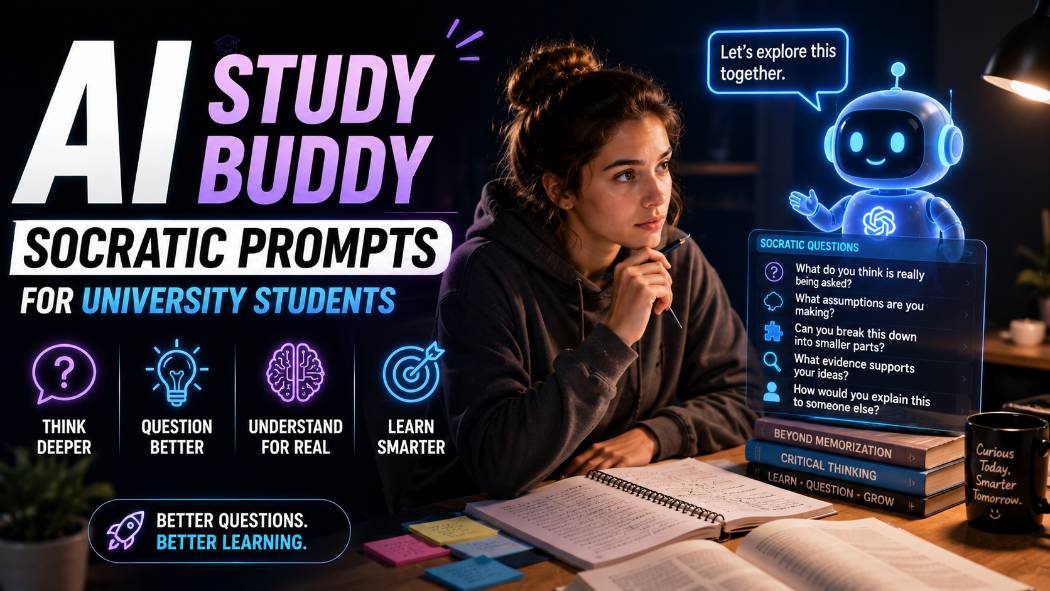
AI Study Buddy: Socratic Prompts For University Students
Every student I know has typed "explain this to me" into an AI chatbot at some point, gotten a clean paragraph back, nodded along, and then blanked on the exact same concept during the exam. Reading an explanation and understanding a concept are two different things, and AI-generated answers are dangerously good at making the first one feel like the second. The fix is not avoiding AI, it is prompting it to stop giving you answers and start asking you questions instead.
Why Getting Answers From AI Doesn't Build Understanding
Here is my honest take: asking AI to explain a concept to you is one of the least effective ways to study with it, even though it is by far the most common way students use it. A clear explanation creates a feeling of understanding that does not necessarily transfer to being able to solve a new problem or answer an exam question under pressure.
The actual skill exams test is retrieval and application, pulling a concept out of memory and using it on a problem you have not seen before. Reading an AI's explanation trains recognition, not retrieval. Those feel similar while you are studying and perform very differently on test day.
What The Socratic Method Actually Does Differently
The Socratic method, named for the teaching style attributed to the philosopher Socrates, works by asking a series of guiding questions that lead you to construct the answer yourself, rather than being told the answer directly. Applied to AI, this means forcing the model to respond to your questions with more questions, not explanations, until you have done the actual reasoning work.
This is uncomfortable at first. It is supposed to be. The friction of having to work through a question yourself, with guidance but not the answer, is exactly what builds the kind of understanding that survives contact with an exam.
Prompt 1: The Socratic Tutor Setup
This is the foundational prompt, it sets the rules for the entire study session before you ask a single content question.
Bad Prompt (what most people type)
Explain the Krebs cycle to me.
Good Prompt (adds structure and context)
Act as a tutor and ask me questions to help me understand the Krebs cycle instead of just explaining it.
Expert Prompt (production-ready, fully specified)
Act as a Socratic tutor helping me learn [TOPIC: e.g. the Krebs cycle] for my [COURSE, e.g. undergraduate biochemistry] exam.
Task: Do not explain the concept to me directly. Instead, ask me one guiding question at a time that leads me toward understanding it myself. Wait for my answer before asking the next question.
Format: One question at a time, short and specific. After I answer, briefly tell me if I am on the right track or gently redirect me, then ask the next question. Only give a direct explanation if I ask for one explicitly or get stuck after two attempts.
Constraints: Do not write out the full concept explanation unprompted, even if I seem close to the answer. Let me get there myself.
Tone: Patient, encouraging, genuinely Socratic, not condescending.
Topic to study: [YOUR TOPIC HERE]
What changed: The bad prompt gets you a clean, forgettable explanation. The good prompt asks for questions but leaves no constraint against the model reverting to explaining anyway, which most models will do by default. The expert prompt explicitly forbids unprompted explanation and sets a clear escape hatch (asking directly or getting stuck twice), which keeps the session genuinely Socratic instead of collapsing back into a lecture after the first exchange.
Prompt 2: Concept Check Before You Move On
Use this after you have studied a concept on your own or in a lecture, to test whether you actually understood it before moving to the next topic.
Expert Prompt
Act as a Socratic tutor checking my understanding of [CONCEPT] before I move on to the next topic.
Task: Ask me 3 to 4 questions of increasing difficulty that test whether I actually understand this concept, not just whether I can repeat a definition. Start with a basic check, then push toward application and edge cases.
Format: One question at a time. After each answer, tell me clearly whether my understanding is solid, partial, or off track, with specific reasoning, then ask the next question or address the gap before continuing.
Constraints: Do not move to the next question until you have addressed any gap in my previous answer. Do not just say 'correct' with no explanation of why.
Tone: Direct, honest about gaps, not falsely encouraging if my understanding is actually weak.
Concept: [YOUR CONCEPT HERE]
The instruction to be honest about gaps matters more than it looks. A tutor that tells you everything is 'great!' regardless of your actual answer is worse than no tutor at all, because it gives you false confidence walking into an exam.
Prompt 3: Essay Prep Without AI Writing Your Essay
This is the prompt that actually solves the plagiarism problem directly, by using AI to strengthen your argument and structure without ever generating your sentences.
Expert Prompt
Act as a Socratic writing coach helping me develop my own essay argument.
Task: I will share my thesis and current argument for an essay on [TOPIC]. Ask me questions that stress-test my argument, point out where my reasoning has gaps or unsupported claims, and push me to clarify my own thinking. Do not write any sentences, paragraphs, or thesis statements for me.
Format: Ask one question at a time about my argument's structure, evidence, or logic. After I respond, tell me specifically where my reasoning is strong or weak, then ask the next question.
Constraints: Never generate essay text, even a single sentence, even if I ask you to as a placeholder. If I ask you to write something, redirect me to explain what I am trying to say myself instead.
Tone: Rigorous, like a demanding but fair thesis advisor.
My thesis and current argument: [PASTE YOUR OWN DRAFT THESIS AND KEY POINTS HERE]
The hard constraint against generating any text, even a placeholder sentence, is deliberate. Once a model writes one sentence for you, it is very easy to lean on it for the next one, and the entire point of this prompt collapses.
Prompt 4: Exam-Style Question Drilling
Use this in the final stretch before an exam, to practice retrieval under conditions that actually resemble test pressure.
Expert Prompt
Act as an exam question generator and Socratic reviewer for [COURSE/TOPIC].
Task: Give me one exam-style question at a time, matching the difficulty and format of [EXAM TYPE, e.g. multiple choice / short answer / essay question]. After I answer, do not just mark it right or wrong, ask me a follow-up question that probes whether I understood why my answer was correct or where my reasoning went wrong.
Format: One question at a time, exam-realistic in length and difficulty. After my answer, a brief assessment plus one probing follow-up question before moving to the next question.
Constraints: Match the actual format and difficulty level I specify, do not simplify questions to make them easier than the real exam.
Tone: Exam-realistic, direct, no unnecessary reassurance.
Course/topic: [YOUR TOPIC HERE]
Exam type: [MULTIPLE CHOICE / SHORT ANSWER / ESSAY / PROBLEM SET]
Prompt 5: Explaining It Back (The Feynman Check)
Named after physicist Richard Feynman's approach to learning, this technique tests understanding by having you explain a concept in simple terms, then using AI to find the gaps in your explanation.
Expert Prompt
Act as a Socratic tutor using the Feynman technique to test my understanding of [CONCEPT].
Task: I am going to explain this concept to you in my own words, as if teaching it to someone with no background in the subject. After I explain it, identify any part of my explanation that was vague, incorrect, or relied on jargon I did not actually define, and ask me a question that forces me to clarify or correct that specific part.
Format: Wait for my full explanation first. Then respond with specific gaps you noticed, followed by one question addressing the most significant gap.
Constraints: Do not correct my explanation for me, ask a question that leads me to correct it myself. Only give the correct information directly if I am unable to get there after two attempts.
Tone: Constructively critical, precise about exactly where the explanation broke down.
Concept I am explaining: [YOUR CONCEPT HERE]
My explanation: [WRITE YOUR OWN EXPLANATION IN YOUR OWN WORDS HERE]
Where The Academic Integrity Line Actually Sits
A Note On Academic Integrity
Every prompt in this guide is designed so the AI asks questions and you produce the ideas, arguments, and written work yourself, which keeps this workflow on the right side of most academic integrity policies. That said, policies vary significantly by institution and by course, and some instructors restrict any AI use at all, even for study support.
Check your specific university and course policy on AI tool use before relying on any of these prompts for graded work, and when in doubt, ask your instructor directly. This post is a study method, not a substitute for knowing your institution's actual rules.
Copy-Paste Template: Universal Socratic Tutor Prompt
Use this as a base for any subject, and adapt the task line for concept review, essay prep, or exam drilling.
Act as a Socratic tutor helping me learn [TOPIC] for [COURSE/EXAM].
Task: Do not explain the concept or write any content for me directly. Ask me one guiding question at a time that leads me toward the answer or argument myself. Wait for my response before continuing.
Format: One question at a time. After my answer, briefly assess whether I am on track, correct any misunderstanding through another question rather than a direct explanation, then continue.
Constraints: Do not give a direct explanation or write content unprompted, even if I seem close. Only explain directly if I ask explicitly or get stuck after two attempts.
Tone: Patient, rigorous, genuinely Socratic, honest about gaps in my understanding.
Topic: [YOUR TOPIC HERE]
-- Role: Socratic tutor for exam and essay preparation
-- Task: Guide through questions, never explain or write directly
-- Format: One question at a time, brief assessment, then next question
-- Constraints: No unprompted explanations or written content, honest gap identification
-- Tone: Patient, rigorous, encouraging but not falsely reassuring
Save this to your prompt library at promptailearning.com/prompts and swap the topic for every subject you are studying this term.
Prompt Glossary
Socratic method: A teaching approach that uses a series of guiding questions to lead a learner toward understanding or discovering an answer themselves, rather than being told directly.
Retrieval practice: A study technique that involves actively recalling information from memory, shown to build stronger long-term understanding than passively re-reading or reviewing material.
Feynman technique: A learning method where you explain a concept in simple terms as if teaching someone new to the subject, which reveals gaps in your own understanding.
Concept check: A quick assessment used to verify understanding of a specific topic before moving on to related or more advanced material.
Academic integrity policy: An institution or course-specific set of rules governing acceptable use of outside tools, including AI, for coursework and assessments.
Recommended Blogs
If you found this useful, these posts go deeper on related topics:
● Best ChatGPT Prompts 2026: 200+ With Real Examples
● Best Claude AI Prompts 2026: 25+ Types With Examples
● Free Prompt Library
Frequently Asked Questions
Is it cheating to use AI as a Socratic tutor?
Using AI to ask you guiding questions, where you produce all the actual ideas, arguments, and written work, is generally considered a study aid rather than cheating under most academic integrity policies, similar to working with a human tutor or study group. Policies vary by institution, so check your specific course rules if you are unsure.
How is a Socratic AI prompt different from just asking AI to explain something?
A standard explanation prompt gives you a finished answer to read, which builds recognition but not necessarily retrieval. A Socratic prompt forces the AI to ask you questions instead, requiring you to actively reason through the material yourself, which builds the kind of understanding that holds up under exam conditions.
Can AI actually stick to only asking questions and not explaining?
With a well-structured prompt that explicitly forbids unprompted explanation and defines when direct explanation is allowed (such as after you ask or get stuck twice), most current AI models follow the constraint consistently. Without that explicit instruction, models tend to default back to explaining.
What is the Feynman technique and how does it work with AI?
The Feynman technique involves explaining a concept in simple terms as if teaching someone new to the subject. Paired with AI, you provide your own explanation first, and the AI identifies specific gaps or vague points in your reasoning through follow-up questions, rather than correcting you directly.
Can I use these prompts to prepare for essay writing without plagiarizing?
Yes, the essay prep prompt in this guide is specifically designed so the AI only asks questions about your argument's structure and evidence, and is explicitly instructed never to generate essay text, even a single sentence, keeping the actual writing entirely your own.
Which AI models work best for Socratic tutoring prompts?
Most current general-purpose models (Claude, ChatGPT, Gemini) can follow a well-structured Socratic tutor prompt effectively, since the technique relies more on prompt instructions than on a specific model's specialized capability.
How often should I use retrieval practice versus reading explanations?
Retrieval practice, actively recalling and applying information, generally produces stronger long-term retention than passive review, so weighting your study time toward active recall methods like Socratic questioning tends to be more effective heading into exams.
What should I do if my university restricts AI tool use entirely?
Follow your institution's specific policy, since some courses or universities restrict any AI use, even for study support. When a policy is unclear, ask your instructor directly rather than assuming a study-only use case is automatically permitted.
References
● Anthropic Claude Documentation - Official model and API documentation
● Prompt AI Learning Prompt Library - 400+ free templates
Follow along on promptailearning.com for weekly guides on prompting, AI tools, and getting more out of every model.
EXPLORE MORE ON PROMPTAILEARNING.COM
STAY UPDATED WITH AI NEWS
Follow the full AI news series and never miss a story:
● Daily AI News - Top 5 Stories Every Morning
● Weekly AI Roundups - 15+ Stories Every Monday
● Monthly AI Recaps - Full Archive by Month
LEARN THE MODELS MAKING THESE HEADLINES
The models in today's news are only useful if you know how to prompt them well. Start here:
● Best Claude AI Prompts 2026 - 25+ Types With Examples
● Best ChatGPT Prompts 2026 - 200+ Real Examples
● Best Gemini AI Prompts 2026 - 100+ Templates
COMPARE THE MODELS
Not sure which model to use? These comparison pages give you the full picture:
● ChatGPT vs Claude - Full 2026 Comparison
● AI Models Directory - Compare 60+ LLMs, Image and Video Models
BUILD SKILLS THAT COMPOUND
Reading AI news is step one. Building skills with these models is step two:
● Free Prompt Library - 213+ Copy-Paste Templates
● Start Prompt Engineering - Free Course for All Levels
● The Guide to Agentic Prompts
● Coding Prompts for Developers - Production-Ready Templates
USE PROMPTS FOR THE NEWS TOPICS YOU READ ABOUT TODAY
Every story in today's post maps to a real use case. These prompt categories help you act on what you read:
● Business and Strategy Prompts - Analysis, Pitch Decks, OKRs
● Writing and Content Prompts - Emails, Case Studies, White Papers
● AI Knowledge Hub - Technical Blueprints and Career Guides
ABOUT THIS BLOG
promptailearning.com publishes free daily AI news, weekly roundups, monthly recaps, prompt guides, model comparisons, and course content for anyone who wants to get better at using AI. Written by Swatantra Verma. No paywalls, no fluff.
Connect With Us
● Email: contact@promptailearning.com
● Founder: Swatantra Verma on LinkedIn
● Co-Founder: Prateek Patel on LinkedIn
● Company LinkedIn: Prompt AI Learning
Company X: @promptailearnin