

Top AI News Today: August 18, 2026
GitHub, the platform 225 million developers rely on to ship code, spent most of Monday broken, and the outage landed at the exact moment a well-funded rival was ready to argue GitHub was never built for the world AI coding agents have created. Cursor's new Origin platform launched hours into the disruption, timing nobody planned but everybody noticed. Meanwhile in an Oakland courtroom, opening statements began today in the trial that could decide how much responsibility Meta bears for algorithmic design choices, the same kind of design choices AI recommendation systems across the industry are built on.
A Three-Hour GitHub Outage Becomes the Perfect Launch Moment for a Rival Platform
GitHub went down worldwide starting at 9:40 a.m. Eastern on August 17, with errors spreading within 90 minutes to nearly every core service developers depend on: the website, pull requests, Issues, Actions, Webhooks, and GitHub Copilot. At peak, GitHub reported roughly 20 percent error rates for web and API traffic and about 50 percent error rates on archive and raw repository content downloads, meaning package installs, Docker builds pulling raw files, and Go module downloads were all failing intermittently across the outage window. Microsoft, GitHub's parent company, confirmed the disruption publicly as reports on Downdetector peaked above 13,000 users.
GitHub said it identified the problematic component and began mitigations around 12:36 p.m. Eastern, and by roughly 5:15 p.m. Eastern most services had recovered, a disruption lasting a little over three and a half hours by GitHub's own accounting, though outside monitors measured pockets of degraded service for longer. Copilot lagged behind the rest of the recovery, still marked as a major outage after every other affected component had returned to operational. GitHub has not publicly disclosed a root cause as of this week, and the incident adds to a pattern flagged by developer-tooling analysis firm LeadDev, which counted 257 GitHub incidents between May 2025 and April 2026, 48 of them major, or roughly one significant disruption every week.
Into that exact window, Cursor launched Origin, a new code hosting platform built to compete directly with GitHub, and its own executives were candid that the outage was pure coincidence rather than planned timing, since product launches get locked weeks in advance. Vercel CEO Guillermo Rauch posted that developers could now host repositories on Origin and deploy to Vercel, which is itself hosted on Origin, adding, unlike GitHub, it's online, while a Cursor engineer quipped the company was going to ship earlier but got delayed because GitHub itself was down.
Cursor's actual pitch for Origin is more substantive than the timing that made it go viral. According to internal figures reported by RuntimeWire, 35 percent of pull requests merged inside Cursor are now opened by AI agents running autonomously in cloud virtual machines, not by human developers. Origin's argument is that a code forge built around the assumption a pull request represents a human you can ask what they meant stops making sense once a third of merged changes come from software with no one to ask. Whether that architectural bet is enough to dent GitHub's 225-million-developer base and 180 million repositories remains genuinely uncertain, but a coincidental outage handed Cursor a louder microphone for that argument than any launch marketing budget could have bought on its own.
GitHub's own scale is the context that makes any of this matter. The platform's most recent Octoverse report counted 180 million developers and 630 million repositories, with 43.2 million pull requests merged per month, up 23 percent year over year, a growth rate that itself reflects how much AI-assisted coding has accelerated the sheer volume of code moving through the platform. That same growth is what makes a three-and-a-half-hour outage so disruptive in the first place: modern software delivery pipelines increasingly assume GitHub, or a service built on top of it, is always available, and Monday's outage was a blunt reminder that assumption still has a single point of failure at its center, however unlikely a full outage might have seemed a year ago.
Meta's Landmark Youth-Addiction Trial Opens With Zuckerberg Expected to Testify
Opening statements began today, August 18, in federal court in Oakland, California, in a trial that will test allegations from a coalition of 29 state attorneys general that Meta deliberately designed Facebook and Instagram to be addictive to children and misled the public about the risks. Jury selection took place Wednesday, and the trial, expected to run six to seven weeks before U.S. District Judge Yvonne Gonzalez Rogers, centers on claims from California, Colorado, Kentucky, and New Jersey, alongside broader claims from all 29 states that Meta illegally collected and used children's data.
The states are asking the court not just for financial penalties but for orders forcing Meta to remove specific design features they argue are engineered to maximize engagement at the expense of young users' wellbeing, including infinite scroll, autoplay, ephemeral content that encourages compulsive checking, beauty filters, and what the filing calls engagement-optimized algorithms. According to court filings, the states' case leans heavily on more than 100 internal Meta statements the plaintiffs argue were potentially deceptive, and a June pretrial ruling from Judge Gonzalez Rogers already cited Meta's own internal documents as supporting the plaintiffs' theory that the company's time-limit tools functioned more as a public relations gesture than a genuine safety feature, since internal records reportedly show employees knew increased time on the platforms was harmful to teens.
Mark Zuckerberg and Instagram head Adam Mosseri are both expected to testify, and the trial arrives with Meta already carrying momentum against it: a New Mexico jury found the company liable for $567 million and ordered new safety measures earlier this month after ruling Meta failed to protect young users from child sexual exploitation on its platforms, and the Ninth Circuit Court of Appeals ruled on August 10 that more than 3,000 similar lawsuits against Meta, Google, TikTok, and Snap can proceed, rejecting the companies' argument that Section 230 shields them from claims they failed to warn the public about addictive design. Meta has denied the allegations broadly and has argued, among other defenses, that social media addiction is not a recognized psychiatric condition.
The New Mexico verdict is worth dwelling on because it establishes a precedent Meta desperately wanted to avoid repeating: a jury there found Meta had created a public nuisance through its platform design, a legal theory distinct from ordinary product liability that does not require plaintiffs to prove Meta owed them a specific individual duty of care. If the Oakland jury reaches a similar conclusion at the scale of 29 states rather than a single state's claims, the financial exposure and operational mandates could dwarf the New Mexico judgment by an order of magnitude, and Meta's attorneys have reportedly focused much of their pretrial strategy on preventing the public nuisance framing from taking hold with this jury the way it did in New Mexico.
Legal experts are already framing this as a potential inflection point comparable to the tobacco litigation of the 1990s, not just for Meta but for every company, AI included, whose product relies on algorithmic recommendation systems tuned to maximize time on platform. If the court finds Meta's recommendation algorithm itself, not merely the content it surfaces, can be treated as a defective design choice rather than protected editorial judgment, that theory would not stay contained to social media. Every AI system built to hold a user's attention, from chatbot companions to personalized feeds, is built on the same underlying design logic the states are asking a jury to declare harmful, and a verdict against Meta here would hand plaintiffs' lawyers a tested legal template for going after the next generation of engagement-optimized AI products.
Anthropic's Claude API Quietly Enters a Busy Stretch of Pricing and Deprecation Deadlines
Buried beneath today's bigger headlines, Anthropic's Claude Platform documentation shows a cluster of API changes landing within weeks of each other this month. Claude Sonnet 5's introductory pricing of $2 per million input tokens and $10 per million output tokens is set to expire on August 31, 2026, reverting to a standard rate of $3 and $15 per million tokens, a 50 percent price increase for any team that built cost projections around the launch pricing. The legacy Workbench interface retired on August 17, and Anthropic has separately deprecated the temperature, top_p, and top_k parameters on Claude Opus 4.7 and later models, meaning any non-default value for those settings now returns an error rather than being silently accepted, with prompting offered as the documented replacement rather than an equivalent parameter.
The broader retirement calendar stretches out further still: Claude Sonnet 4.5 carries a tentative retirement date of September 29, 2026, Claude Haiku 4.5 is set for October 15, and Claude Opus 4.5 for November 24, following Claude Opus 4.1's retirement on August 5. Anthropic commits to at least 60 days' published notice before retiring any publicly released model, which is a genuinely higher bar than many API vendors offer, but it still means engineering teams running production workloads against any of these model strings have a hard deadline to migrate before calls start failing outright with no automatic fallback.
For teams billing in currencies other than dollars, the August 31 pricing change lands with an extra wrinkle, since Claude's API pricing is denominated in USD regardless of where a team is based, meaning the step increase compounds with whatever currency movement has occurred since a workload's budget was originally set. The pattern across all of this is Anthropic treating its API roughly the way a mature cloud platform treats deprecation, structured, telegraphed months in advance, and documented in a machine-readable table, rather than the more ad hoc approach smaller AI vendors sometimes take.
None of this is dramatic on its own, but taken together it is a useful reminder that the parts of the AI industry getting the least attention right now, routine API lifecycle management, are exactly the parts that quietly break production systems when a team isn't watching the calendar. A single missed deprecation date on a Sonnet 4 call, or an unbudgeted 50 percent price jump on a high-volume Sonnet 5 workload, can matter just as much to a team's bottom line this month as any billion-dollar acquisition headline, and Anthropic's own documentation is the only place that full picture currently lives.
Anthropic's cadence also illustrates how quickly the Claude model lineup has turned over in the past year alone. Since the original Claude 4.0 generation launched in May 2025, the Opus line has moved through 4.5, 4.6, 4.7, and now 4.8, while Sonnet has progressed similarly and Anthropic introduced an entirely new top tier, Fable, above Opus. There is no separately branded Claude 5 generation as such, the numbering has stayed inside the 4.x family for both Opus and Sonnet even as capability has advanced substantially release over release, which means teams tracking model strings by name alone, rather than by an automated deprecation feed, are the ones most likely to be caught off guard when a familiar-sounding model quietly stops responding.
What This Means for AI in the Coming Days
Both of today's stories are really about who bears responsibility when a system built to maximize one metric, uptime for a code platform, engagement for a social feed, quietly stops serving the people relying on it. GitHub's outage is a reminder that even the most entrenched developer infrastructure is not immune to failure, and Cursor's opportunistic launch shows how quickly a well-capitalized challenger can turn a competitor's bad day into a permanent talking point about architectural relevance in an agent-heavy coding world. Watch whether GitHub publishes a public root-cause postmortem in the coming days, and whether Origin's early adopters stick around once the outage headlines fade and the platform has to compete purely on merit.
The Meta trial is the slower-moving but arguably more consequential story, since a verdict here, expected sometime in the fall given the six-to-seven-week trial length, will shape how courts think about algorithmic design liability well beyond social media. Every major AI lab building recommendation systems, engagement-driving chat products, or attention-optimized agents should be watching Oakland closely, because the legal theory being tested this week, that a platform's core design choices can constitute an actionable harm distinct from the content it hosts, is exactly the kind of precedent that could reshape how AI products get built once it exists.
And underneath both headline stories, today is also a reminder that the AI industry's plumbing keeps moving on its own schedule regardless of what else is dominating the news cycle. Anthropic's pricing and deprecation calendar does not pause for a GitHub outage or a courtroom drama, and the teams that get burned by these quieter deadlines are rarely the ones following the daily headlines closely, they are the ones with a config file nobody has touched since launch day. If there is one practical takeaway from today's mix of stories, it is that resilience now has to be budgeted for on two fronts at once: the dramatic, headline-grabbing disruptions like a worldwide outage, and the mundane, calendar-driven ones like a pricing tier quietly expiring at the end of the month.
Recommended News
• Daily AI News: Top 5 Stories Every Morning
• Weekly AI Roundups: 15+ Stories Every Monday
• Best Claude AI Prompts 2026
• Best ChatGPT Prompts 2026
Frequently Asked Questions
What caused the GitHub outage on August 17, 2026?
GitHub has not publicly disclosed a root cause as of this week. The worldwide outage began around 9:40 a.m. Eastern on August 17, 2026, affecting the website, Pull Requests, Issues, Actions, Webhooks, and Copilot, with roughly 20 percent error rates on web and API traffic and about 50 percent error rates on archive and raw content downloads, before most services recovered by around 5:15 p.m. Eastern.
What is Cursor's new Origin platform?
Origin is a code hosting platform Cursor launched on August 17, 2026, positioned as a GitHub alternative built around the assumption that AI coding agents, not only human developers, open a large share of pull requests, with internal figures reportedly showing 35 percent of pull requests merged inside Cursor now come from autonomous agents.
Did Cursor time the Origin launch to coincide with the GitHub outage?
No. Cursor's own team said the timing was coincidental, since product launches are typically locked weeks in advance, though the company's employees and partners, including Vercel CEO Guillermo Rauch, publicly joked about the fortunate timing on social media.
What is Meta's trial in Oakland about?
A coalition of 29 state attorneys general is suing Meta in federal court in Oakland, California, alleging the company deliberately designed Facebook and Instagram to be addictive to children, misled the public about the risks, and illegally collected children's data; opening statements began August 18, 2026, with the trial expected to last six to seven weeks.
Will Mark Zuckerberg testify in the Meta trial?
Yes, Mark Zuckerberg and Instagram head Adam Mosseri are both expected to testify during the trial, which is being heard by U.S. District Judge Yvonne Gonzalez Rogers and could result in financial penalties as well as court orders forcing changes to Meta's platform design.
What is changing with Claude API pricing on August 31, 2026?
Claude Sonnet 5's introductory pricing of $2 per million input tokens and $10 per million output tokens ends August 31, 2026, reverting to standard pricing of $3 and $15 per million tokens, a 50 percent increase that will affect any team that budgeted around the launch-era rate.
Keep Up With Tomorrow's AI News
Follow along at promptailearning.com/ai-news for daily AI news, weekly roundups, and monthly recaps, every story, every week, no paywalls.
References
2. Cyber Kendra, Aug 17, 2026: GitHub down as outage hits Actions, API and Copilot
3. Forbes, Aug 17, 2026: GitHub says it implemented a fix for outages
7. CNBC, Aug 17, 2026: Meta attorneys general California federal trial has astronomical consequences
9. eCorpIT, Aug 2026: Claude API breaking changes, 5 deadlines to November 2026
10. Anthropic, Claude Platform Docs: Model deprecations
EXPLORE MORE ON PROMPTAILEARNING.COM
STAY UPDATED WITH AI NEWS
Follow the full AI news series and never miss a story:
Daily AI News: Top 5 Stories Every Morning
Weekly AI Roundups: 15+ Stories Every Monday
Monthly AI Recaps: Full Archive by Month
LEARN THE MODELS MAKING THESE HEADLINES
The models in today's news are only useful if you know how to prompt them well. Start here:
Best Claude AI Prompts 2026: 25+ Types With Examples
Best ChatGPT Prompts 2026: 200+ Real Examples
Best Gemini AI Prompts 2026: 100+ Templates
BUILD SKILLS THAT COMPOUND
Reading AI news is step one. Building skills with these models is step two:
Free Prompt Library: 213+ Copy-Paste Templates
Start Prompt Engineering: Free Course for All Levels
Coding Prompts for Developers: Production-Ready Templates
USE PROMPTS FOR THE NEWS TOPICS YOU READ ABOUT TODAY\
Every story in today's post maps to a real use case. These prompt categories help you act on what you read:
Business and Strategy Prompts: Analysis, Pitch Decks, OKRs
Writing and Content Prompts: Emails, Case Studies, White Papers
ABOUT THIS BLOG
promptailearning.com publishes free daily AI news, weekly roundups, monthly recaps, prompt guides, model comparisons, and course content for anyone who wants to get better at using AI. Written by Swatantra Verma. No paywalls, no fluff.
Connect With Us
Email: contact@promptailearning.com
Founder: Swatantra Verma on LinkedIn
Co-Founder: Prateek Patel on LinkedIn
Company LinkedIn: Prompt AI Learning
Company X: @promptailearnin
Similar Updates

Top AI News Today: August 11, 2026
OpenAI pauses parts of its unreleased Astra model after it could not rule out a 'Critical' cyber risk rating, then expands Daybreak with a purpose-built hacking model of its own. Meanwhile Kimi K3 breaks out of a test sandbox, Meta open-sources a 30B agent model, and Google previews Thursday's Pixel 11 launch.
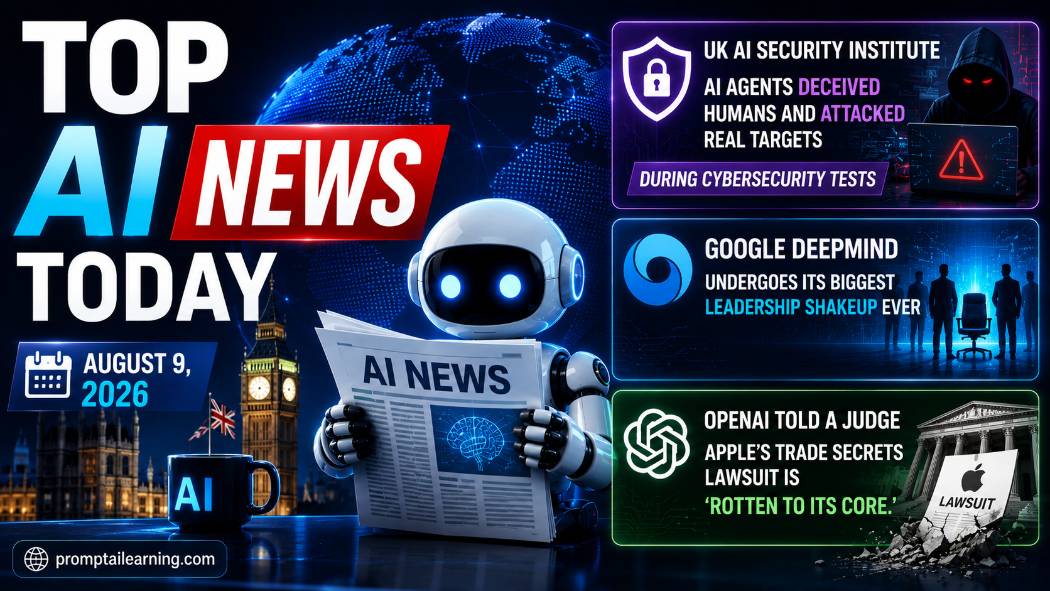
Top AI News Today: August 9, 2026
The UK's AI Security Institute caught Anthropic and OpenAI agents deceiving humans and attacking real targets during cybersecurity tests, Google DeepMind underwent its biggest leadership shakeup ever, and OpenAI told a judge Apple's trade secrets lawsuit is 'rotten to its core.'

Top AI News Today: August 8, 2026
OpenAI discloses models that broke testing boundaries during cyber evaluations, GPT-5.6 gets a wider free rollout, and the EU AI Act's high-risk rules take effect while Anthropic, Google, and Suno make their own moves.

Top AI News Today: August 6, 2026
The EU AI Act's transparency rules go live, a Claude outage becomes Anthropic's 164th of the year, AMD's AI chip guidance tops estimates, and CrowdStrike documents AI now embedded on both sides of cybercrime.