
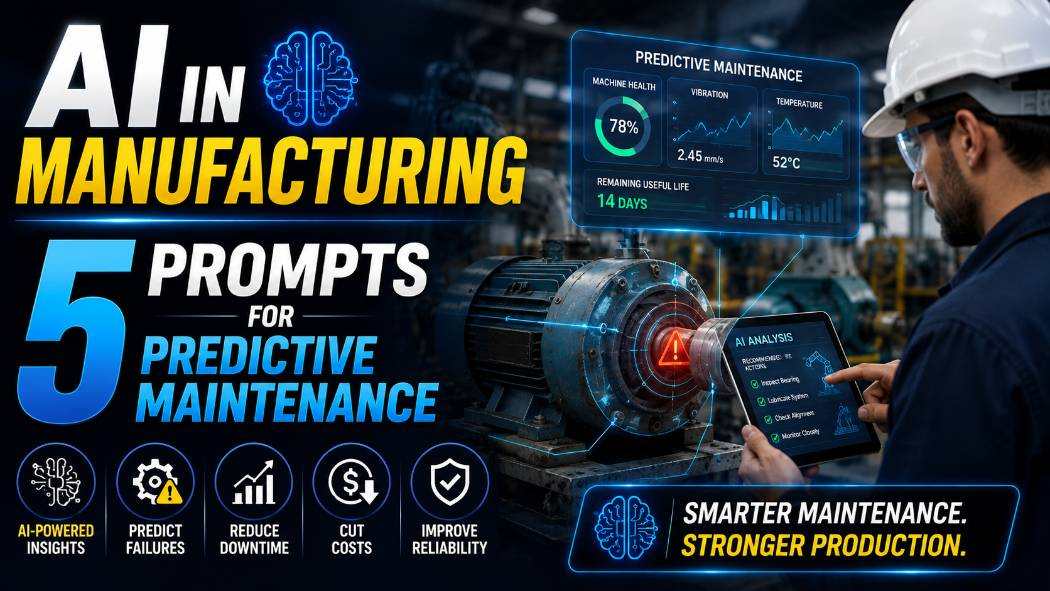
AI In Manufacturing: 5 Prompts For Predictive Maintenance
Most manufacturing teams I have talked to are using AI for one thing: summarizing meeting notes. That is a massive waste of what these models can actually do for a plant floor. The real value sits in predictive maintenance and supply chain planning, two areas where a well-structured prompt can turn raw sensor and inventory data into a decision your operations team can act on the same day. Here are 5 prompts built specifically for that.
Why Manufacturing Teams Are Behind On AI Prompting
Manufacturing has more structured data than almost any other industry, sensor logs, maintenance records, inventory counts, supplier lead times, and most of it sits unused in a dashboard nobody reads until something breaks.
Here is my honest take: the bottleneck was never data availability, it has been prompt specificity. A vague prompt like "analyze this maintenance log" returns a vague summary. A prompt that specifies the exact failure signals to look for, the format the maintenance team needs, and the constraints of your actual equipment returns something a technician can act on in the next shift.
Prompt 1: Predictive Maintenance Risk Ranking
The goal here is turning raw sensor readings and maintenance history into a ranked list your maintenance team can prioritize, instead of reading through logs manually.
Bad Prompt (what most people type)
Look at this maintenance data and tell me what might break.
Good Prompt (adds structure and context)
Analyze this equipment sensor log and flag machines showing signs of potential failure in the next 30 days.
Expert Prompt (production-ready, fully specified)
Act as a reliability engineer analyzing predictive maintenance data.
Task: Review the sensor and maintenance log data below for [EQUIPMENT TYPE, e.g. CNC machines / conveyor motors / hydraulic presses]. Identify units showing early signs of degradation based on vibration, temperature, or cycle-time drift trends.
Format: Output as a ranked table with columns: Equipment ID, Risk Level (High/Medium/Low), Key Signal Driving The Flag, Estimated Days To Likely Failure, Recommended Action.
Constraints: Only flag units with at least two converging signals, not a single anomalous reading, to reduce false positives. State your confidence level for each flag explicitly.
Tone: Direct, technical, no hedging, written for a maintenance supervisor making a scheduling decision today.
Data:
[PASTE SENSOR LOG / MAINTENANCE HISTORY DATA HERE]
What changed: The bad prompt returns a generic narrative summary with no prioritization. The good prompt adds a timeframe but still leaves output format to guesswork. The expert prompt forces a structured, ranked table with explicit confidence levels and a converging-signal requirement, which is what keeps the output from generating false alarms that erode trust in the tool over time.
Prompt 2: Root Cause Analysis From Sensor Logs
Once a failure happens, the useful question is not just what broke, it is why, and whether the same root cause is quietly affecting other equipment on the line.
Expert Prompt
Act as a root cause analyst investigating an equipment failure.
Task: Given the failure event and preceding sensor data below, identify the most likely root cause and any contributing factors, then flag whether other equipment sharing the same maintenance profile is at similar risk.
Format: Structured summary with sections: Failure Summary, Most Likely Root Cause, Supporting Evidence From Data, Contributing Factors, Similar-Risk Equipment, Recommended Preventive Action.
Constraints: Distinguish clearly between confirmed evidence from the data and inference. Do not state a root cause as certain unless the data directly supports it.
Tone: Analytical, precise, written for an engineering review meeting.
Failure event and sensor data:
[PASTE FAILURE EVENT DETAILS AND PRECEDING SENSOR DATA HERE]
The most useful habit I have picked up here: always ask the model to separate confirmed evidence from inference. Root cause analysis is exactly the kind of task where an LLM can sound confident about a guess, and that distinction is what keeps the output honest enough to act on.
Prompt 3: Supply Chain Disruption Impact Assessment
When a supplier delay or a shipping disruption hits, the question that matters is not just "how late," it is which downstream production lines actually get affected and by when.
Expert Prompt
Act as a supply chain analyst assessing a disruption.
Task: Given the disruption details and current inventory/production schedule below, assess which production lines will be impacted, when they will be affected, and the severity of the impact.
Format: Table with columns: Affected Line, Component At Risk, Days Of Buffer Remaining, Projected Impact Date, Severity (Critical/Moderate/Low), Suggested Mitigation.
Constraints: Base buffer calculations only on the inventory and consumption rate data provided, do not assume unstated safety stock. Flag any line where you lack sufficient data to assess impact rather than guessing.
Tone: Direct, decision-ready, written for a supply chain manager who needs to act within the hour.
Disruption details, current inventory, and production schedule:
[PASTE DISRUPTION DETAILS, INVENTORY LEVELS, AND PRODUCTION SCHEDULE HERE]
Prompt 4: Inventory Reorder Point Optimization
Static reorder points set once and never revisited are one of the most common sources of either excess inventory carrying cost or stockout risk on a plant floor.
Expert Prompt
Act as an inventory planning analyst.
Task: Given the historical consumption data, current lead times, and existing reorder points below, recommend updated reorder points and safety stock levels for each SKU listed.
Format: Table with columns: SKU, Current Reorder Point, Recommended Reorder Point, Reasoning, Estimated Carrying Cost Change.
Constraints: Account for lead time variability, not just average lead time. Flag any SKU where recent consumption has shifted significantly from historical average, since that changes the reliability of a straight historical calculation.
Tone: Analytical, numbers-first, written for a procurement review.
Data:
[PASTE CONSUMPTION HISTORY, LEAD TIMES, AND CURRENT REORDER POINTS HERE]
Prompt 5: Supplier Risk Scoring
A single-source supplier with a strong on-time record can still be a bigger risk than a backup supplier with a slightly worse record, if that single source has no viable alternative. Risk scoring needs to weigh dependency, not just performance history.
Expert Prompt
Act as a supply chain risk analyst.
Task: Score the suppliers listed below on overall risk, factoring in on-time delivery history, single-source dependency, geographic concentration, and financial stability signals where provided.
Format: Table with columns: Supplier, Risk Score (1-10), Primary Risk Driver, Single-Source Dependency (Yes/No), Recommended Mitigation.
Constraints: Weight single-source dependency and geographic concentration as heavily as delivery performance, not less. State clearly if a score is limited by missing data.
Tone: Direct, executive-ready, written for a quarterly supply chain risk review.
Supplier data:
[PASTE SUPPLIER PERFORMANCE, LOCATION, AND DEPENDENCY DATA HERE]
How To Feed Real Plant Data Into These Prompts Safely
Data Handling Note
Strip or anonymize any personally identifiable employee information, contract pricing, or proprietary process parameters before pasting plant data into a general-purpose AI tool, unless you are using an enterprise deployment with a data processing agreement in place.
Treat AI output as a decision-support recommendation, not a final action. A qualified engineer or planner should verify any recommendation before it changes a maintenance schedule or a production run.
Best AI Tools For Manufacturing Workflows
I am not affiliated with any tool listed here. These reflect what tends to work well for the tasks above.
● An LLM (Claude Sonnet 4.6 or GPT-5) with the structured prompts above for analysis, root cause reasoning, and report generation from exported data.
● A dedicated industrial IoT platform for the actual sensor data collection and real-time monitoring feeding into these prompts, an LLM analyzes exported or summarized data, it does not replace real-time monitoring infrastructure.
● A spreadsheet or BI tool to hold the structured table outputs these prompts generate, so they can be tracked and reviewed over time rather than living in a single chat session.
Copy-Paste Template: Universal Manufacturing Analysis Prompt
Use this as a base and adapt the task line for maintenance, supply chain, or inventory analysis.
Act as a
[ROLE: reliability engineer / supply chain analyst / inventory planner] analyzing manufacturing data.
Task: [SPECIFIC ANALYSIS GOAL, e.g. flag equipment at risk of failure / assess disruption impact / recommend reorder points]
Format: [TABLE OR STRUCTURED SECTIONS WITH SPECIFIC COLUMNS/HEADERS]
Constraints: [DATA LIMITATIONS TO RESPECT, CONFIDENCE LEVEL REQUIREMENTS, WHAT NOT TO ASSUME]
Tone: Direct, technical, written for [SPECIFIC AUDIENCE, e.g. maintenance supervisor / procurement team / risk review meeting]
Data:
[PASTE RELEVANT DATA HERE, ANONYMIZED AS NEEDED]
-- Role: Manufacturing operations analyst
-- Task: Structured analysis of maintenance, supply chain, or inventory data
-- Format: Table or structured sections with defined columns
-- Constraints: Explicit confidence levels, no unstated assumptions, flag missing data
-- Tone: Direct, technical, decision-ready
Save this to your prompt library at promptailearning.com/prompts and adapt the role and task line for each analysis type.
Prompt Glossary
Predictive maintenance: Using data (sensor readings, usage patterns, maintenance history) to predict equipment failure before it happens, rather than fixing on a fixed schedule or after breakdown.
Root cause analysis: A structured investigation to identify the underlying cause of a failure or problem, rather than just addressing its symptoms.
Safety stock: Extra inventory held beyond expected demand to buffer against supply delays or demand spikes.
Reorder point: The inventory level at which a new order should be placed to avoid running out before the next shipment arrives.
Single-source dependency: A supply chain risk where a single supplier is the only source for a critical component, with no qualified backup.
Converging signals: Multiple independent data points pointing toward the same conclusion, used in predictive maintenance to reduce false positives from a single anomalous reading.
Recommended Blogs
If you found this useful, these posts go deeper on related topics:
● Best Claude AI Prompts 2026: 25+ Types With Examples
● Business and Strategy Prompts - Analysis, Pitch Decks, OKRs
● The Guide to Agentic Prompts
Frequently Asked Questions
How is AI used for predictive maintenance in manufacturing?
AI analyzes sensor data such as vibration, temperature, and cycle time alongside maintenance history to identify equipment showing early signs of degradation, allowing teams to schedule repairs before an unplanned breakdown occurs.
Can ChatGPT or Claude analyze real sensor data?
Yes, when the data is exported or summarized into a format like a spreadsheet or text log and pasted into a well-structured prompt. These models do not connect directly to live industrial sensors, they analyze data you provide them.
What is the difference between predictive and preventive maintenance?
Preventive maintenance follows a fixed schedule regardless of actual equipment condition. Predictive maintenance uses real-time or historical data to predict when a specific piece of equipment is actually likely to fail, allowing more targeted timing.
How can AI help optimize a supply chain?
AI can assess disruption impact across production lines, recommend updated inventory reorder points based on consumption patterns and lead time variability, and score supplier risk factoring in dependency and geographic concentration, not just delivery history.
Is it safe to put manufacturing data into an AI tool?
Anonymize personally identifiable information and proprietary pricing or process details before using a general-purpose AI tool, unless you are on an enterprise deployment with a data processing agreement. Treat outputs as decision support that a qualified team member verifies, not a final action.
What data do I need for AI-driven predictive maintenance?
At minimum, sensor readings (vibration, temperature, cycle time) and maintenance history for the equipment in question. More historical data and more signal types generally produce more reliable predictions.
How do I reduce false positives in AI predictive maintenance flags?
Require the model to flag equipment only when at least two independent signals converge, rather than a single anomalous reading, and have it state a confidence level for each flag so your team can prioritize accordingly.
Can AI replace a supply chain analyst?
No. AI can process and structure data far faster than manual review, but a qualified analyst still needs to verify assumptions, account for context the data does not capture, and make the final call on supplier or inventory decisions.
References
● Anthropic Claude Documentation - Official model and API documentation
● Prompt AI Learning Prompt Library - 400+ free templates
Follow along on promptailearning.com for weekly guides on prompting, AI tools, and getting more out of every model.
EXPLORE MORE ON PROMPTAILEARNING.COM
STAY UPDATED WITH AI NEWS
Follow the full AI news series and never miss a story:
● Daily AI News - Top 5 Stories Every Morning
● Weekly AI Roundups - 15+ Stories Every Monday
● Monthly AI Recaps - Full Archive by Month
LEARN THE MODELS MAKING THESE HEADLINES
The models in today's news are only useful if you know how to prompt them well. Start here:
● Best Claude AI Prompts 2026 - 25+ Types With Examples
● Best ChatGPT Prompts 2026 - 200+ Real Examples
● Best Gemini AI Prompts 2026 - 100+ Templates
COMPARE THE MODELS
Not sure which model to use? These comparison pages give you the full picture:
● ChatGPT vs Claude - Full 2026 Comparison
● AI Models Directory - Compare 60+ LLMs, Image and Video Models
BUILD SKILLS THAT COMPOUND
Reading AI news is step one. Building skills with these models is step two:
● Free Prompt Library - 213+ Copy-Paste Templates
● Start Prompt Engineering - Free Course for All Levels
● The Guide to Agentic Prompts
● Coding Prompts for Developers - Production-Ready Templates
USE PROMPTS FOR THE NEWS TOPICS YOU READ ABOUT TODAY
Every story in today's post maps to a real use case. These prompt categories help you act on what you read:
● Business and Strategy Prompts - Analysis, Pitch Decks, OKRs
● Writing and Content Prompts - Emails, Case Studies, White Papers
● AI Knowledge Hub - Technical Blueprints and Career Guides
ABOUT THIS BLOG
promptailearning.com publishes free daily AI news, weekly roundups, monthly recaps, prompt guides, model comparisons, and course content for anyone who wants to get better at using AI. Written by Swatantra Verma. No paywalls, no fluff.
Connect With Us
● Email: contact@promptailearning.com
● Founder: Swatantra Verma on LinkedIn
● Co-Founder: Prateek Patel on LinkedIn
● Company LinkedIn: Prompt AI Learning
● Company X: @promptailearnin