
Automating Onboarding: How to Prompt AI for 30-60-90 Day New Hire Plans
I once received a 30-60-90 day plan on my first day at a job that had clearly been copy-pasted from a template site, it still said "[Insert Department]" in one of the headers. It told me nothing about what success actually looked like in that specific role, at that specific company, and I spent the first month guessing at priorities instead of executing against a real plan. A 30-60-90 day plan is only useful if it is built around the actual role, the actual team, and the actual goals a manager has in mind, not a generic structure with the job title swapped in.
Why Generic 30-60-90 Templates Fail New Hires
A generic prompt like "create a 30-60-90 day plan for a new marketing manager" produces exactly what you would expect from a request with no company or role context: a list of activities so generic they could apply to almost any marketing role at almost any company, "get familiar with the team," "understand key processes," "start contributing to projects." None of that tells a new hire what success actually looks like or what their manager will actually be evaluating.
My honest opinion here: a 30-60-90 day plan is a management tool disguised as an onboarding document. Its real job is to force a hiring manager to articulate specific, measurable expectations before day one, which most managers do not naturally do without being prompted to. A generic AI-generated plan skips that forcing function entirely and just produces filler that looks like a plan without doing the actual job of one.
What Each Phase Should Actually Accomplish
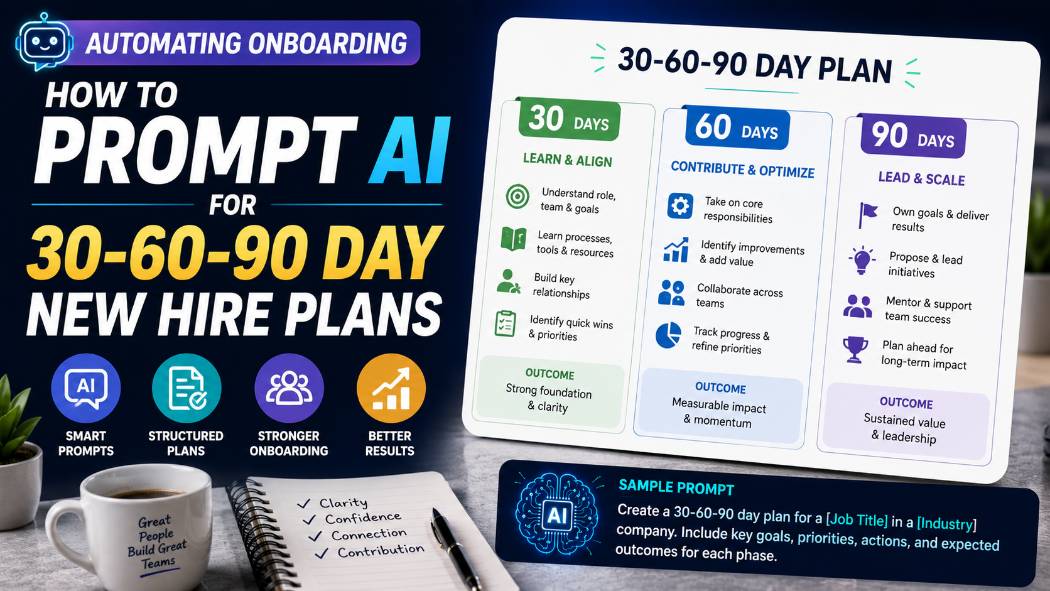
● Days 1-30 (Learning): Understanding systems, relationships, and context. Success here is measured by comprehension and integration, not output.
● Days 31-60 (Contributing): Taking on real, scoped pieces of work with support. Success is measured by execution on defined tasks.
● Days 61-90 (Owning): Operating with increasing independence on a defined area of responsibility. Success is measured by ownership and early impact.
A prompt that does not explicitly tie each phase to a different type of success metric will tend to produce three similar-looking lists of generic activities instead of a plan that actually shows progression.
Building the 30-Day Learning Phase
Bad Prompt (what most people type)
Create a 30-60-90 day plan for a new marketing manager
Good Prompt (adds structure and context)
Create the first 30 days of an onboarding plan for a new Marketing Manager, focused on learning our team structure, tools, and current campaigns, at a mid-size B2B SaaS company.
Expert Prompt (production-ready, fully specified)
Role: Act as an HR onboarding specialist building a role-specific 30-60-90 day plan.
Task: Create the Days 1-30 section of an onboarding plan for a new Marketing Manager at a [COMPANY TYPE, e.g. "mid-size B2B SaaS company"], reporting to [MANAGER ROLE, e.g. "VP of Marketing"].
Constraints: Organize into weekly goals (Week 1, Week 2, Week 3-4). Each week should include specific learning objectives (tools, systems, key stakeholders to meet) and one measurable checkpoint the manager can use to confirm understanding, not just "get familiar with X." Include a list of 5-8 specific people or roles the new hire should meet with in this phase and why.
Format: Weekly sections, each with objectives, a checkpoint, and stakeholder meetings.
Tone: Practical and specific, written for both the new hire and their manager to reference.
What changed: The expert prompt requires a measurable checkpoint per week instead of a vague learning goal, which forces the plan to define what "understanding the tools" actually looks like in practice, verifiable rather than assumed.
Building the 60-Day Contributing Phase
Bad Prompt
Add the next 30 days to the plan
Good Prompt
Create Days 31-60 of the plan, focused on the new hire taking ownership of one real campaign with manager support.
Expert Prompt
Role: Act as an HR onboarding specialist continuing the 30-60-90 day plan established above.
Task: Create the Days 31-60 section, focused on the new Marketing Manager taking on [SPECIFIC SCOPED RESPONSIBILITY, e.g. "managing one active campaign with manager review at each stage"].
Constraints: Define 2-3 specific deliverables with target completion dates relative to day 60. Specify what level of manager review or approval is expected at each stage (fully independent, review before execution, or collaborative). Include one point where the new hire should proactively share a status update, rather than waiting to be asked.
Format: A list of deliverables with target dates, review level, and check-in points.
Tone: Practical and specific, written for both the new hire and their manager.
What changed: The expert prompt requires an explicit review level per deliverable, which prevents the common onboarding failure where a new hire either over-checks every decision or moves ahead on something the manager actually expected to review first.
Building the 90-Day Ownership Phase
Bad Prompt
Finish the plan with the last 30 days
Good Prompt
Create Days 61-90 of the plan, focused on the new hire operating independently on their core responsibilities and setting goals for the next quarter.
Expert Prompt
Role: Act as an HR onboarding specialist finalizing the 30-60-90 day plan established above.
Task: Create the Days 61-90 section, focused on the new Marketing Manager operating with defined independence on [CORE RESPONSIBILITY AREA] and preparing goals for their next quarter.
Constraints: Define what "successful ownership" looks like by day 90 in specific, observable terms (not "doing well," but a specific outcome or metric). Include a structured 90-day review conversation outline for the manager, covering what went well, what needs support, and 2-3 goals for days 91-180.
Format: A definition of success for day 90, followed by a structured review conversation outline.
Tone: Practical and specific, written for the manager conducting the 90-day check-in.
What changed: The expert prompt requires an observable definition of success rather than a vague sense of progress, and builds the 90-day review conversation directly into the plan, which is the step most onboarding templates skip even though it is where the plan actually gets used.
I keep this three-phase onboarding prompt sequence saved in the free prompt library so every new hire plan starts from role-specific detail instead of a generic template.
Copy-Paste Template: 30-60-90 Day Plan Prompt
Use this exactly as written, in three parts, one phase at a time. Replace the [brackets] with your specifics.
PART 1 - DAYS 1-30 (LEARNING)
Role: Act as an HR onboarding specialist building a role-specific 30-60-90 day plan.Task: Create the Days 1-30 section for a new [ROLE] at a [COMPANY TYPE], reporting to [MANAGER ROLE].
Constraints: Weekly goals (Week 1, Week 2, Week 3-4), each with specific objectives and a measurable checkpoint. Include 5-8 specific stakeholders to meet and why.
Format: Weekly sections with objectives, checkpoint, stakeholder meetings.
Tone: Practical, specific, for new hire and manager.
PART 2 - DAYS 31-60 (CONTRIBUTING)
Role: Act as an HR onboarding specialist continuing the plan above.Task: Create Days 31-60, focused on [SPECIFIC SCOPED RESPONSIBILITY].
Constraints: 2-3 deliverables with target dates, defined review level per deliverable, one proactive check-in point.
Format: Deliverables list with dates, review level, check-ins.
Tone: Practical, specific.
PART 3 - DAYS 61-90 (OWNING)
Role: Act as an HR onboarding specialist finalizing the plan above.Task: Create Days 61-90, focused on independence in [CORE RESPONSIBILITY AREA] and next-quarter goal setting.
Constraints: Observable definition of day-90 success, structured 90-day review conversation outline with 2-3 goals for days 91-180.
Format: Success definition plus review conversation outline.
Tone: Practical, specific, for the manager's use.
Save this to your prompt library at promptailearning.com/prompts.
Prompt Glossary
30-60-90 day plan: A structured onboarding roadmap divided into three phases, typically learning, contributing, and owning, used to set expectations and measure new hire progress.
Measurable checkpoint: A specific, verifiable indicator used to confirm progress, as opposed to a vague goal like "get familiar with" that cannot be objectively assessed.
Review level: The degree of manager oversight expected for a given task or deliverable, ranging from fully independent to requiring approval before execution, which should be explicitly defined to avoid mismatched expectations.
Constraint stacking: Listing multiple specific rules, such as requiring measurable checkpoints and defined review levels, in a single prompt so the model produces an actionable plan rather than a generic activity list.
System Prompt: Instructions given to the AI before your actual request, used here to define the "Role" that anchors the entire response, such as HR onboarding specialist.
Recommended Blogs
If you found this useful, these posts go deeper on related topics:
● The Bias-Free Prompt: How to Write Inclusive Job Descriptions Using AI
● Best ChatGPT Prompts 2026: 200+ With Real Examples
● Business and Strategy Prompts: Analysis, Pitch Decks, OKRs
Frequently Asked Questions
What is a 30-60-90 day plan?
A 30-60-90 day plan is a structured onboarding roadmap divided into three phases, typically learning, contributing, and owning, used to set clear expectations and measure a new hire's progress during their first three months.
Can ChatGPT create a good 30-60-90 day plan?
Yes, but only when given specific role, company, and manager context. A generic prompt without these details tends to produce a generic list of activities that could apply to almost any role.
Why do most 30-60-90 day plan templates feel generic?
Most templates are written to apply broadly across roles and companies, which strips out the specific goals, stakeholders, and success metrics that make a plan actually useful to a particular new hire in a particular role.
Should a 30-60-90 day plan include measurable goals?
Yes. Vague goals like "get familiar with the team" are difficult to evaluate, while a measurable checkpoint, such as a specific deliverable or a defined understanding check, gives both the new hire and manager a clear way to assess progress.
Who should be involved in creating a new hire's 30-60-90 day plan?
The hiring manager should be closely involved, since the plan should reflect their specific expectations, priorities, and definition of success for the role, rather than being built entirely independent of their input.
How specific should the Days 1-30 section be?
It should include specific weekly objectives, a list of stakeholders to meet, and measurable checkpoints, rather than a general instruction to "learn the role," which gives the new hire no clear sense of what progress looks like.
What should happen at the 90-day mark?
A structured review conversation between the manager and new hire, covering what went well, what needs additional support, and goals for the next quarter, which many onboarding plans stop short of including.
Can the same 30-60-90 day plan template work for every role?
Not effectively. While the three-phase structure can apply broadly, the specific objectives, stakeholders, and success metrics need to be tailored to the actual role and company to be genuinely useful rather than generic.
Save this three-phase onboarding prompt sequence to the free prompt library so your next new hire gets a real roadmap instead of a copy-pasted template.