
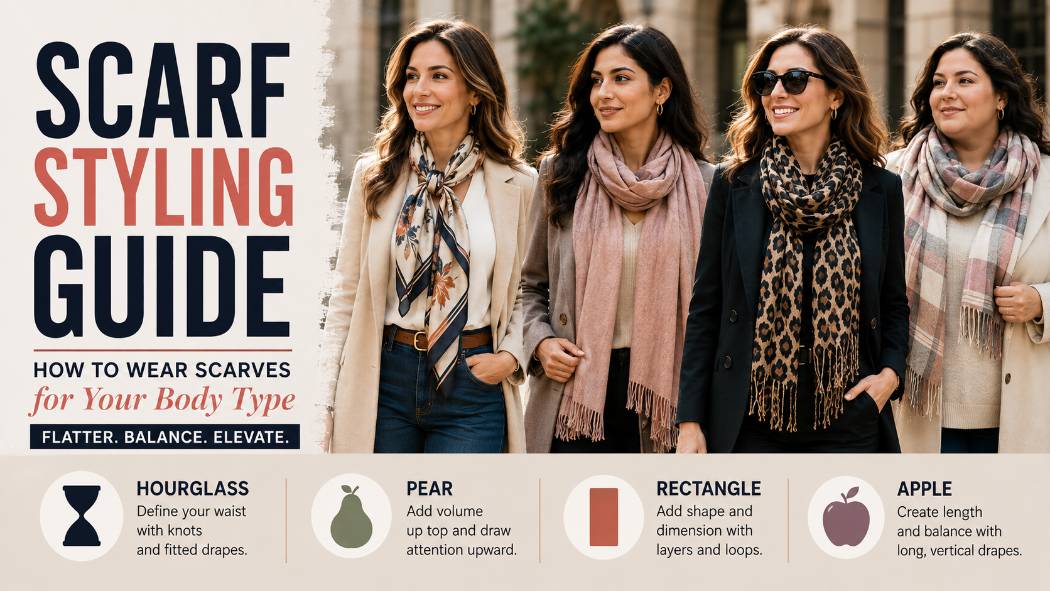
Scarf Styling Guide: How To Wear Scarves For Your Body Type
A scarf is the easiest accessory to get wrong without realizing it. The exact same scarf, tied the exact same way, can add a flattering layer to one body and visually shorten or bulk up another, and most people never connect a scarf they "just don't like on themselves" to how it was tied rather than the scarf itself. The tie matters more than the scarf.
Why The Knot Matters More Than The Scarf
Here is my honest take: most scarf advice focuses entirely on pattern and color and almost never mentions volume placement, which is the actual variable that determines whether a scarf flatters your proportions. A bulky knot sitting right at the widest part of your neck and shoulders reads very differently depending on your frame, and that is true regardless of how nice the scarf itself is.
Once you think about a scarf as adding volume to a specific, chosen spot rather than as a flat accessory draped somewhere vague, styling it for your own proportions gets much more straightforward.
Scarf Styling By Body Type
Petite Frame
Volume at the neck can visually shorten a petite frame if it is bulky and sits high and wide. A loose, single loop with a long vertical drape works better than a thick multi-wrap knot, since the vertical line elongates rather than adding horizontal width right under the chin. Keep the scarf's ends longer than its knot for the same reason.
Plus Size Frame
A scarf that disappears into the neckline or gets lost under a coat collar undersells the accessory entirely. A looser, longer drape with visible movement, rather than a tight, compact knot pulled close to the throat, tends to read as more intentional and gives the eye a clear focal point rather than a small tight knot competing with the rest of the outfit.
Pear Shape (Fuller Hip, Narrower Shoulder)
A scarf is a genuinely useful tool here, since adding volume and visual interest at the neck and shoulder helps balance proportions against a fuller hip. A structured knot with some width, or a scarf draped over one shoulder, adds presence to the upper body without needing to change anything else in the outfit.
Apple Shape (Fuller Midsection)
A long, single vertical drape past the bust works better than a wrapped knot that sits directly on the midsection, since the vertical line draws the eye down in a straight column rather than adding horizontal bulk at the widest point. Avoid short, high, bulky knots that sit right where you may not want extra volume.
Rectangle (Balanced Shoulder And Hip)
This frame has the most flexibility with scarf styling. A structured knot with some volume, like a French knot or a loose infinity wrap, adds shape and a defined focal point that a fully straight silhouette benefits from.
Matching Scarf Length And Width To Your Frame
● Shorter frames generally do better with a single loop or loose drape rather than a scarf so long it visually cuts the body into unequal segments.
● A wider scarf reads as more substantial and works well as a single-drape statement piece, a narrower scarf is more versatile for multiple knot styles without becoming bulky.
● For a fuller bust, a scarf that ends above rather than at the bust line tends to sit more cleanly, since a knot landing exactly at the bust can visually flatten or add unwanted volume there.
Five Knots Worth Actually Learning
● The Loose Loop: Drape the scarf around the neck and let both ends hang loose and uneven. Low effort, elongating, works well for petite and apple shapes.
● The French Knot: Fold the scarf in half, drape around the neck, and pull the loose ends through the folded loop. Adds structured volume, good for rectangle and pear shapes.
● The Single Wrap Drape: Wrap once loosely around the neck with long ends left hanging. Adds presence without bulk, versatile across most body types.
● The Shoulder Drape: Lay the scarf over one shoulder and let it hang long on both sides, secure loosely if needed. Adds asymmetric visual interest, particularly good for pear shapes.
● The Infinity Wrap: Using a circle scarf, loop it once or twice depending on desired volume. A double loop adds more presence for plus size frames, a single loose loop keeps it lighter for petite frames.
Using AI To Preview A Scarf Look Before You Commit
This is the step most style guides skip, and it is genuinely useful for a small, specific accessory decision like this: you can use an AI image tool to visualize how a specific scarf tie will actually sit before you spend time practicing a knot in the mirror.
Bad Prompt (what most people type)
Show me how to wear a scarf.
Good Prompt (adds structure and context)
Show a woman wearing a red scarf tied in a loose knot with a winter coat.
Expert Prompt (production-ready, fully specified)
Act as a fashion stylist creating a reference visualization.
Task: Generate a visualization of a burgundy wool scarf styled in a loose single-loop drape, worn over a camel wool coat, for a petite frame.
Format: Upper-body front-facing shot, neutral studio background, natural standing pose.
Constraints: The scarf knot should sit slightly below the collarbone, not high and tight against the throat, with both ends hanging unevenly to create a vertical line. No bulky, wide knot directly under the chin.
Tone: Editorial, clean, minimal styling, soft natural lighting.
What changed: The bad prompt returns a generic image with no useful styling detail. The good prompt adds color and coat but leaves the actual knot placement to guesswork. The expert prompt specifies exact knot placement and the visual effect it should create, which is what lets you actually judge whether that specific tie works for your proportions before trying it yourself.
A Note On Style Advice
Body type categories here are a starting point for how volume and drape behave, not a rule your body needs to fit into. The goal is more ways to wear a scarf you already like, not a checklist. Wear the knot that feels good and looks good to you, that matters more than any guideline in this post.
Fabric And Season Considerations
● Chunky knit scarves add real bulk, better suited to a loose drape than a tight knot for most body types, since a tight knot in heavy fabric can look stiff rather than soft.
● Silk and lightweight scarves drape closer to the body and work well for tighter knots like the French knot without adding unwanted volume.
● For layering under a coat, choose a thinner fabric and simpler knot, bulky ties get lost or create an uncomfortable lump under a buttoned coat collar.
Copy-Paste Template: AI Scarf Styling Visualization Prompt
Use this exactly as written. Replace the [brackets] with your specifics.
Act as a fashion stylist creating a reference visualization.
Task: Generate a visualization of a [SCARF COLOR/FABRIC] scarf styled in a [KNOT STYLE: loose loop / French knot / shoulder drape / infinity wrap], worn with [OUTFIT/COAT], for a [BODY TYPE] frame.
Format: Upper-body front-facing shot, neutral studio background, natural standing pose.
Constraints: [Knot placement/height], [volume level], [any specific detail like uneven ends or vertical drape].
Tone: Editorial, clean, minimal styling, soft natural lighting.
-- Role: Fashion stylist reference visualization
-- Task: Preview a specific scarf knot and placement for a named body type
-- Format: Upper-body front shot, neutral background
-- Constraints: Exact knot placement and volume specified
-- Tone: Editorial, clean, natural lighting
Save this to your prompt library at promptailearning.com/prompts and reuse it for every scarf and knot combination you're deciding between.
Style Glossary
Volume placement: Where on the body a garment or accessory adds visual bulk, a key consideration for how a scarf knot interacts with a specific body shape.
French knot: A scarf tying technique where the scarf is folded in half, draped around the neck, and the loose ends pulled through the folded loop, creating a structured, compact knot.
Infinity scarf: A circular scarf with no loose ends, worn by looping it once or more around the neck, offering adjustable volume depending on how many times it's looped.
Vertical drape: A scarf styling approach where the fabric hangs in a long, uninterrupted line down the body, used to create an elongating visual effect.
Shoulder drape: Draping a scarf over one shoulder rather than around the neck, creating an asymmetric line often used to add visual interest to one side of the body.
Recommended Blogs
If you found this useful, these posts go deeper on related topics:
● Best Gemini AI Prompts 2026: 100+ Templates
● Best ChatGPT Prompts 2026: 200+ With Real Examples
● Free Prompt Library
Frequently Asked Questions
How should a petite person wear a scarf?
A loose single loop with a long, uneven vertical drape works well for a petite frame, since it elongates rather than adding bulky horizontal volume right under the chin. Avoid thick, multi-wrap knots that sit high and wide at the neck.
What is the best scarf knot for a plus size frame?
A looser, longer drape with visible movement tends to work better than a tight, compact knot pulled close to the throat, since it reads as an intentional statement piece rather than getting lost against the rest of the outfit.
Can a scarf help balance a pear-shaped body?
Yes, adding volume and visual interest at the neck and shoulders through a structured knot or a one-shoulder drape helps balance proportions against a fuller hip, without needing to change the rest of the outfit.
What scarf styling works best for an apple shape?
A long, single vertical drape that falls past the bust works better than a wrapped knot sitting on the midsection, since the vertical line draws the eye down in a straight column rather than adding volume at the widest point.
What is a French knot and how do you tie it?
Fold the scarf in half, drape it around your neck with the folded loop on one side, then pull the two loose ends through that loop and let them hang. It creates a structured, relatively compact knot.
Does scarf fabric affect which knot works best?
Yes, chunky knit fabrics add real bulk and suit a looser drape better than a tight knot, while lightweight fabrics like silk drape closer to the body and work well with more structured knots like the French knot.
Can AI help me decide how to style a scarf before trying it myself?
Yes, a detailed AI image prompt specifying the scarf color, knot style, and exact placement can help you preview how a specific tie will look on your frame before spending time practicing it in the mirror.
Is there one scarf knot that works for every body type?
Not really, since the right knot depends on where you want to add or avoid visual volume. The Loose Loop and Single Wrap Drape are the most broadly versatile starting points, but adjusting for your own frame typically gives a more flattering result than a single universal knot.
References
● Prompt AI Learning Prompt Library - 400+ free templates
● Prompt AI Learning Blogs
Follow along on promptailearning.com for weekly guides on prompting, AI tools, and getting more out of every model.
EXPLORE MORE ON PROMPTAILEARNING.COM
STAY UPDATED WITH AI NEWS
Follow the full AI news series and never miss a story:
● Daily AI News - Top 5 Stories Every Morning
● Weekly AI Roundups - 15+ Stories Every Monday
● Monthly AI Recaps - Full Archive by Month
LEARN THE MODELS MAKING THESE HEADLINES
The models in today's news are only useful if you know how to prompt them well. Start here:
● Best Claude AI Prompts 2026 - 25+ Types With Examples
● Best ChatGPT Prompts 2026 - 200+ Real Examples
● Best Gemini AI Prompts 2026 - 100+ Templates
COMPARE THE MODELS
Not sure which model to use? These comparison pages give you the full picture:
● ChatGPT vs Claude - Full 2026 Comparison
● AI Models Directory - Compare 60+ LLMs, Image and Video Models
BUILD SKILLS THAT COMPOUND
Reading AI news is step one. Building skills with these models is step two:
● Free Prompt Library - 213+ Copy-Paste Templates
● Start Prompt Engineering - Free Course for All Levels
● The Guide to Agentic Prompts
● Coding Prompts for Developers - Production-Ready Templates
USE PROMPTS FOR THE NEWS TOPICS YOU READ ABOUT TODAY
Every story in today's post maps to a real use case. These prompt categories help you act on what you read:
● Business and Strategy Prompts - Analysis, Pitch Decks, OKRs
● Writing and Content Prompts - Emails, Case Studies, White Papers
● AI Knowledge Hub - Technical Blueprints and Career Guides
ABOUT THIS BLOG
promptailearning.com publishes free daily AI news, weekly roundups, monthly recaps, prompt guides, model comparisons, and course content for anyone who wants to get better at using AI. Written by Swatantra Verma. No paywalls, no fluff.
Connect With Us
● Email: contact@promptailearning.com
● Founder: Swatantra Verma on LinkedIn
● Co-Founder: Prateek Patel on LinkedIn
● Company LinkedIn: Prompt AI Learning
Company X: @promptailearnin