
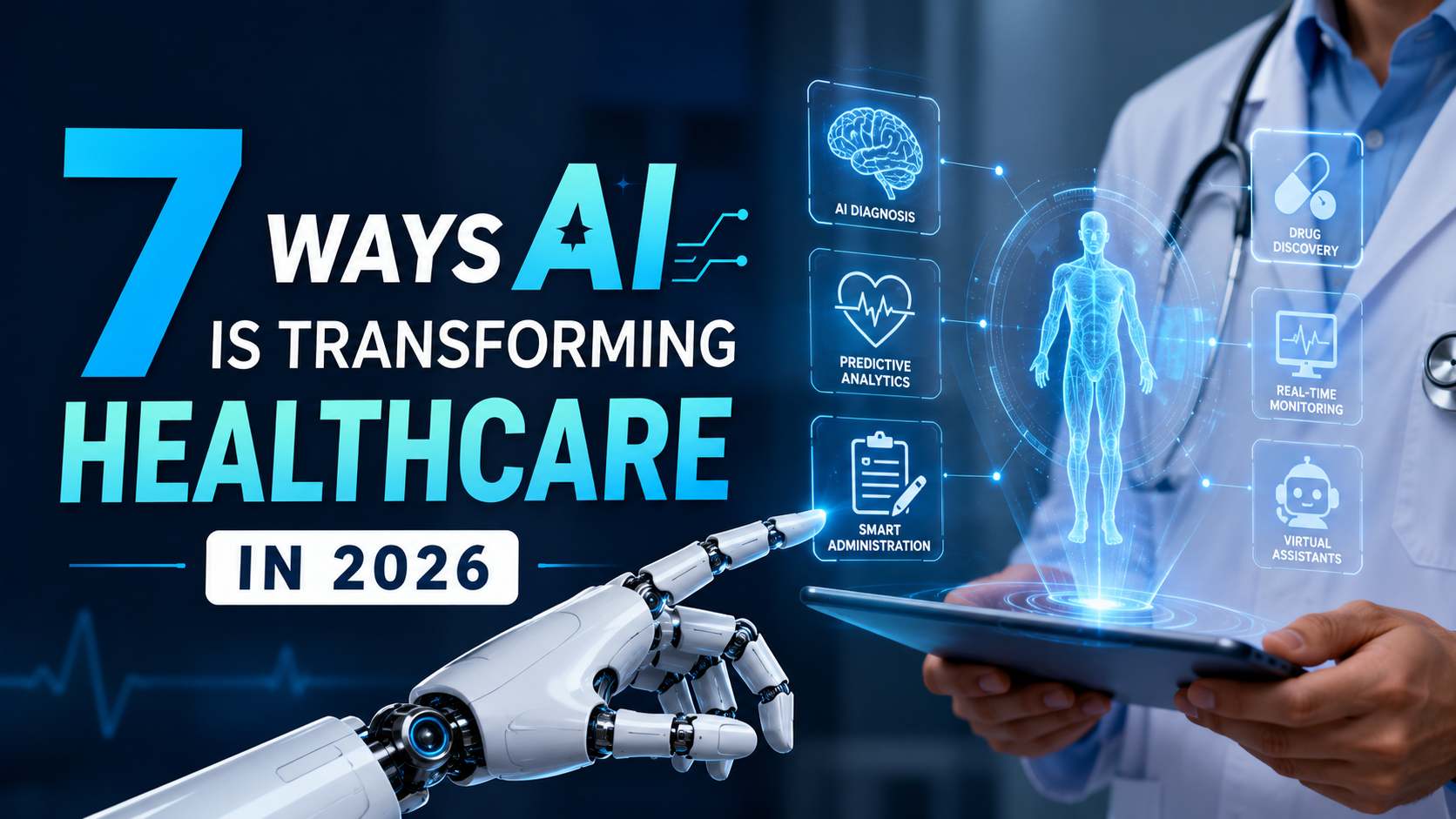
7 Ways AI is Transforming Healthcare in 2026
70% of healthcare organizations now have AI in active production deployment — up from 63% just a year ago. That is not a trend. That is an industry that has crossed a threshold. The question is no longer "should we adopt AI?" — it is "how fast can we scale it, and where is the ROI proving out fastest?"
I have been tracking AI adoption in healthcare since 2022, and what I am seeing in 2026 is genuinely different from the hype cycles of prior years. NVIDIA's State of AI in Healthcare and Life Sciences report confirms it: 85% of healthcare executives report revenue gains from AI, and nearly half are planning 10%+ budget increases for next year. Real numbers. Real outcomes.
Here are the 7 ways AI is actually — not theoretically — transforming healthcare right now.
1. Agentic AI: From Copilot to Autonomous Clinical Teammate
Agentic AI is the single biggest shift in healthcare AI in 2026. Unlike a traditional AI tool that answers questions when prompted, agentic AI operates autonomously — it monitors systems, coordinates tasks, and executes workflows without waiting for a human to click a button.
Mount Sinai Health System, Mayo Clinic, and the UK's NHS have all launched active agentic AI programs in 2026. The NHS specifically launched a project focused on responsible agentic AI deployment across its entire system — not a pilot, a program. These systems handle patient summaries, flag missing clinical information before appointments, and coordinate care across multiple clinical teams simultaneously.
My take: this is the most important development in health tech right now, and most people outside the industry have no idea it is happening. When people talk about "AI replacing doctors," what is actually happening is closer to the opposite — AI is absorbing the administrative and coordination load so that physicians spend more time on the 20% of tasks that actually require a physician.
The Gartner 2026 prediction is stark: by 2028, 80% of ambulatory claims will be processed through AI-enabled, real-time adjudication. That means the administrative backbone of healthcare is shifting to AI within 24 months.
Example 1 — Agentic Patient Triage Workflow
BAD PROMPT
Tell me about a patient with chest pain.
Why it fails: No context, no role, no constraints. Claude or ChatGPT will produce generic medical information that is unhelpful and potentially unsafe in a clinical context.
GOOD PROMPT
You are a clinical decision support assistant working with a licensed emergency physician at a Level 1 trauma center.
PATIENT CONTEXT: - Age: 58, male, presenting with substernal chest pain, 7/10 intensity, onset 2 hours ago - PMH: Type 2 diabetes, hypertension, smoker (20 pack-year history) - Current meds: Metformin 1000mg BID, Lisinopril 10mg daily - Initial vitals: BP 158/94, HR 92, SpO2 97% on room air TASK: Generate a structured clinical summary including:
1. Three most likely diagnoses with supporting reasoning (rank by probability)
2. Immediate workup priorities (list in order of urgency)
3. Red flag findings that would change management immediately
FORMAT: Use numbered lists. Flag any information gaps. Note this is decision SUPPORT only — the physician retains all clinical authority.
Why it works: Role is set (clinical decision support), context is specific, task is structured, output format is defined, and the boundaries of AI authority are explicitly stated — critical for HIPAA-aware clinical workflows.
2. Medical Imaging: 35% Faster, 67% Fewer Missed Diagnoses
Radiology is where AI has the longest track record and the clearest outcomes. The numbers I keep coming back to are these: AI reduces chest X-ray interpretation time by 35.81% and reduces false negatives per radiology case by 67% in trauma applications. These are not projections — these are peer-reviewed results.
Radiology accounts for 76% of all FDA AI-enabled medical device authorizations through 2025. The FDA has been approving AI imaging tools faster than any other category, which tells you where the clinical evidence is strongest. Globally, about 3.6 billion imaging procedures happen every year — and the radiologist workforce is already stretched, with some facilities requiring radiologists to review up to 1,000 exams per day.
In May 2026, Aidoc partnered with Sol Radiology to deploy enterprise-grade clinical AI across Southern California, integrating imaging-based AI into radiology workflows specifically to improve diagnostic prioritization. That is not a research study — that is a production deployment at scale.
The contrarian point worth making: AI does not replace the radiologist. It changes what the radiologist does. The 30-40% workforce gap in radiology that AI is being tasked to address is a real problem — but the best outcome is not AI doing radiology alone. It is AI doing the first pass, triage, and flagging so that radiologists spend their cognitive energy on the complex, ambiguous cases that genuinely require clinical judgment.
Example 2 — AI Imaging Report Analysis Prompt
BAD PROMPT
What does this radiology report mean?
Why it fails: No report text, no patient context, no audience specification. The AI has nothing to work with and will produce a generic non-answer.
GOOD PROMPT
You are assisting a primary care physician with interpreting a radiology report for a patient education summary.
RADIOLOGY REPORT TEXT (de-identified): [Paste de-identified report text here]
PATIENT BACKGROUND: 65-year-old female, referred for CT chest with contrast due to persistent cough (8 weeks), non-smoker, no prior malignancy history.
TASKS:
1. Summarize the key findings in plain language (reading level: 7th grade)
2. Identify any findings that require urgent physician follow-up (flag these clearly)
3. List the recommended next steps mentioned in the report
4. Note what the report does NOT address that may be relevant given the referral reason
FORMAT: Use headers for each section. Bold urgent findings. This summary is for physician review before patient communication — not for direct patient distribution.
Why it works: Clear role (physician tool, not patient-facing), specific task breakdown, explicit urgency flagging, and clear disclaimer that this is physician-reviewed content rather than autonomous AI output.
Get top updates & guides delivered directly to your inbox.
3. AI-Powered Drug Discovery: Cutting 10 Years Down to 2
Drug discovery used to take 10-15 years and cost over a billion dollars. AI is compressing that timeline in ways that were genuinely unimaginable five years ago. The drug discovery technologies market is projected to hit $77.6 billion in 2026, nearly doubling by 2032.
The most credible real-world evidence: In March 2026, Eli Lilly signed a $2.75 billion partnership with Insilico Medicine to bring AI-developed drugs to global markets — with $115 million upfront. That is not a research grant. That is a major pharmaceutical company betting its balance sheet on AI drug discovery. Generative AI could deliver $60-110 billion annually in value for the pharma industry based on current estimates.
AI is doing three things in drug discovery that no prior technology could do at scale: screening millions of molecular structures simultaneously to identify promising candidates, simulating drug-protein interactions in silico before expensive lab synthesis, and predicting toxicity profiles earlier in the pipeline. The net effect: pharmaceutical companies are reducing lead times in drug discovery significantly.
About 80% of professionals in pharmaceutical and life sciences now use AI in drug discovery according to a Scilife study. That number would have been close to zero in 2020. I think the realistic timeline to the first major AI-originated drug approval is within 18-24 months given where current trial pipelines sit.
Example 3 — Drug Research Summarization Prompt
BAD PROMPT
Summarize AI drug discovery research.
Why it fails: Too vague. You will get a high-level overview that is neither actionable nor targeted to any specific molecule, disease area, or business decision.
GOOD PROMPT
You are a pharmaceutical research analyst preparing a competitive intelligence briefing for a biotech R&D leadership team.
TASK:
Review the following research abstract and extract the information most relevant to a company working on GLP-1 receptor agonist candidates for obesity treatment. [Paste research abstract here] REQUIRED OUTPUT STRUCTURE:
1. Core finding (1-2 sentences)
2. Relevance to GLP-1 programs: direct impact, indirect signal, or limited relevance (explain)
3. Key data points to flag for our team (numbers, timelines, efficacy metrics)
4. Gaps or limitations in this research (what questions does it leave unanswered)
5. Recommended follow-up action: none / monitor / investigate further / urgent review CONSTRAINTS: No speculative conclusions beyond what the data supports. Flag assumptions explicitly. Target length: 200-300 words per abstract.
Why it works: Role and audience are specific (R&D leadership, not general readers), therapeutic focus narrows the relevance assessment, and the structured output enables parallel processing of many abstracts efficiently.
4. Ambient Clinical Documentation: Giving Doctors Back Their Time
Documentation is the part of medicine that burns out clinicians. Physicians spend an average of 2+ hours on documentation for every hour of patient-facing time. Ambient AI — systems that passively listen to patient encounters and auto-draft clinical notes — is the highest-ROI AI application in healthcare right now according to usage data.
The numbers from Taction's 2026 ROI analysis are striking: ambient clinical documentation consistently tops the list of AI healthcare use cases by return on investment, with time-to-positive-payback measured in weeks, not years. One deployment example showed administrative tasks per patient dropping from 15 minutes to 1-5 minutes — a 10x reduction. That adds hours back to a physician's day.
OpenAI launched a HIPAA-compliant AI suite for healthcare in 2026. Anthropic's Claude models are being integrated into clinical workflow tools that handle everything from ambient note generation to discharge summary drafting. The market signal is clear: ambient documentation is not an experimental feature anymore — it is becoming table stakes for competitive healthcare systems.
What most articles miss: the benefit is not just efficiency. Research published in JAMA found that 88% of discharge instructions are not readable to the population they serve. AI-drafted patient education materials, when clinician-reviewed, consistently test higher for patient comprehension. This is a quality outcome, not just a time-saving one.
Example 4 — Clinical Note Drafting Prompt
BAD PROMPT
Write a SOAP note for a diabetic patient visit.
Why it fails: No encounter information, no specific findings, no medications or lab values. The AI will hallucinate plausible-sounding but entirely fictional clinical content — dangerous in a medical context.
GOOD PROMPT
You are a clinical documentation assistant helping a family medicine physician draft a SOAP note for chart completion.
This is a first draft — the physician will review and finalize before signing.
ENCOUNTER SUMMARY (physician-dictated, de-identified): - 52-year-old male, established patient, follow-up for Type 2 diabetes management - HbA1c this visit: 7.8% (was 8.4% three months ago, improving) - Reports improved adherence to Metformin 1000mg BID, occasional GI side effects - Weight: 198 lbs (down 4 lbs from last visit), BP: 134/82 - No hypoglycemic episodes since last visit - Plan discussed: continue current regimen, recheck HbA1c in 3 months, referral to dietitian placed TASK:
Draft a structured SOAP note in standard clinical format.
FORMAT:
Standard SOAP (Subjective, Objective, Assessment, Plan).
Use clinical terminology appropriate for an EMR.
Flag any items where the physician needs to add information (mark as [PHYSICIAN TO CONFIRM]).
**Do not include patient name or DOB.*
Why it works: Clear first-draft framing, specific de-identified encounter data, explicit instruction to flag gaps rather than fill them in with assumptions, and no PHI in the prompt.
5. Predictive Analytics: Stopping Hospitalizations Before They Happen
Nearly 70% of healthcare providers now use predictive analytics to identify high-risk patients and intervene before a crisis. Healthcare providers using AI-driven predictive analytics have achieved up to a 50% reduction in hospital readmissions. A 30% reduction in unnecessary tests. These are operational outcomes that translate directly into cost reduction and patient wellbeing.
AI predictive models do something no prior clinical tool could do efficiently: they synthesize structured data (vitals, labs, medications) and unstructured data (clinical notes, social determinants) simultaneously to generate patient-specific risk scores. Sepsis early-warning systems are the clearest example — early detection before clinical deterioration is measurable and the mortality impact is documented.
The emerging application I am most interested in is remote patient monitoring with predictive capabilities. Lightbeam Health and similar platforms use AI to monitor chronic disease patients between visits — flagging trends before they become emergencies. The AI tool Corti now listens to 911 emergency calls and detects signs of cardiac arrest with 95% accuracy, prompting faster CPR guidance from dispatchers. That is not a future application — it is deployed.
Example 5 — Predictive Risk Communication Prompt
BAD PROMPT
Explain readmission risk to a patient.
Why it fails: Generic and one-size-fits-all. "Explaining readmission risk" to a 35-year-old post-surgical patient is completely different from explaining it to a 78-year-old with CHF. Context determines everything.
GOOD PROMPT
You are helping a care coordinator create a personalized discharge communication for a patient who has been flagged as moderate-to-high readmission risk by the hospital's predictive model.
PATIENT CONTEXT (de-identified): - 72-year-old female, admitted for CHF exacerbation, discharged after 4-day stay - Primary language: English, lives alone, limited mobility - Readmission risk score: 78th percentile (model flags: medication adherence, social isolation, dietary compliance) -
Discharge medications: Furosemide 40mg daily, Carvedilol 12.5mg BID, Lisinopril 10mg daily
TASK:
Write a plain-language discharge summary and action plan.
REQUIREMENTS: -
Reading level: 6th grade (use short sentences, avoid medical jargon — spell out any terms used) - Include: 3 specific warning signs that require immediate 911 or ER visit - Include: Daily weight monitoring instructions (with threshold for calling physician) - Include: Medication schedule in plain English - Tone: Warm, reassuring, not alarming - Length: 350-400 words This draft will be reviewed by the care team before printing for the patient.
Why it works: Uses the predictive risk data (not just generic discharge instructions), addresses the specific flags the model identified, specifies reading level for this patient population, and keeps the human review step explicit.
6. AI Prior Authorization: Ending the Insurance Approval Nightmare
Prior authorization is one of the most hated processes in healthcare — for physicians, for patients, and honestly for the health plan staff who have to process thousands of requests manually. It is slow, inconsistent, and administratively brutal. AI is starting to fix this.
Gartner predicts that by 2028, 80% of ambulatory claims will be processed through AI-enabled real-time adjudication. More immediately: survey data shows 99% of clinicians and 96% of office administrators are comfortable with AI assisting in prior authorization decisions when appropriate safeguards are in place. The willingness is there. The technology is ready. The regulatory frameworks are catching up.
Medical coding copilots — AI systems that review encounter documentation and draft billing codes with citation to the clinical evidence — are producing measurable revenue outcomes. A 30% coder-time reduction at a 50-FTE coding team saves approximately $3.5 million per year in fully-loaded labor cost. Coding accuracy improvements of 3-8% in capture rate add $5-15 million annually in revenue for a 200-bed hospital. These are live deployment outcomes, not projections.
My contrarian take: health systems that resist AI in administrative workflows because of job displacement concerns are making a strategic mistake. The coding and authorization backlog is not getting smaller — it is growing. AI tools here are augmenting understaffed teams, not replacing headcount in a tight labor market.
Example 6 — Prior Authorization Documentation Prompt
BAD PROMPT
Write a prior auth letter for an MRI.
Why it fails: No clinical indication, no payer information, no physician details, no patient context. The output would be a generic template unusable in any real submission.
GOOD PROMPT
You are a medical necessity documentation specialist preparing a prior authorization letter for a commercial health plan.
PATIENT/CLINICAL CONTEXT (de-identified): - Diagnosis: Chronic low back pain with left leg radiculopathy, 6-week duration, L4-L5 level suspected - Requested procedure: MRI lumbar spine with and without contrast (CPT 72148 and 72149) - Conservative treatment completed: Physical therapy x 6 weeks (documented), NSAIDs x 4 weeks, no improvement - Red flags present: New onset bladder dysfunction, progressive neurological deficit in left lower extremity - Referring physician: Board-certified orthopedic spine specialist
TASK: Draft a prior authorization letter that clearly articulates medical necessity.
REQUIREMENTS: - Lead with the specific clinical criteria this case meets (most payers use MCG or InterQual guidelines) - Explicitly document the failed conservative treatment history - Highlight the red flag symptoms that escalate urgency - Reference that delayed imaging poses patient safety risk - Tone: Clinical, factual, no emotional appeals - Format: Standard PA letter format, 250-350 words This is a first draft for physician review and signature.
Why it works: Provides the clinical evidence the letter must cite, calls out payer guideline frameworks, addresses urgency escalation factors, and keeps the physician-review and signature step explicit for compliance.
7. How to Use AI Prompts Effectively in Healthcare Workflows
Every prompt example in this post follows the same design logic. Before you start using AI in any clinical or healthcare administrative workflow, understand this principle: the quality of AI output in healthcare is almost entirely determined by the quality of the prompt. Generic inputs produce generic (and sometimes dangerous) outputs. Specific, role-anchored, context-rich prompts produce clinically useful drafts.
For healthcare professionals new to AI prompting, I recommend starting with patient education materials — they carry the lowest HIPAA risk and produce immediately visible results. The AI Buzz guide to AI prompts for healthcare professionals has a full set of HIPAA-aware templates organized by workflow category that you can adapt directly.
Five rules every healthcare AI prompt must follow:
• Assign a role explicitly. "You are a clinical documentation assistant" performs better than no role context.
• State the audience. A prompt for a patient education document and a prompt for a physician briefing should be different documents.
• De-identify before you prompt. No PHI in the prompt. This is not optional — it is a HIPAA requirement and a patient trust requirement.
• Define the output format. SOAP note, bullet list, 300-word summary — tell the AI what structure you need.
• Flag it as a first draft. Always include language that positions AI output as a draft for human review. Always.
For a library of 400+ prompt templates across workflow categories (including healthcare, business, writing, and productivity), visit the Prompt AI Learning prompt library — free access, copy-paste ready.
Example 7 — General Healthcare AI Workflow Prompt
BAD PROMPT
Help me with healthcare administration.
Why it fails: Impossible to act on. The AI has no idea what administrative task, what department, what workflow, what format, or what output you need. This generates a menu of options rather than actual work.
GOOD PROMPT
You are an AI workflow assistant for a busy outpatient primary care clinic with 8 physicians.
TASK: Draft a standard operating procedure (SOP) for how clinical staff should use AI-generated draft SOAP notes in daily workflow.
INCLUDE: - Step-by-step process from patient encounter to finalized signed note - Specific review checkpoints the physician must complete before signing - HIPAA compliance notes (what information should and should not be entered into AI prompts) - Common errors to watch for in AI-drafted notes (hallucinated medications, incorrect dosages, timing errors) - A brief staff training summary (bullet points) that can be shared at a 10-minute team huddle
FORMAT: SOP style with numbered steps, bold headers for each section, approximately 500 words. This SOP will be reviewed by the practice manager and medical director before adoption.
Why it works: Specific task (SOP), specific context (8-physician outpatient clinic), specific compliance requirements (HIPAA notes), specific error-checking requirements, and appropriate review step before implementation.
Recommended Blogs
If you found this useful, these posts go deeper on related topics:
Best Claude AI Prompts 2026: 25+ Types With Examples
Best ChatGPT Prompts 2026: 200+ With Real Examples
Frequently Asked Questions
How is AI transforming healthcare in 2026?
AI is transforming healthcare in 2026 across seven major areas: agentic AI clinical workflows, diagnostic imaging, drug discovery, ambient documentation, predictive analytics, prior authorization automation, and AI-powered patient engagement. According to NVIDIA's 2026 healthcare AI survey, 70% of healthcare organizations now deploy AI in production, up from 63% in 2025, with 85% of executives reporting measurable revenue gains.
What is agentic AI in healthcare?
Agentic AI in healthcare refers to autonomous AI systems that execute tasks, coordinate workflows, and operate across clinical systems without waiting for human prompts at each step. Unlike a chatbot that answers questions, agentic AI can monitor patient data, flag missing information, coordinate care teams, and draft documentation proactively. Mayo Clinic, Mount Sinai, and the UK NHS all have active agentic AI programs as of 2026.
How is AI used in medical imaging?
AI in medical imaging provides automated analysis of X-rays, CT scans, MRIs, and other imaging studies. A peer-reviewed MDPI Diagnostics study found AI reduces chest X-ray interpretation time by 35.81% and reduces false negatives in trauma radiology by 67%. Radiology accounts for 76% of all FDA-authorized AI medical devices. In May 2026, Aidoc deployed enterprise AI imaging systems with Sol Radiology across Southern California.
Can AI help with drug discovery?
AI is dramatically accelerating drug discovery by screening millions of molecular structures simultaneously, simulating drug-protein interactions before lab synthesis, and predicting toxicity earlier in the development pipeline. The drug discovery technology market is projected at $77.6 billion in 2026. Eli Lilly signed a $2.75 billion partnership with Insilico Medicine in March 2026 specifically to commercialize AI-discovered drugs. Traditional drug development took 10-15 years; AI platforms are compressing timelines to 2-3 years for candidate identification.
What is ambient clinical documentation AI?
Ambient clinical documentation AI passively listens to patient-physician encounters and automatically drafts clinical notes — SOAP notes, discharge summaries, referral letters — without the physician needing to manually type or dictate after the visit. It is the highest-ROI AI application in healthcare in 2026 according to multiple analyses, with time-to-payback measured in weeks. One deployment showed administrative tasks per patient dropping from 15 minutes to 1-5 minutes.
How can AI reduce hospital readmissions?
AI predictive analytics models analyze patient data including vitals, lab trends, medications, and social determinants to generate readmission risk scores before discharge. Healthcare systems using these tools have achieved up to a 50% reduction in readmissions. Nearly 70% of healthcare providers now use predictive analytics for high-risk patient identification. The key is acting on the risk score with targeted discharge interventions — personalized follow-up plans, remote monitoring, or care coordination.
What are the best AI prompts for healthcare professionals?
The best AI prompts for healthcare workflows follow five rules: assign a clinical role to the AI, specify the target audience (clinician vs. patient), de-identify all patient data before prompting, define the exact output format needed, and always frame AI output as a first draft for human review. For 10 ready-to-use HIPAA-aware prompt templates organized by workflow category, visit AI Buzz's guide to AI prompts for healthcare professionals.
Is AI in healthcare safe?
AI in healthcare is safe when deployed with appropriate clinical oversight, validation, and human review processes. The FDA has published its "Guiding Principles of Good AI Practice in Drug Development" in January 2026 and has cleared over 1,000 AI medical devices — the vast majority in radiology. The risks are real: AI hallucination in clinical notes, bias in training data, and over-reliance without physician review are documented failure modes. The answer is not avoiding AI but deploying it with structured human oversight at every decision point.
Follow along on promptailearning.com for weekly guides on prompting, AI tools, and getting more out of every model.