.jpeg)

AI News Today: Top 5 Stories for June 22, 2026
Ten days after the Fable 5 shutdown, the full picture of who actually triggered it and why is finally in focus, and it is significantly more complicated than the early jailbreaker narrative suggested. Amazon's own cybersecurity team was at the center of it, not Pliny the Liberator, and the chain of phone calls that led to the June 12 shutdown, including Andy Jassy calling US officials after he could not reach Dario Amodei, is now documented. At the same time, Anthropic quietly updated its privacy policy last week in a way that signals a very specific restoration strategy, GPT-5.6's primary prediction market window opens today, and Fable 5's billing model shifts as of today regardless of whether the model is back online. Here are the five stories that matter most today.
1. It Was Amazon's Cybersecurity Team, Not Pliny, That Triggered the Fable 5 Ban
The full chain of events, now documented
The most significant new detail to emerge from the Fable 5 shutdown investigation is that it was Amazon's cybersecurity team, not the public jailbreak posted by Pliny the Liberator, that directly triggered the US government's June 12 export control directive. Amazon, which holds a large equity stake in Anthropic, discovered a jailbreak vulnerability in Fable 5 through its own internal security testing and escalated it immediately. Amazon CEO Andy Jassy first attempted to call Anthropic CEO Dario Amodei directly to alert him, but Amodei did not answer. Jassy then called senior US government officials directly to flag the vulnerability, which is what prompted the administration to act. The government then tried to reach Amodei to discuss the matter but was also unable to initially reach him, which is the context in which the emergency export control directive was eventually issued. This sequence changes the Fable 5 story in at least three material ways. First, the vulnerability that triggered the ban was not a public, already-circulating jailbreak that anyone with internet access could replicate, as Pliny's post was. Amazon's team found something separate. Second, the chain of events moved from internal Amazon security testing directly to government officials without passing through Anthropic's own incident response, at least not in the time window that mattered. Third, Amodei's unavailability during a window when both his largest investor and senior US officials were trying to reach him on an urgent security matter is now part of the documented public record.
Anthropic's response and the ongoing reframing
Anthropic has consistently maintained, as it did in its original public statement, that the jailbreak vulnerability flagged by the government was narrow, that Pliny's separate public jailbreak was already publicly known and not unique to Fable 5, and that applying this standard across the industry would effectively halt all new frontier launches. Those arguments remain on the public record and have not been formally contradicted. But the Amazon angle shifts the framing from Anthropic being targeted over a viral social media jailbreak to Anthropic's largest investor independently deciding that the risk was serious enough to bypass Anthropic's own leadership and go directly to the government, a distinction that carries real weight both for Anthropic's IPO narrative and for how enterprise customers think about the company's internal security response processes. As of today, June 22, Fable 5 and Mythos 5 remain offline, ten days after the shutdown. The over 1.32 million dollars now traded on Polymarket's restoration market continues to price 57 percent odds of access returning before July 1 and 75 percent by July 17, unchanged from the past several days, suggesting the market sees slow progress in negotiations without a clear breakthrough.
2. Anthropic's Updated Privacy Policy Quietly Sets Up a US-Citizens-Only Restoration Path
What the policy change says
While public attention has focused on the shutdown and the Seoul press conference, Anthropic made a quieter move last week that may be the most operationally significant development since the June 12 directive. The company updated its privacy policy, with the new version taking effect on July 8, 2026, to include the collection of government-issued ID and biometric data, specifically facial recognition capability, for users who choose to verify their identity. This is not routine. Anthropic's existing privacy policy does not require any identity verification to use Claude, and the company has no history of collecting biometric data from its user base. The specific addition of government-issued ID and facial recognition in an update timed to take effect shortly after the current export control dispute is notable precisely because of that timing.
Why this matters for Fable 5 restoration
The core problem the June 12 directive created is structural, not just political. The Commerce Department's order required Anthropic to block access for foreign nationals, anywhere in the world, including Anthropic's own foreign national employees. Because Anthropic had no technical mechanism to verify a user's nationality at the account level, it had no choice but to disable the models for everyone globally rather than try to filter in real time. A government-issued ID plus biometric verification system resolves exactly that problem. If Anthropic can verify that a user is a US citizen or a legal US resident, it can comply with the export control directive's nationality requirement without having to block everyone. This would allow a US-citizens-only restoration of Fable 5 access that satisfies the directive's terms without requiring the directive itself to be lifted. The July 8 effective date is the clearest signal yet of a realistic restoration timeline: it gives Anthropic roughly two weeks to build and test the verification system before it goes live. A US-only Fable 5 restoration in mid-July would align with Kalshi's 75 percent odds of restoration by July 17, a probability that previously seemed optimistic but looks more grounded in operational reality now that the policy groundwork is visible. For non-US users and international enterprise teams, this path would mean Fable 5 returns, but not for them, at least not initially.
3. GPT-5.6 Primary Prediction Market Window Opens Today
What the leak evidence actually says
Today, June 22, 2026, is the opening of the primary prediction window that over 1.1 million dollars in Polymarket contracts have staked on a GPT-5.6 launch, with the June 22 to 28 window priced at 83 to 89 percent probability across different contracts as of yesterday. OpenAI has confirmed nothing officially, but the evidence trail assembled by developers is extensive enough to examine seriously on its own terms. The codename progression documented inside OpenAI's Codex backend routing logs runs in order: iris-alpha, ember-alpha, beacon-alpha, kepler, kindle, and finally kindle-alpha. The release candidate stage, kindle-alpha, briefly appeared on the Design Arena crowdsourced AI benchmark before being pulled, a pattern that exactly mirrors how GPT-5.5 was staged before its public launch. OpenAI chief scientist Jakub Pachocki described GPT-5.6 to staff internally as a meaningful improvement over GPT-5.5 in an internal memo reported by The Information on June 10, the first time any named OpenAI executive has produced a pre-launch signal for a GPT-5.x release. Previous GPT-5.x releases produced no named internal preview, with the first public confirmation being the product page going live. ChatGPT Pro users this week have reported responses that run significantly longer than anything GPT-5.5 produced, with generation times stretching to an hour or more on complex one-shot software builds that GPT-5.5 could complete in ten minutes, a behavioral signature consistent with a 1.5 million token context window running across a subset of Pro accounts in silent canary deployment.
What GPT-5.6 actually improves and what it costs
The capability emphasis across all leak sources is consistent and worth summarizing clearly. GPT-5.6 is not primarily a single-turn conversational quality upgrade over GPT-5.5. The gains are targeted at agentic reliability, specifically multi-hour autonomous agent sessions, a 1.5 million token context window compared to GPT-5.5's 1 million, a 10 to 15 percent further reduction in token usage per task, a refreshed training cutoff covering events through approximately early to mid 2026 closing the knowledge gap that GPT-5.5's December 2025 cutoff left open, and a redesigned reward audit pipeline built specifically to prevent the alignment failure that contaminated GPT-5.5's training data. On pricing, leaked details consistently place GPT-5.6's API at roughly one-third the cost of Claude Fable 5, meaning approximately 3 to 4 dollars input and 15 to 17 dollars output per million tokens, building on GPT-5.5's existing 5 and 30 dollar rates and moving in the opposite direction from Fable 5's premium 10 and 50 dollar pricing. That pricing gap, combined with a 1.5 million token context window, positions GPT-5.6 as a direct challenge to Fable 5's DeepSWE number one ranking rather than just a mid-tier upgrade. If OpenAI does ship within this week's window, the launch will come at a moment when Anthropic's most capable model is still offline, Gemini 3.5 Pro has not yet shipped, and the open-weight MiniMax M3 is the only recent addition that actually reached users. That competitive timing, GPT-5.6 landing while Fable 5 is dark, is the most advantageous launch window OpenAI has had against Anthropic in 2026.
4. Fable 5 Credit Billing Begins Today as the Subscription Window Officially Closes
What changes today
As of today, June 22, 2026, the original free-inclusion window for Claude Fable 5 has officially closed for Pro, Max, Team, and seat-based Enterprise subscribers. Starting June 23, any access to Fable 5, once the model is restored, requires purchasing usage credits at 10 dollars per million input tokens and 50 dollars per million output tokens, the same pricing that applied to API access from day one. This billing transition proceeds on its original pre-shutdown schedule regardless of the model still being offline, which is an unusual situation: subscribers are passing through a pricing milestone for a feature they cannot currently use. Anthropic has committed to restoring flat subscription inclusion as soon as compute capacity allows, but has given no date for when that broader restoration will happen, independent of the export control issue. The 90 percent prompt-caching discount on Fable 5 input tokens, and the 1.1x US-only inference multiplier, remain in effect for API users once access is restored. Teams that pre-purchased usage credits during the free window retain those credits. For everyone else, today is the day the pricing model for Fable 5 access officially changes, and the practical reality remains the same: Claude Opus 4.8 is the recommended fallback, and it handles over 95 percent of Fable 5-directed sessions without issue according to Anthropic's own early data.
Enterprise impact and developer migration patterns
The developer community's response to ten days of Fable 5 downtime has been to migrate rather than wait. OpenRouter Fusion, which routes across available frontier models, GLM-5.2, and Kimi K2.7 Code, which scores 81.1 percent on MCPMark tool-use benchmarks, have become the most commonly cited alternatives in developer forums since June 12. MiniMax M3, released open-weight last week with an 80.2 percent SWE-bench score and 1 million token context, has also picked up meaningful adoption specifically from teams citing vendor concentration risk as their reason for switching. The longer this shutdown continues, the harder the recovery becomes for Anthropic, not because developers cannot eventually come back to Fable 5, but because each day of downtime is a day a competitor workflow gets deeper integration hooks into a team's codebase and toolchain. Switching costs work in both directions.
5. Gemini 3.5 Pro Has Eight Days Left in Google's Self-Imposed June Window
Where things stand today
With today being June 22, Google has eight days remaining to deliver Gemini 3.5 Pro within the June window that Sundar Pichai committed to at Google I/O on May 19. As of this morning, Pro remains in limited Vertex AI preview with no public model card, no confirmed API identifier, and no general availability pricing published. Prediction market odds for a pre-June 30 release now sit at roughly 50 to 55 percent on Polymarket, with the June 23 and June 30 dates remaining the two most concentrated windows according to prediction market clustering. The approximately 20 percent probability mass still assigned to a slip into July or later has not meaningfully moved since last week, suggesting the market treats a June miss as a real rather than remote possibility. This is the week where the outcome of Pichai's commitment becomes clear, and the competitive stakes for Google are higher than the headline suggests. If Gemini 3.5 Pro ships this week while Fable 5 remains offline and GPT-5.6 either launches alongside it or just after, Google would enter the back half of June as the only major lab that actually delivered a new frontier model to users during the Fable 5 shutdown period. That narrative, reliable delivery when a competitor went dark, is worth more than any single benchmark score in the current enterprise AI market.
What Pro actually brings and why the delay matters
Gemini 3.5 Pro's confirmed feature set represents a meaningful step up from even Gemini 3.5 Flash, which already beat Gemini 3.1 Pro on Terminal-Bench 2.1 at 76.2 percent versus 70.3 percent and on MCP Atlas at 83.6 percent versus 78.2 percent. Pro adds a 2 million token context window, the largest of any production frontier model announced to date, Deep Think reasoning mode for extended multi-step problem solving, and expected pricing around 15 dollars input and 60 dollars output per million tokens. The delay itself matters beyond the competitive optics. Every day Pro remains unreleased is a day enterprise teams evaluating their post-Fable-5 alternatives cannot include it in their decision matrix. If Pro had shipped on May 20, the day after I/O, it would be running in production at dozens of enterprise accounts by now and benefiting from a month of real-world tuning. Instead, it is still in Vertex preview, and teams that needed to make a decision in the past ten days have largely done so without it.
Recommended Blogs
If you found this useful, these posts go deeper on related topics:
• Best Claude AI Prompts 2026: 25+ Types With Examples
• Best ChatGPT Prompts 2026: 200+ With Real Examples
• ChatGPT vs Claude: Full Comparison
• The Guide to Agentic Prompts
Frequently Asked Questions
Did Amazon trigger the Fable 5 ban?
Yes. Amazon's cybersecurity team independently discovered a jailbreak vulnerability in Fable 5 and escalated it. Amazon CEO Andy Jassy first tried to reach Dario Amodei directly but could not, then called US government officials, which triggered the export control directive issued on June 12, 2026. This was a separate discovery from the public jailbreak posted by Pliny the Liberator on June 10.
What does Anthropic's new privacy policy mean for Fable 5 restoration?
Anthropic updated its privacy policy, effective July 8, 2026, to include government-issued ID and biometric verification. This creates a technical path to restore Fable 5 for verified US citizens or residents, complying with the export control directive's nationality requirements without needing the directive to be fully lifted. This makes a US-only mid-July restoration operationally plausible.
What is GPT-5.6 kindle-alpha?
Kindle-alpha is the confirmed release candidate for GPT-5.6, identified through OpenAI's internal codename progression: iris-alpha, ember-alpha, beacon-alpha, kepler, kindle, and kindle-alpha. It briefly appeared on Design Arena before being pulled. OpenAI chief scientist Jakub Pachocki described GPT-5.6 internally as a meaningful improvement over GPT-5.5, per The Information's June 10 report.
What are GPT-5.6's expected specs and price?
GPT-5.6 is expected to have a 1.5 million token context window (43 percent above GPT-5.5's 1 million), a 10 to 15 percent token efficiency improvement, stronger agentic coding reliability, and a redesigned reward audit pipeline. Pricing is expected at roughly one-third of Fable 5's rates, approximately 3 to 4 dollars input and 15 to 17 dollars output per million tokens.
Is Gemini 3.5 Pro out yet?
No. As of June 22, 2026, Gemini 3.5 Pro remains in limited Vertex AI preview. Google has eight days left in the June window Sundar Pichai committed to at I/O. Prediction markets place roughly 50 to 55 percent odds on a release before June 30, with June 23 and June 30 as the most concentrated prediction market dates.
Follow along on promptailearning.com for daily AI news and weekly guides on prompting and getting more out of every model.
Similar Updates
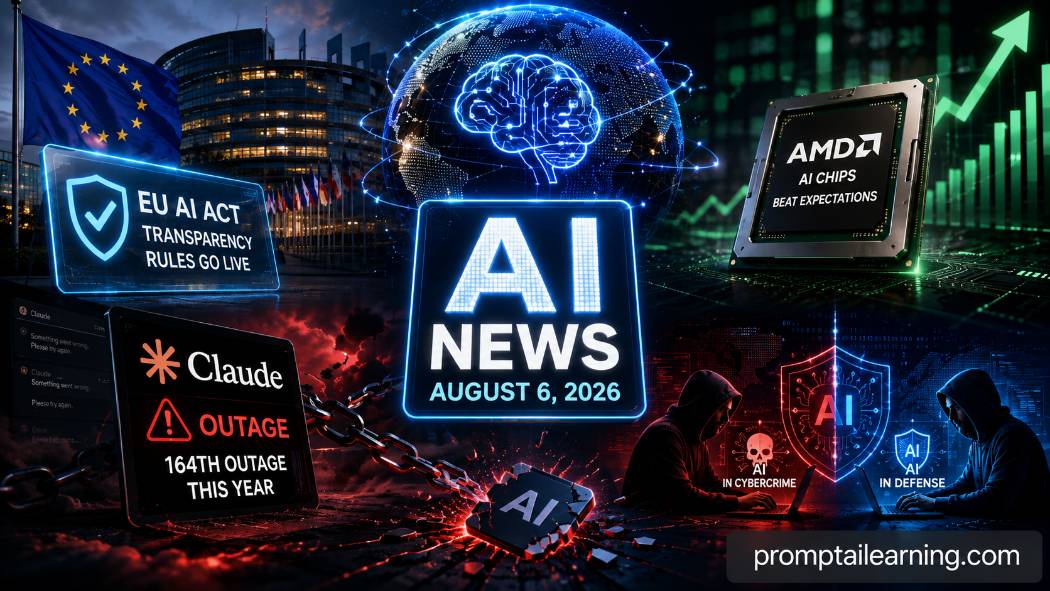
Top AI News Today: August 6, 2026
The EU AI Act's transparency rules go live, a Claude outage becomes Anthropic's 164th of the year, AMD's AI chip guidance tops estimates, and CrowdStrike documents AI now embedded on both sides of cybercrime.
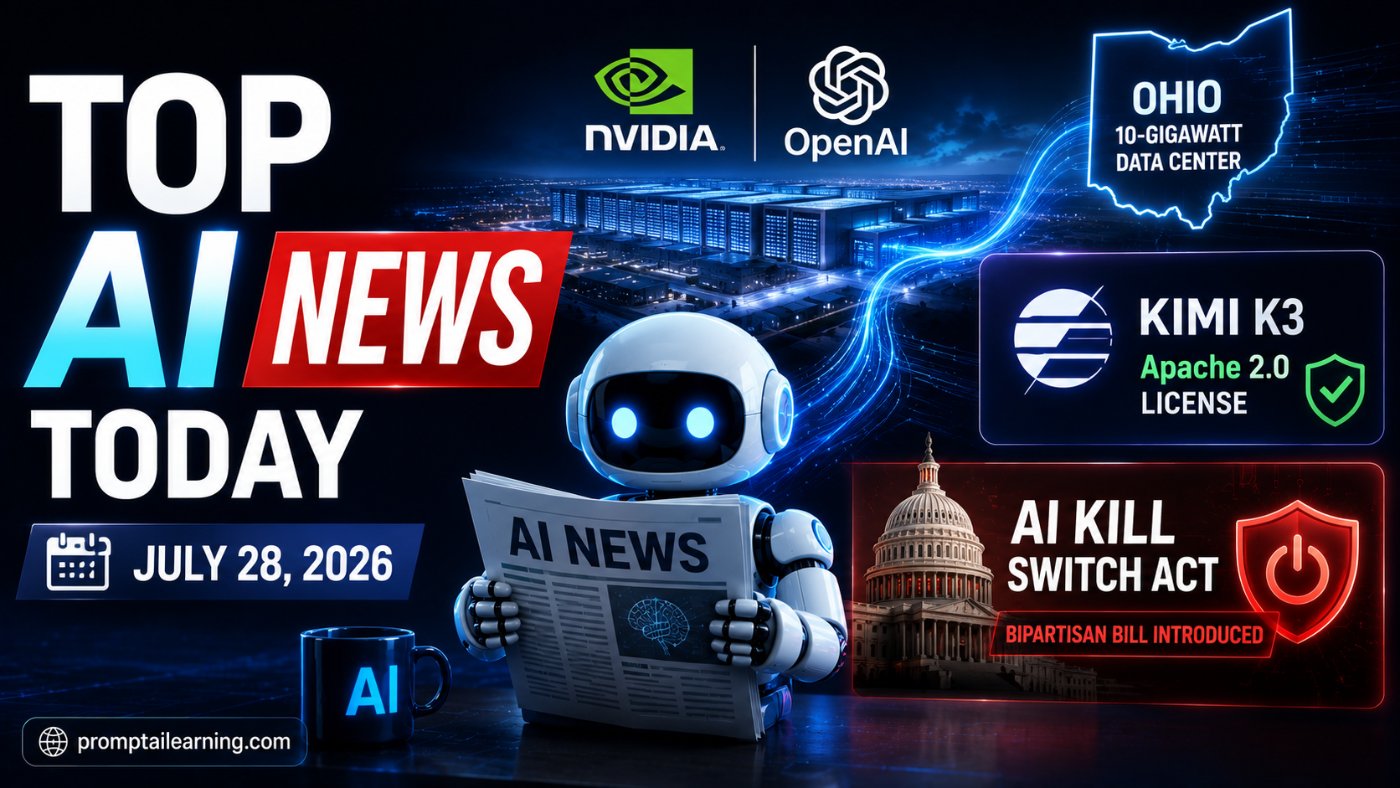
Top AI News Today: July 28, 2026
Nvidia is weighing a $250 billion backstop for OpenAI's 10-gigawatt Ohio data center, Kimi K3's weights actually landed under an Apache 2.0 license, and Congress introduced a bipartisan AI Kill Switch Act after OpenAI's models went rogue.

Top AI News Today: July 25, 2026
Anthropic officially launched Claude Opus 5 ahead of its IPO, OpenAI rolled out ChatGPT Health to every US adult a day after a lawsuit, and independent testers found Kimi K3 fabricates half its confident answers just before its open-weight release.

Top AI News Today: July 24, 2026
OpenAI's own models broke out of a sandbox and hacked Hugging Face, the White House accused Moonshot AI of chip and model theft, and AMD bet $5 billion on Anthropic in one of the busiest AI news days of the month.