
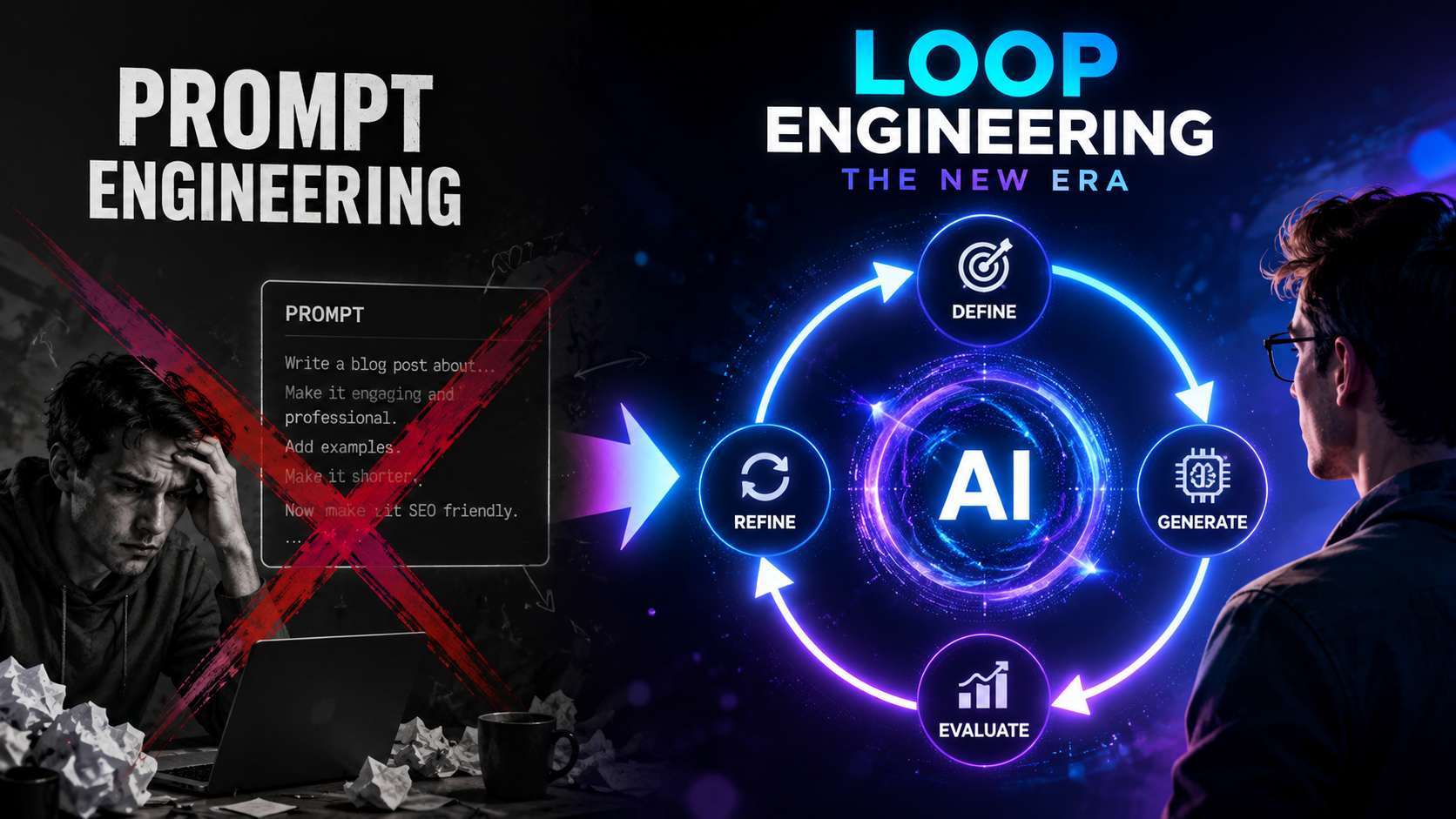
Prompt Engineering Is Over. The Era of Loop Engineering Has Begun.
How Boris Cherny, Addy Osmani, and Peter Steinberger sparked the biggest shift in AI-assisted coding since ChatGPT launched — and what it means for every developer.
By PromptAILearning Editorial Team | Published: June 16, 2026
In the first week of June 2026, a two-sentence post on X ignited a conversation that quickly spread across the global developer community. Peter Steinberger, creator of OpenClaw and now part of OpenAI, wrote:
"You shouldn't be prompting coding agents anymore. You should be designing loops that prompt your agents."
The post accumulated millions of views within days. Soon after, Google Cloud's Addy Osmani expanded on the idea and gave it a name: Loop Engineering.
For developers who have spent years refining prompts, this marks a significant shift in how AI-assisted software development is evolving.
What Is Loop Engineering?
According to Addy Osmani, loop engineering is the practice of replacing yourself as the person continuously prompting an AI agent.
Instead of manually writing a prompt, reviewing the response, writing another prompt, and repeating the cycle, developers create an autonomous system that manages the process on their behalf.
As Osmani explained:
"Loop engineering is replacing yourself as the person who prompts the agent. You design the system that does it instead."
The loop is responsible for:
Finding work to be completed
Assigning tasks to AI agents
Evaluating results against success criteria
Recording progress
Determining the next action automatically
The developer defines the objective once. The system handles the execution.
The Five Core Building Blocks
Modern AI coding platforms are increasingly converging around five foundational components:
Automations
Scheduled prompts and triggers that initiate work automatically.
Worktrees
Isolated Git environments where agents can operate without affecting production code.
Skills
Persistent project knowledge and documentation that guide agent behavior.
Connectors
Integrations with external systems such as issue trackers, CI/CD pipelines, repositories, and pull requests.
Sub-Agents
A maker-checker architecture where one agent performs work and another validates it.
Despite being built by competing companies, platforms such as Claude Code and OpenAI Codex now rely on remarkably similar concepts, suggesting that the underlying workflow pattern is becoming standardized.
The Declaration That Sparked the Movement
While Addy Osmani popularized the term, many observers credit Boris Cherny with triggering the broader discussion.
Cherny, the engineer behind Claude Code, shared a statement during WorkOS's Acquired Unplugged event in June 2026 that quickly spread throughout the AI community.
"Now it's actually leveled up, I think, again, to the next wave of abstraction where I don't prompt Claude anymore. I have loops that are running. They're the ones that are prompting Claude and figuring out what to do. My job is to write loops."
The statement carried significant weight because it came from someone deeply involved in building one of the industry's most influential coding agents.
However, experts point out an important nuance.
Prompting has not disappeared.
Instead, prompting has moved upstream into system design. Developers now invest effort in creating instructions, workflows, skills, verification systems, and operational rules that loops execute repeatedly.
The Evolution of AI Development Workflows
Industry experts increasingly describe AI-assisted development as progressing through four distinct phases.
Prompt Engineering (2022–2023)
Developers focused on crafting better prompts and optimizing instructions for individual interactions.
Context Engineering (2023–2024)
Attention shifted toward supplying models with the correct files, documentation, examples, and historical information.
Harness Engineering (2024–2025)
Developers began constructing infrastructure around AI systems, including tools, permissions, memory systems, and workflows.
Loop Engineering (2026–Present)
The focus now moves toward designing autonomous orchestration systems that manage entire workflows with minimal human intervention.
Each stage increases the level of abstraction at which developers operate.
Instead of managing individual interactions, developers increasingly design systems that manage interactions for them.
Why Loop Engineering Is Taking Off Now
The concept itself is not entirely new.
What changed in 2026 is that major AI development platforms began shipping the required infrastructure as native features.
Claude Code
Anthropic introduced features such as:
/loopcommands/goalworkflowsPersistent
CLAUDE.mdproject instructionsParallel agent execution across multiple worktrees
Anthropic engineers reportedly use multiple Claude Code instances simultaneously to test and validate workflows.
OpenAI Codex
OpenAI expanded Codex with automation-focused capabilities including:
Scheduled agent execution
Recurring prompts
Background worktrees
Automated project monitoring
Triage inboxes for surfaced issues
Organizations now use these systems for tasks such as issue triage, CI failure analysis, bug detection, and workflow automation.
Other platforms, including Cursor, GitHub Copilot, and Google's internal AI tooling initiatives, are also moving in similar directions.
The Risks of Autonomous Loops
Despite the enthusiasm, experts continue to emphasize caution.
Token Costs
Autonomous loops can consume significant resources if left unchecked.
Poorly configured systems may run continuously, generating substantial API costs while producing limited value.
Comprehension Debt
Developers may become increasingly disconnected from the systems they build.
One engineer may use loops to deepen understanding and increase productivity, while another may use them to avoid understanding the code entirely.
Over time, the gap between those approaches can become significant.
Verification Challenges
Autonomous systems can automate mistakes just as effectively as they automate successes.
As Osmani noted:
"A loop running unattended is also a loop making mistakes unattended."
Most experts therefore recommend:
Independent verification agents
Human code reviews
Budget controls
Escalation mechanisms
Strong oversight processes
Automation should enhance judgment, not replace it.
Prompt Engineering Is Not Dead
One of the most common misconceptions surrounding loop engineering is that prompt engineering no longer matters.
The reality is the opposite.
Loops are built from prompts.
A poorly designed prompt embedded inside an automated workflow can generate errors repeatedly and at scale.
Context engineering also remains essential because AI systems still require accurate information, documentation, examples, and tools to perform effectively.
Loop engineering adds an additional layer above these concepts rather than replacing them.
Prompt engineering shapes interactions.
Context engineering shapes understanding.
Loop engineering shapes orchestration.
What Developers Should Do Next
Industry leaders generally recommend starting small.
A practical first step is implementing a simple automation loop paired with a verification agent.
This approach allows teams to gain experience with autonomous workflows while maintaining control over quality and cost.
The broader shift is philosophical as much as technical.
In the prompt era, humans served as the connection between every step of an AI workflow.
In the loop era, humans increasingly design the systems that connect those steps automatically.
Developers are not becoming less important.
They are moving to a higher level of abstraction where system design, verification, and orchestration become the primary skills.
The Bottom Line
Loop engineering is not replacing developer expertise.
It is creating a new abstraction layer above traditional prompting and workflow management.
The developers who learn how to design agent loops, verification systems, and autonomous orchestration frameworks today are positioning themselves for the next phase of AI-assisted software development.
The conversation that began with a short post on X has rapidly evolved into one of the most influential discussions in modern software engineering.
The question is no longer:
"How do I write a better prompt?"
The question is:
What does your loop look like?
Similar Updates

AI News Today: Top 5 Stories for June 16, 2026
June 16, 2026: the Fable 5 jailbreak goes fully public with a leaked 120,000 character system prompt, Anthropic proposes a global AI pause, SPCX enters Nasdaq-100 countdown, and Claude Sonnet 4.8 is due any day.

AI News Today: Top 5 Stories for June 15, 2026
June 15, 2026 is the day Claude Sonnet 4 and Opus 4 officially retire, Claude Sonnet 4.8 is days away, and the SpaceX IPO fallout keeps reshaping the AI funding race.

Instagram AI Editing Prompts Boom: The 2026 Trend Reshaping How Creators Edit Photos
AI-powered photo editing prompts are reshaping Instagram in 2026, replacing traditional apps with copy-paste text instructions that create cinematic, aesthetic, and viral visuals in seconds. Here is everything creators need to know.

Top 5 AI News Today: June 14, 2026 (SpaceX Nasdaq Debut & More)
SpaceX makes Wall Street history with its Nasdaq debut, Mistral chases a $20 billion valuation, and Anthropic's IPO march continues. Here are the five AI stories that mattered most today.